Sage and story-teller:
pp. 40-41 · Read in the full issue
Hamilton’s last years
Ironically, it is the last few months of Hamilton’s life that are the most fully documented, and by very literate and literary people.
Henry Adams, the Boston historian, had been writing in tensively and travelling for several years to forget the suicide of his wife, Marian. On a South Seas cruise, he visited Samoa and saw a lot of Hamil ton and Mary.
John La Farge, travelling with Adams, later wrote Re miniscences of the South Seas, frequently mentioning the Hamiltons (as Samsoni or Samasone).
In October, 1890, Adams went octopus fishing with Con sul Harold Sewell (Harvard, class of 1882), who “sent the squid (sic) to Mele Samsoni. . .
JOSEPH THEROUX concludes his three-part series on fellow New Englander Elisha Lyman Hamilton, who lived in Samoa from the 1850 s until his death in 1891.
and asked her to make some squid soup. So at noon we had lunch in Samsoni’s hut in the banana grove hard by. There was old Hamilton once a whaleman and pilot his wife Mele or Mary, three girls who live with them, Sewell, Black lock, La Farge and I, sitting on the mats with the lunch spread on banana leaves before us . . .” Adams devoured the “squid”, six oranges and a coconut of water, “smoked a cigar and dropped off asleep while Mele Samsoni fanned the flies from me with a banana
leaf”. They dined frequently, and visited often. “Fagalo and the two other girls at Samsoni’s supply our house with flowers every morning, and generally the whole foreign population English or American is seen to be lounging on Samsoni’s porch, or sprawling on mats in his enclosure, laughing with Mrs Samsoni or Fagalo or the others. ”
On November 8, Adams wrote: “Samoa becomes more curious, in this sort of grotesqueness, the more one sees of it. The sexual arrange
merits are queer enough, and the stories of old Samasoni . . . amuse me beyond description, though they are rarely capable of record ...” Speaking of dances, Adams wrote that . . their dances proper or im proper always represent facts, and never attempt to reproduce an emotion. The dancers play at ball, or at bathing, or coconut gathering . . . Old Samasoni . . . tells us that the worst dance he ever saw here was a literal reproduc tion of the marriage ceremony, and that the man went through the entire form, which is long and highly peculiar, and ended with the consummation openly, before the whole vil lage, delighted with the fun 99 La Farge also enjoyed the
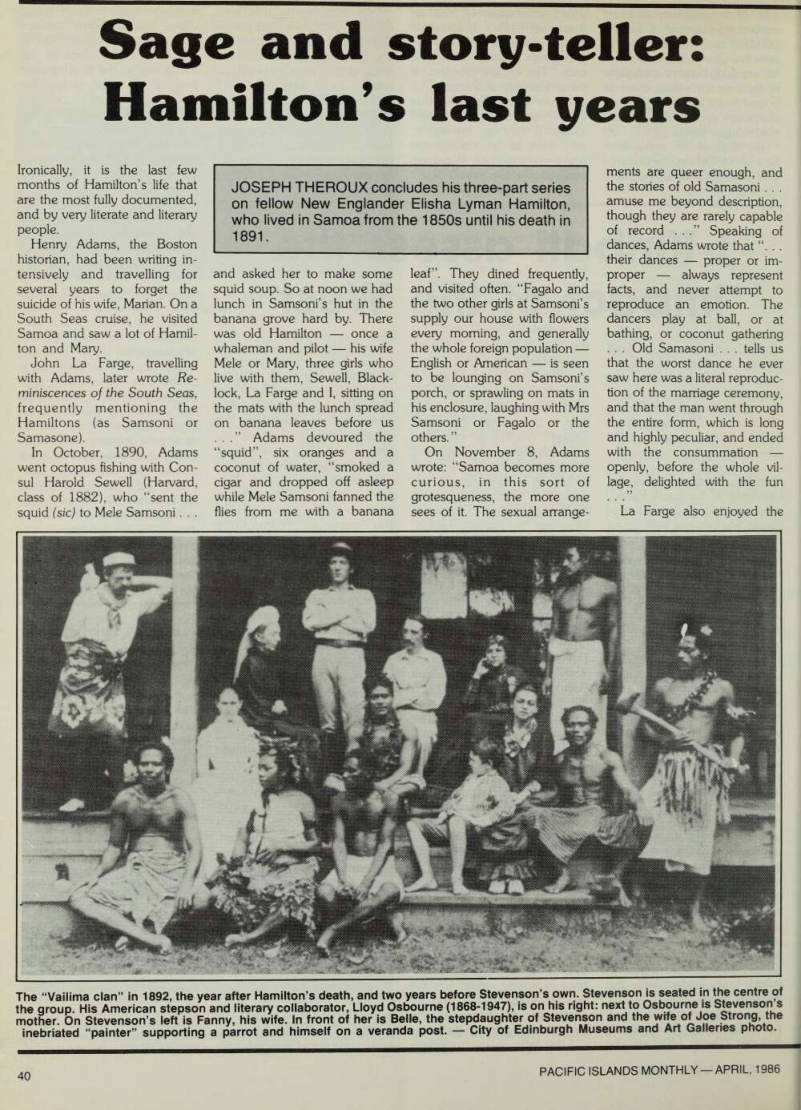
The “Vailima clan” in 1892, the year after Hamilton’s death, and two years before Stevenson’s own. Stevenson is seated in the centre of the group. His American stepson and literary collaborator, Lloyd Osbourne (1868-1947), is on his right: next to Osbourne is Stevenson s mother. On Stevenson’s left is Fanny, his wife. In front of her is Belle, the stepdaughter of Stevenson and the wife of Joe Strong, the inebriated “painter” supporting a parrot and himself on a veranda post. City of Edinburgh Museums and Art Galleries photo.
accounts. “Old Samasone was telling us the stories of these old times: how some stranded ruf fian, unable to return to white lands, had felt obliged, upon being questioned, to assert his value and knowledge by some imitation that might not later conflict with the outside facts.
Some brutal, drunken, murder ous wretch would choose, someday, to simulate a Sun day, and sing obscene or brutal forecastle songs, all the same to those who did not understand a word, as representing the church service of song which he described.
“Samasone .. . tells us lengthily and in detail such stories, and gives us long accounts of Samoan manners, in the same way that might be his if he were still in his native New England. And when I shut my eyes, I can fancy myself sitting on the edge of some Newport wharf, and listening to Captain Jim or Captain Sam, discoursing wisely, with infinite detail.”
La Farge and Adams rode on horseback around Apia and in the jungle behind to the waterfall slides at Papase-ea “. . . Mele Hamilton (told) us that the last time she had gone over the fall, she had struck badly against a rock, and so had her companion ...” She showed them one of the Sa moan jungle delicacies. La Farge wrote: “Even all my liking for Meli Hamilton and my admiration for the fullness and redness of her lips, and for the gleam of her teeth, could scarcely reconcile me to the wriggling of the great tree worms through which she crun ched so gayly and healthily at our last great Samoan dinner. ”
On November 22, Adams writes: “. . . Samasoni reassures me as to the probable cost of a taupo-wife. In pigs and mats, she would come higher, in apparent price, than in coin.
Cash down, in Chilian silver dollars, Samasoni thinks that a hundred dollars would be suffi cient. That is about seventy dollars in gold. Dog cheap, as far as the gift is concerned.”
Adams and La Farge spent about four months in Samoa, where they observed and ex perienced quite a lot. But they
tended to romanticise the place and the people. There is a good deal of “Noble Savage” imag ery in their letters. But there are reasons for it. They were tre ated royally during a particu larly peaceful time in a troubled period. The very spot where they feasted upon octopus in Hamilton’s fale had seen fight ing not two years previously.
And three months after they left, Stevenson was writing to a friend: “It will come to war again, is the opinion of the well informed ...”
But, on December 30, 1890, with much of this talk already being heard, Adams found it all hard to believe: “Every day these stories come to us,” he wrote. “Old Samasoni waddles up, almost insane with native rumors, and predicts civil war within 24 hours. ” Adams mock ed, but civil war did come.
Though he had just turned 62, Hamilton was still the en tertaining talker, the old salt that La Farge had characterised him as. But with age came cranki ness. Trood wrote (in a series of newspaper recollections that would make up his 1909 work Island Reminiscences: “He was another American of excellent type, not particularly good tem pered, somewhat crusty in fact, but still a very good fellow when you did not jump on his corns. That he not only ob jected to, but, although a mem ber of the church, was apt to forcibly return the compli ment. ”
Perhaps Hamilton was ill In March of 1891 he took to his sick bed and all of Apia knew
the end was near. On March 23, Robert Louis Stevenson was in town preparing for a trip to Tutuila, “fighting about drafts and money, ” along with Consul Sewell. He wrote: “About 11, the flags were all half-masted; it was old Captain Hamilton (Samesoni the na tives called him) who had pas sed away. In the evening I walked round to the U.S. Con sulate; it was a lovely night with a full moon; as I got round to the hot comer of Matautu I heard hymns in front. The balcony of the dead man’s house was full of women sing ing; Mary ... sat on a chair by the doorstep, and I was set beside her on a bench ... as I sat down I had a glimpse of the old captain, who lay on a sheet on his own table. After the hymn was over, a native pastor made a speech which lasted a long while; the light poured out of the door and windows; the girls were sitting clustered at my feet; it was choking hot. After the speech was ended, Mary carried me within; the captain’s hands were folded on his bosom, his face and head were composed; he looked as if he might speak at any moment; I have never seen this kind of waxwork so express or more venerable; and when I went away, I was conscious of a certain envy for the man who was out of the battle. All night it ran in my head, and next day when we sighted Tutuila, and . . . beautiful Pago Pago . . .
Captain Hamilton’s folded hands and quiet face said a great deal more to me than the
scenery. ”
There was a church funeral in addition to the Samoan service, but no eulogy for the dead man could match Stevenson’s.
Actually, Stevenson had sup pressed one incident which, he felt, marred the reverence of the occasion. Fanny Stevenson wrote in her diary: “There seemed to be some doubt as to whether Hamilton was really dead. A confusion that would have appealed to him, I imagine. So before the coffin was finally closed, the doctor came in to have a final look at the body. Louis had been there for some time and was talking in subdued tones to the widow and friends of the deceased man, when a loud cheery voice was heard, that of Dr Bernard Funk. The gentle man (?) came pounding in with a lighted cigar in his mouth, and filling the room with his strident voice. ”
One can imagine the general shock, especially the sensitive Stevenson’s, at this outburst.
But, in fairness to Dr Funk, by all accounts he was a dedicated and resourceful surgeon. Even Fanny had spoken earlier in her diary of his skill. Returning from Tutuila, Stevenson was ill, but, Fanny wrote, “too ill to see the doctor (a boisterous surgeon named Funk) ... I think he has recoiled at Dr F. since the day of Captain Hamilton’s burial.”
Three years later, Dr Funk would be present at Stevenson’s deathbed. • • • Harold Sewell of Maine signed Hamilton’s will on March 24.
He would later be U.S. Minister to Hawaii. Henry Ide of Ver mont signed the land commis sion claim on September 29.
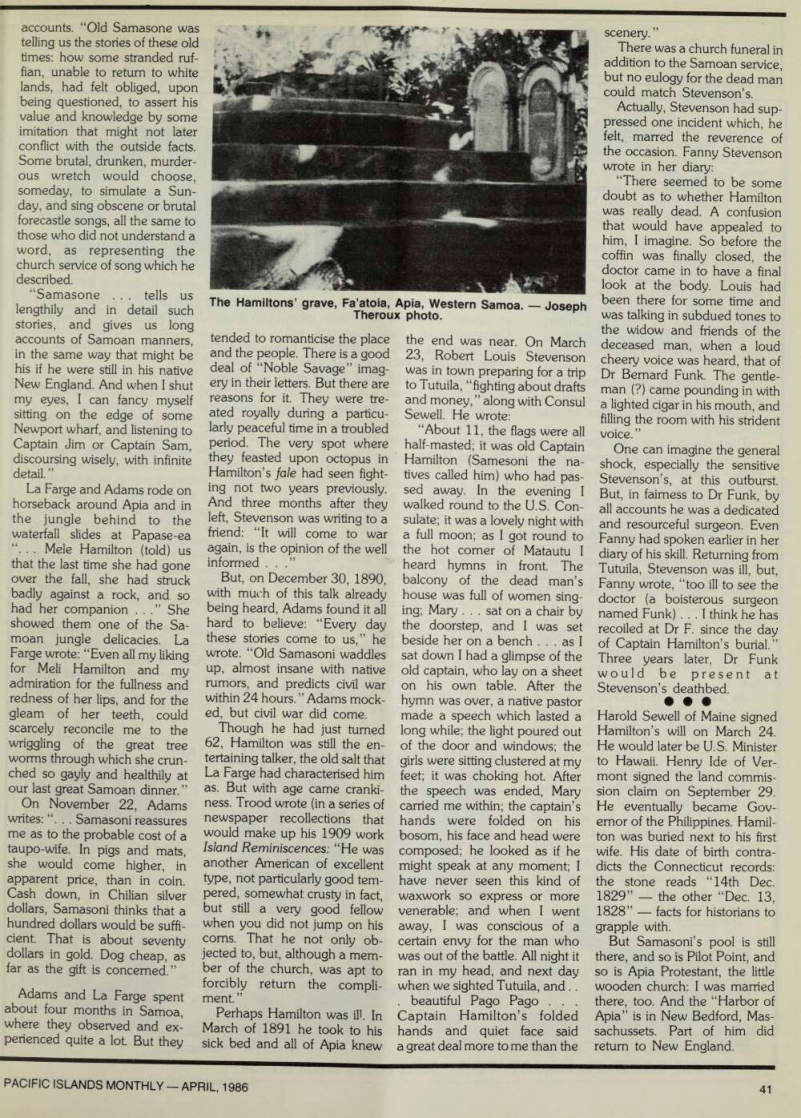
He eventually became Gov ernor of the Philippines. Hamil ton was buried next to his first wife. His date of birth contra dicts the Connecticut records: the stone reads “14th Dec. 1829” the other “Dec. 13, 1828” facts for historians to grapple with.
But Samasoni’s pool is still there, and so is Pilot Point, and so is Apia Protestant, the little wooden church; I was married there, too. And the “Harbor of Apia” is in New Bedford, Mas sachussets. Part of him did return to New England.
The Hamiltons’ grave, Fa’atoia, Apia, Western Samoa. Joseph Theroux photo.