New hope for Bikini
p. 19 · Read in the full issue
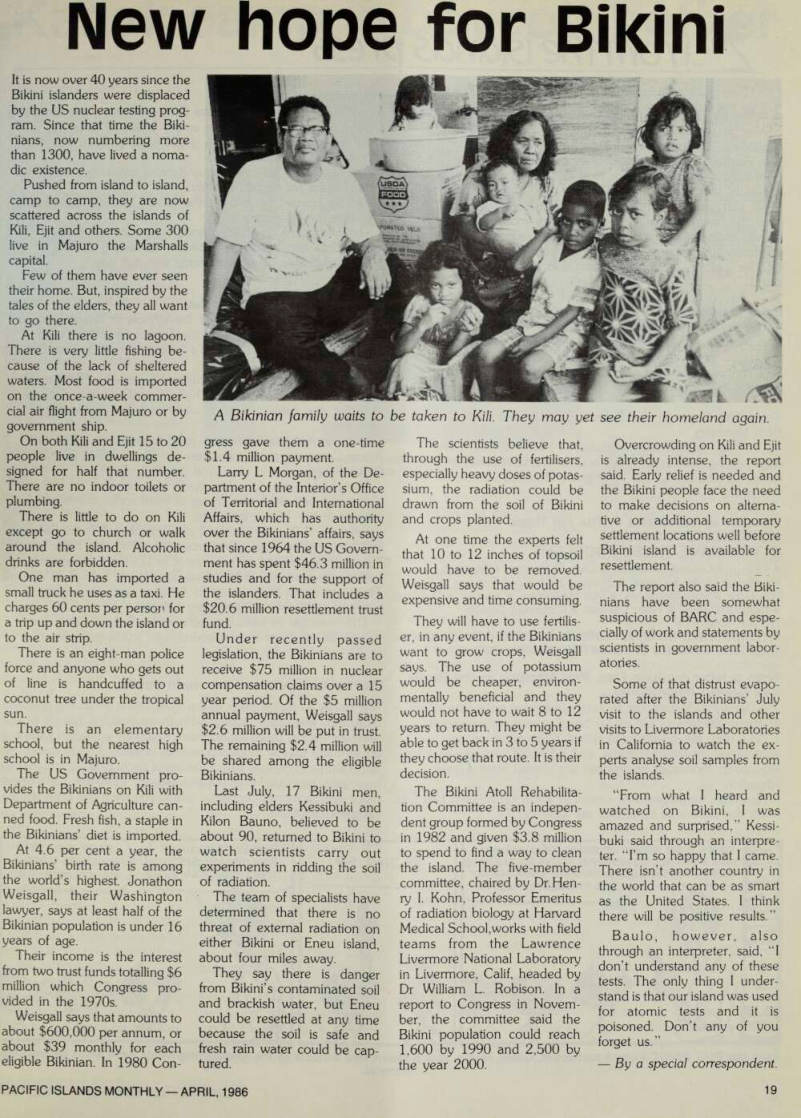
It is now over 40 years since the Bikini islanders were displaced by the US nuclear testing prog ram. Since that time the Biki nians, now numbering more than 1300, have lived a noma dic existence.
Pushed from island to island, camp to camp, they are now scattered across the islands of Kili, Ejit and others. Some 300 live in Majuro the Marshalls capital.
Few of them have ever seen their home. But, inspired by the tales of the elders, they all want to go there.
At Kili there is no lagoon.
There is very little fishing be cause of the lack of sheltered waters. Most food is imported on the once-a-week commer cial air flight from Majuro or by government ship.
On both Kili and Ejit 15 to 20 people live in dwellings de signed for half that number.
There are no indoor toilets or plumbing.
There is little to do on Kili except go to church or walk around the island. Alcoholic drinks are forbidden.
One man has imported a small truck he uses as a taxi. He charges 60 cents per person for a trip up and down the island or to the air strip.
There is an eight-man police force and anyone who gets out of line is handcuffed to a coconut tree under the tropical sun.
There is an elementary school, but the nearest high school is in Majuro.
The US Government pro vides the Bikinians on Kili with Department of Agriculture can ned food. Fresh fish, a staple in the Bikinians’ diet is imported.
At 4.6 per cent a year, the Bikinians’ birth rate is among the world’s highest. Jonathon Weisgall, their Washington lawyer, says at least half of the Bikinian population is under 16 years of age.
Their income is the interest from two trust funds totalling $6 million which Congress pro vided in the 19705.
Weisgall says that amounts to about $600,000 per annum, or about $39 monthly for each eligible Bikinian. In 1980 Con-
gress gave them a one-time $1.4 million payment.
Larry L Morgan, of the De partment of the Interior’s Office of Territorial and International Affairs, which has authority over the Bikinians’ affairs, says that since 1964 the US Govern ment has spent $46.3 million in studies and for the support of the islanders. That includes a $20.6 million resettlement trust fund.
Under recently passed legislation, the Bikinians are to receive $75 million in nuclear compensation claims over a 15 year period. Of the $5 million annual payment, Weisgall says $2.6 million will be put in trust.
The remaining $2.4 million will be shared among the eligible Bikinians.
Last July, 17 Bikini men, including elders Kessibuki and Kilon Bauno, believed to be about 90, returned to Bikini to watch scientists carry out experiments in ridding the soil of radiation.
The team of specialists have determined that there is no threat of external radiation on either Bikini or Eneu island, about four miles away.
They say there is danger from Bikini’s contaminated soil and brackish water, but Eneu could be resettled at any time because the soil is safe and fresh rain water could be cap tured.
The scientists believe that, through the use of fertilisers, especially heavy doses of potas sium, the radiation could be drawn from the soil of Bikini and crops planted.
At one time the experts felt that 10 to 12 inches of topsoil would have to be removed.
Weisgall says that would be expensive and time consuming.
They will have to use fertilis er, in any event, if the Bikinians want to grow crops, Weisgall says. The use of potassium would be cheaper, environ mentally beneficial and they would not have to wait 8 to 12 years to return. They might be able to get back in 3 to 5 years if they choose that route. It is their decision.
The Bikini Atoll Rehabilita tion Committee is an indepen dent group formed by Congress in 1982 and given $3.8 million to spend to find a way to clean the island. The five-member committee, chaired by Dr. Hen ry I. Kohn, Professor Emeritus of radiation biology at Harvard Medical School,works with field teams from the Lawrence Livermore National Laboratory in Livermore, Calif, headed by Dr William L. Robison. In a report to Congress in Novem ber, the committee said the Bikini population could reach 1,600 by 1990 and 2,500 by the year 2000.
Overcrowding on Kili and Ejit is already intense, the report said. Early relief is needed and the Bikini people face the need to make decisions on alterna tive or additional temporary settlement locations well before Bikini island is available for resettlement.
The report also said the Biki nians have been somewhat suspicious of BARC and espe cially of work and statements by scientists in government labor atories.
Some of that distrust evapo rated after the Bikinians’ July visit to the islands and other visits to Livermore Laboratories in California to watch the ex perts analyse soil samples from the islands.
“From what I heard and watched on Bikini, I was amazed and surprised,” Kessi buki said through an interpre ter. “I’m so happy that I came.
There isn’t another country in the world that can be as smart as the United States. I think there will be positive results.”
Baulo, however, also through an interpreter, said, “I don’t understand any of these tests. The only thing I under stand is that our island was used for atomic tests and it is poisoned. Don’t any of you forget us.”
By a special correspondent.
A Bikinian family waits to be taken to Kili. They may yet see their homeland again.