Rainbow warrior:
pp. 14-16 · Read in the full issue
Anatomy of a scandal
Atop French Govern ment defence adviser wanted to time-bomb the Greenpeace ship Rainbow Warrior on the high sea, thus killing many of the crew, according to a team of journalists who have investi gated the incident.
The London Sunday Times newspaper’s “Insight Team” has written a book about the attack on the ship in New Zealand, a world scandal which implicated the French Govern ment.
“Rainbow Warrior: The French Attempt to Sink Green peace” was published in Britain last month.
The book reports that, over a year ago, the head of the French nuclear testing centre at Moruroa, Admiral Henri Pages, was desperately worried about the return of the direct action environmentalist group, Green peace, to the testing site. The visit was timed to co-incide with mid-year underground tests.
The admiral knew of the Greenpeace plan. He knew it was more ambitious than ever
before and that its biggest ship, the 419-ton Rainbow Warrior would be able to stay in the area for months acting as a supply ship for a fleet of smaller vessels which could then sus tain the protest.
He was most worried that smaller craft such as dinghies which could not be detected on radar, could land on the atoll, where the French would then have to arrest, decon taminate and deport the protes ters who would then broadcast their experience worldwide.
Admiral Pages reported his concern to defence minister Charles Hernu who ordered the DGSE (France’s external secur ity office) to “forecast and anti cipate” the Greenpeace ac tions.
And three millionn francs were allocated for the purpose.
DGSE boss, Admiral Pierre Lacoste agreed the Greenpeace flotilla should not be allowed to reach Moruroa, and advocated towing the boats away as soon as they entered French waters.
He is thought to have opposed the sabotage plan, but
was overruled by his superiors in the government and in the defence department, according to the Insight team.
Meanwhile, Hernu’s top adviser, Jean-Francois Dubois, wanted to blow up the Rainbow Warrior in open water as this would have left less evidence for investigators.
But Lacoste knew this would end the lives of many of the crew and, eventually, the alternative sabotage plan won the day, with Hemu giving President Mitterrand’s military chief of staff, General Jean Saulnier, a complete briefing.
A former army captain re cruited to the French secret service after injury made her unfit for regular duty, Christine Gabon, would infiltrate Auck land’s Greenpeace office in late April last year.
Described as a “useful low level mole” by the authors, she had worked undercover before, helping the Israelis pinpoint PLO targets in Beirut, then infiltrating the ecological Green Party in West Germany to discover whether it intended to spread its activities to France.
After a month in the Green peace Auckland office doing translating work and claiming to write articles about Greenpeace for French newspapers and magazines, she left. She filed a complete report with her bosses in Paris and the chain of events that would end in death and disgrace began in earnest.
The sabotage team, headed by Lt.-Col. Louis-Pierre Dillais from the frogmen’s base in Aspretto, Corsica, included his former deputy Alain Mafart and the most senior female DGSE operative, Dominique Prieur.
Four men were chosen to take the explosives to New Zealand aboard the yacht Ouuea and carry out the opera tion, but before that, one of the men, DGSE petty officer Gerald Andries, calling himself Eric Andriene went to London.
He bought a French-built inflat able dinghy and a low power second hand Yamaha outboard motor, the craft to be used to plant the bomb.
Analysis of the French plan ning of the operation has since revealed great care being taken to avoid detection by the British security service, MI6 and, in the light of this, it is strange the dinghy was bought in London.
According to the Insight team, the French regarded the New Zealand authorities as pushovers as long as Ml 6 did not tip them off.
They took pains to avoid this, making sure word was filtered back to the British that the French were planning a covert operation in New Caledonia, to crack a ring of gun-runners.
New Zealand was to be used as a staging post.
In the event, it all went horribly wrong. On July 10, 1985, the Rainbow Warrior was sunk by the blast,and a Green peace photographer, Fernando Pereira, died.
New Zealand’s investigation swung into action, led by Auck land’s top detective, Supt Allan
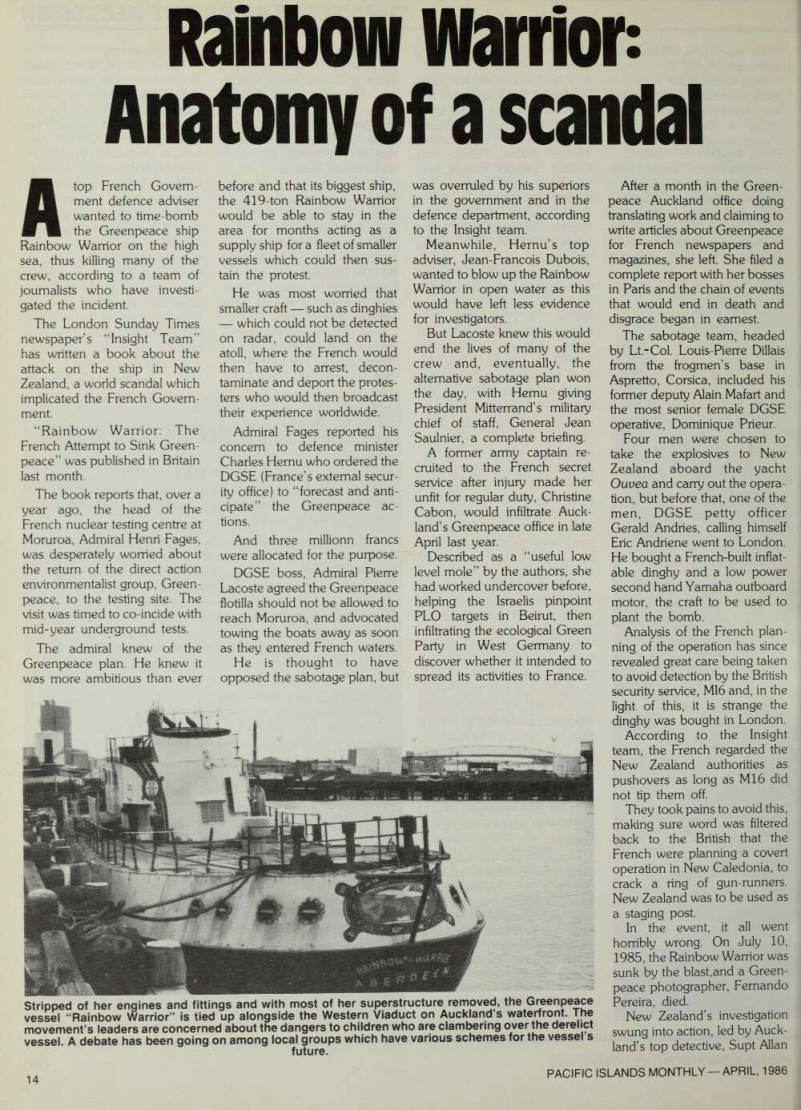
Stripped of her engines and fittings and with most of her superstructure removed, the Greenpeace vessel “Rainbow Warrior” is tied up alongside the Western Viaduct on Auckland’s waterfront. The movement’s leaders are concerned about the dangers to children who are clambering over the derelict vessel. A debate has been going on among local groups which have various schemes for the vessel s future.
Galbraith.
The owner of a now-aban doned floating dinghy had been seen getting a lift from a couple in a hire van owned by New man’s one of New Zealand’s biggest travel firms. The couple, known then as Alain and Sophie Turenge were duly picked up and questioned.
Alain Mafart and Dominique Prieur sustained prolonged and detailed questioning but re vealed nothing New Zealand police could hold them for, although there were minor dis crepancies in their stories and at one point Prieur told an in vestigating officer: “Check us out in Paris, then you will find out who we really are and you will have to let us go.”
They were detained on Fri day July 12. By Saturday even ing, Interpol had the evidence the New Zealand police re quired; the passports of the “Turenges” were fake.
The luck was not so good with the agents aboard the Ouuea. One escaped through Sydney, the others, although found and questioned, could not be held due to lack of evidence.
It is not known how they escaped, although the yacht disappeared, assumed scuttled.
But the New Zealand authorities now had two French agents firmly in the hand, and began tracing the trail which led them through the French secret service, to the government and the Elysee Palace itself, aided by the investigations of the French press.
The French Prime Minister, Laurent Fabius admitted the French were responsible for the bombing on Sunday Septem ber 22.
Mafart and Pireur were even tually charged with murder, arson and conspiracy to commit arson. They pleaded not guilty but on November 4 pleaded guilty to lesser charges. They received 10 years each for wilful damage.
The backwash of the story discovered by the French press led to Hernu’s resignation and the sacking of Lacoste. Fabius and the French president, Fran cois Mitterrand were politically damaged, Fabius for appearing incompetent, Mitterrand be cause the budget for the sabot age plan had been signed by an officer in his department.