Tuna fleet rifles out
pp. 11-47 · Read in the full issue
recession
DESPITE periodic im provements in market conditions the world tuna industry has re mained depressed since the onset of the 1981 recession.
This has resulted in internation al restructuring of the industry.
Some of the more important changes that have occurred since 1981 include: • Radically altered patterns of resource exploitation, espec ially for the US purse seine fleet. This has involved a move ment from traditional fishing grounds in the eastern Pacific to fishing grounds in the central and western Pacific. • The closure of all major tuna processing plants on the US mainland. Only one small cannery with a processing capa city of 10,000 tonnes per annum remains operational in the continental United States. • A rise in canning indus-
Since recession hit the tuna industry in 1981, there has been a restructuring. Catches in the islands region have, however, continued to increase. David Doul man* surveys recent developments and points out that despite the public utterances of governments signifi cant onshore developments are still a long way over the horizon.
tries especially in Thailand based on the utilisation of low-cost and efficient labor and imported raw material (tuna). • Continued reductions in the size of the Japanese pole and-line and long-line fleets through government-instituted rationalisation programs. • Concerted efforts by European fleets to develop a purse seine tuna fishery in the Indian Ocean. • A trend toward basing purse seiners in the islands region as a means of improving their operational efficiency.
These changes, coupled with the general pessimism and un certainty surrounding the in ternational tuna industry, sug gest that the recession since 1981 is related to fundamental and deep-seated changes that are stil evolving.
The impact of these worldwide changes has been strongly felt in the islands re gion. This region covers a large tract of the central and western Pacific Ocean and includes the geographical areas of Mi cronesia, Melanesia and Polynesia. The region’s tuna
resources are exploited by dis tant-water fishing fleets as well as by fleets based at ports within the region.
In 1984 an estimated 35 per cent of the total world tuna catch was taken in the region.
Local processing facilities for example in American Samoa, Fiji and the Solomon Islands utilise part of the catch landed by the fleets based there.
Distant-water fishing fleets
*Dr Doulman is a research fellow at the East-West Center in Honolulu and is director of the Multinational Corporations in the Pacific Tuna Industry Project being undertaken by the centre’s Pacific Islands De velopment Program. He was previously chief fisheries economist in the Department of Primary Industry in PNG.
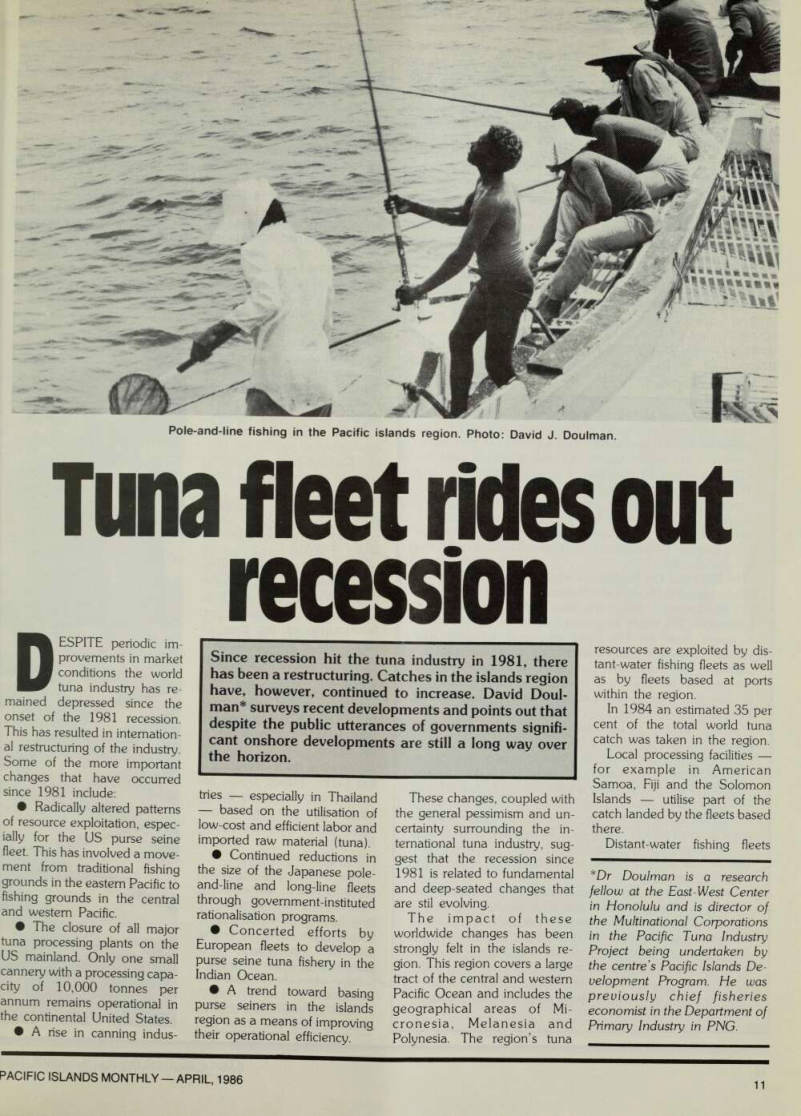
Pole-and-line fishing in the Pacific islands region. Photo: David J. Doulman.
using purse seine, long-line and pole-and-line fishing techniques operate throughout the year in islands waters. These vessels come from at least 10 countries though most are of US, Japan ese, Taiwanese and Korean registrations.
All foreign vessels legally fishing in the region operate under licence.
For a fee, island nations assign the owners of foreign fishing vessels a right to operate in their respective economic zones.
The right to fish is for a specified period usually two months and owners and operators must observe proce dures laid down by the licensing nation. Thus, the island coun tries derive revenue from their
tuna though the revenue is small, usually less than five per cent of the market value of the fish harvested.
The Japanese purse seine fleet consists of 32 single seiners and eight group seiners. How ever, the latter vessels operate in the Pacific islands region for only about four months each year.
The single seiners target almost exclusively on the fisher ies zones of Papua New Guinea and the Federated States of Micronesia. These zones have become the traditional fishing grounds for this fleet because they are proven and produc tive.
The Japanese single purse seine fleet caught approximate ly 100,000 tonnes of fish in
In 1984 about 110 purse seiners operated in the islands region. Approximately 65 of these were affiliated to the American Tunaboat Association (ATA) and of either US, Carribean or Central American registrations. In 1984 the ATA had about 85 operational vessels in the fleet. The ATA represents formally the interests of US tuna vessel owners and informally US citizens and companies operating vessels under foreign flags. The association has customarily negotiated fishing access agreements with foreign governments in Latin America and the Pacific islands.
In 1984 the US fleet harvested, according to the US Government’s National Marine Fisheries Service, 171,000 tonnes offish in the central and western Pacific.
However, 1984 catch estimates for the ATA fleet (which is larger than the US fleet) infer that ATA-affiliated vessels harvested about 220,000 tonnes in the region.
Despite the large number of ATA vessels operating in the region in 1984 the association had no fishing agreements with several island countries for most of 1984 and no agreements in 1985. Papua New Guinea, for example, has had no agreement with the ATA since 1982 despite the fact that Papua New Guinea’s EEZ is one of the most important zones for purse seining in the region.
Nonetheless, association vessels were not denied access to Papua New Guinea’s waters in 1983, 1984 and 1985 but rather were licensed to operate under the terms and conditions of the Papua New Guinea/Japan Fisheries Arrangement which has been in force since 1981. Under this agreement ATA vessels are treated by Papua New Guinea as though they were Japanese vessels for licensing purposes.
Fleets of other registrations (for example, Taiwanese, Korean and Filipino whose countries do not have access agreements with Papua New Guinea) are also treated in the same way as ATA vessels although negotiations are in progress to establish bilateral access arrangements with agencies in these countries. Similarly, since 1984 island states have been engaged in a series of negotia tions to establish a multilateral tuna access agreement with the United States.
1984. The other purse seine fleets from Korea, Taiwan, Phi lippines, Mexico, etc., operating in the region took about 50,000 tonnes in the same year.
A small Soviet Union tuna fleet consisting of purse seine and long-line vessels has oper ated in international waters in the Pacific islands region for several years. However, prior to the conclusion of the controver sial fisheries agreement be tween Kiribati and Russia in late 1985, no Soviet vessels had been licensed to fish in the Zones of island states.
While the Kiribati/Soviet agreement prohibits vessels from operating in the country’s territorial areas and denies them port access, it is expected that Soviet approaches will be made to other countries in the Pacific islands with proposals to develop shore-based facilities.
These would be primarily established to service the Rus sian fleet but they could also be used to service fleets of other countries.
In terms of total landings of tuna in the region about 630.000 tonnes in 1984 about 370,000 tonnes (or 59 per cent) were made by purse sein vessels and about 35 per cent by the ATA fleet, (see box) As part of the international restructuring of the tuna in dustry, purse seine landings in the islands have increased from 90.000 tonnes in 1980 to 370.000 tonnes in 1984 an overall increase of 310 per cent.
In 1980 the ATA fleet took less than 10,000 tonnes of fish in the region.
Long-line fleets operating in the Pacific islands region are now almost exclusively fishing for the Japanese sashimi mar ket, as many of the vessels that formerly fished for abacore have ceased operations.
This contraction has been primarily due to financial con siderations; tuna landed by long-line vessels, which is signi ficantly more costly per unit of production than other forms of tuna fishing, is not price-com petitive when the product is to be canned.
Other considerations such as declining catch rates have also
played some part in the decline of the long-line fishery. How ever a sizeable fleet of smaller class distant-water long liners continues to operate in the region, principally in Mic ronesia.
In the mid-1970s albacore tuna long-line fleets based in the Pacific islands operated from ports in American Samoa, French Polynesia, and Vanuatu. Today these fleets are largely reduced in size, and, in the case of French Polynesia,
their operations have been terminated.
Most of the purse seine pro ducts harvested in the region are currently directed to can neries in the United States (American Samoa and Puerto Rico), Japan, and Thailand.
Pole-and-line caught fish goes to a variety of end uses in Japan depending on whether it is landed frozen or iced. The frozen product tends to be canned either in Japan or over seas while the iced product is
usually sold as a lower-grade sashimi.
Tuna fleets of all gear types are based in 12 countries and territories in the islands American Samoa, Fiji, Guam, Hawaii, Kiribiti, the Marshall Islands, Nauru, Papua New Guinea, Solomon Islands, Ton ga, Tuvalu, and Vanuatu. The combined catches of these fleets at current levels of fishing effort are estimated to be in the range 80,000-100,000 tonnes annually.
Approximately 80 per cent of these landings are processed in the region, mainly in American Samoa. At 1984 prices it is estimated that the unprocessed values of these landings were SUSSO-55 million, while the final market value in canned and sashimi form was in the vicinity of SUSI6O million.
As a matter of policy most countries and territories in the region are attempting to ex pand their fishing capacity and to this end governments and private investors are evaluating the deployment of purse seine vessels. Through time, there fore, landings made by fleets based within the region will steadily increase.
Shore-based facilities in the islands designed for handling tuna consist of two types: trans hipment and processing.
Design-specific transhipment facilities exist in two countries, Palau and Vanuatu. The facility in Palau has not been used since 1982, but efforts are reportedly underway to bring it back into service. The facility in Vanuatu, which until recently was owned by Mitsu, is under used. It has a capacity to handle 10,000 tonnes of tuna annual ly, but in 1984 only 4,500 tonnes of tuna were trans hipped.
The possibility of establishing transhipment facilities in other countries the Federated States of Micronesia, the Mar shall Islands, Solomon Islands, and Papua New Guinea is under investigation.
Tuna transhipment from
ATA, Japanese and Taiwanese purse seine vessels is also taking place at Guam, Tinian (North ern Marianas) and Rabaul (Papua New Guinea). The operations, however, are in herently temporary because they do not involve the use of shore-based facilities.
In the case of Tinian and Rabaul transhipment simply in volves a transfer of fish from one vessel to another in shel tered waters. Nonetheless, it is estimated that in 1984 about 80,000 tonnes of tuna was transhipped at ports in Guam, the Northern Marianas, and Papuan New Guinea.
During most of 1984 proces sing facilities for the production of canned tuna existed in Amer ican Samoa, Fiji, Hawaii and
Solomon Islands.
The cannery in Hawaii closed in late 1984. The total annual processing capacity of the re maining canneries in the region is about 160,000 tonnes per annum, of which 140,000 ton nes are attributable to the Star- Kist (80,000 tonnes) and Van Camp (60,000 tonnes) canner ies in American Samoa.
The processing capacity of the Fiji cannery is at maximum 15,000 tonnes per annum and the capacity of Solomon Islands cannery is 5,000 tonnes maxi mum per annum. In 1986 the Solomon Islands cannery is being re-sited to the Western Province and expanded to pro cess 10,000 tonnes per annum.
In addition to these canner-
Continued on page 47
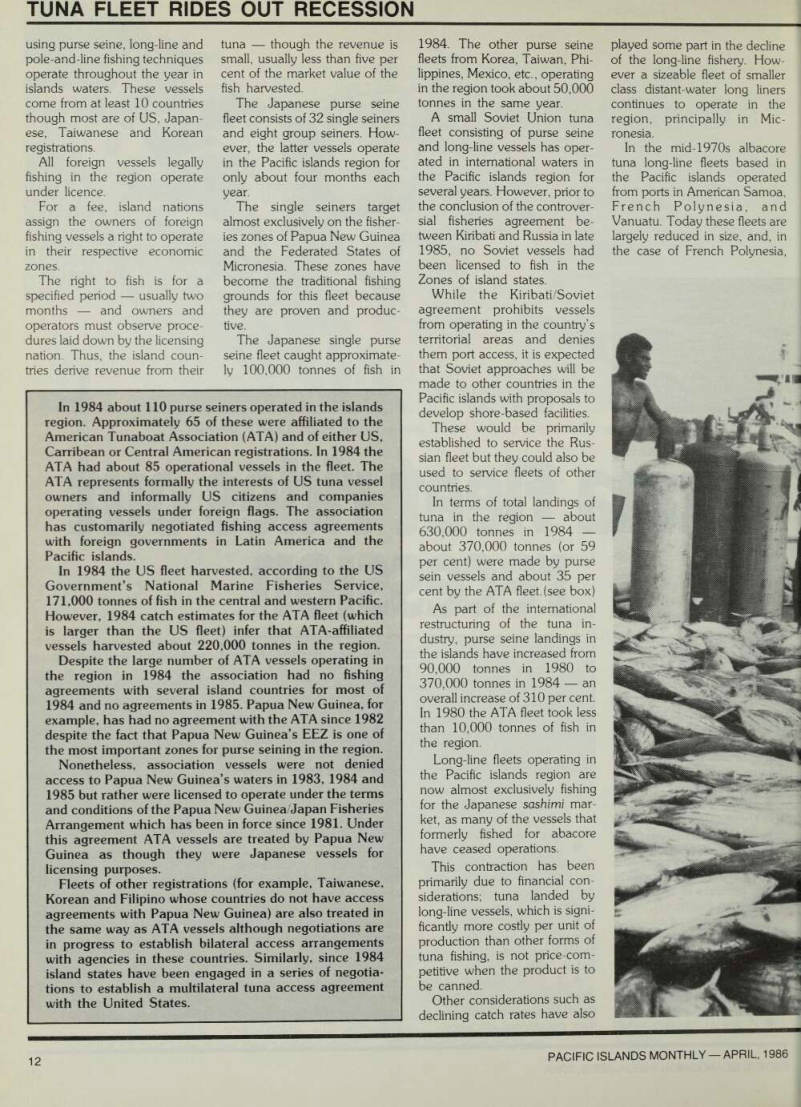
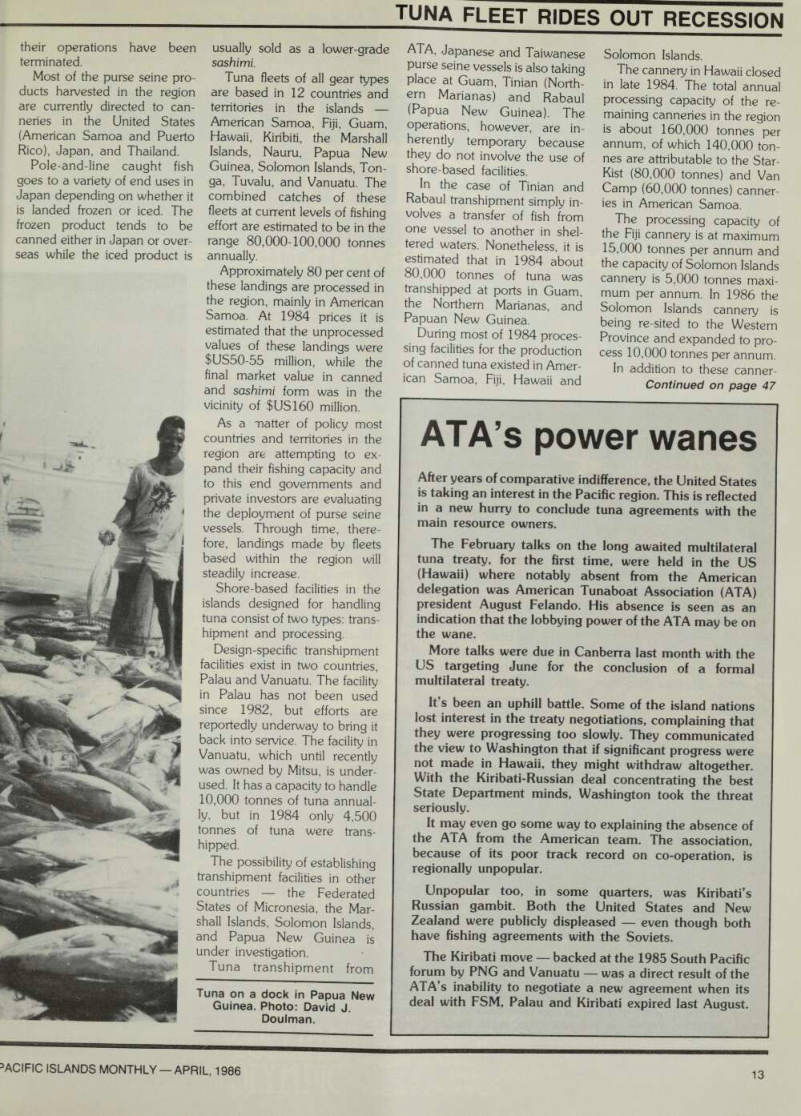
Tuna on a dock in Papua New Guinea. Photo: David J.
Doulman.
ies, Papua New Guinea is negotiating with developers for the establishment of a small cannery. Similarly, according to recent press reports, a cannery is to be established in the Marshall Islands.
Other tuna processing in the region involves the production of katsuobushi (smoked tuna).
Facilities for the production of this product are located in Solo mon Islands and the Marshall Islands. Both facilities are small and produce for export to Japan.
The many changes that have taken place internationally in the tuna industry have not yet fully worked themselves out.
There are indications that the tuna industry is gaining some
stability and that this trend should continue, albeit in a modest way.
The Pacific Islands will re main a crucial production area for the world’s tuna fishing fleets, and it is expected that there will be a continuing trans fer of capital primarily in the form of fishing vessels to countries in the region as means of improving the op erational efficiency of fleets and of securing preferential access to the region’s tuna resources.
So long as current market conditions persist, however, no significant increase in the re gion’s processing capacity is expected despite what govern ments say and want about the establishment of domestic tuna industries.