pacific report
pp. 7-9 · Read in the full issue
Remeliik: Three
Convicted
The three men facing charges of murder and conspiracy for the assassination of Palau’s President Haruo I. Remeliik (PIM Feb. p 7) were convicted in Koror on March 6. Melwert Tmetuchl, Leslie Tewid, and Anghenio Sabino were ac cused of the fatal shooting of Remeliik as he stepped from his car outside his home on June 30, 1985. A three-judge panel headed by Judge Robert Hefner of Saipan, Northern Marianas, deliber ated for about five hours before voting unanimously to convict all three men, according to Palau Attorney-General Russell Weller. “This is the climax of eight months of investigation,” said Wel ler. "It’s been a long haul. Right now the reaction is one of satisfaction and fatigue as much as anything.” Guam attorney Randy Cunliffe, who represented Tme tuchl during the trial, had checked out of his hotel room on the afternoon of March 6, and was not immediately reachable by phone. The three men, who had been free on bail during the trial, were taken to Koror’s national prison to await senten cing. All three face mandatory life sent ences with the possibility of parole for the murder conviction, Weller said. Each also faces a five-year sentence for the conspiracy conviction. On July 22, the trio and a fourth man, Francisco Gib bons, were charged in the killing. The charges against the four were dropped on August 16 after a lie detector test administered to an important witness indicated her testimony could be unreli able. The three were later charged a second time and trial began on February 24. Remeliik became the tiny republic’s first elected president in 1980, and was re-elected in 1984. In a special election held last September, voters elected Lazarus Salii to succeed him. “I'm happy that this case is finally brought to a conclusion,” Salii said after the verdict was announced. During the trial, the prosecution introduced a witness who testified she overheard the three men plan the killing, and another witness who testified that he sold a .30-calibre rifle and ammunition to Tmetuchl before the killing. AAP.
Palau Compact
Strife Won’T Die
Opinions are divided in Palau over the result of a February 21 plebiscite on the draft of the proposed Compact of Free Association with the United States About 72 per cent of the 7500 votes counted supported the draft, but this is still below the 75 per cent vote required to override the constitutional ban on the entry, use or storage of nuclear material
in Palau. Palau President Lazarus Salii supports the American view that only a simple majority is needed in the light of the U.S. pledge not to store, test or use nuclear weapons in Palau, and the acceptance by Palau of U.S. policy neither confirming not denying nuclear capability of its naval vessels in Palau waters. Other Palauans however oppose this view, and maintain that the draft of the compact has not been approved.
Court action could follow.
“More People”
Cries Lafleur
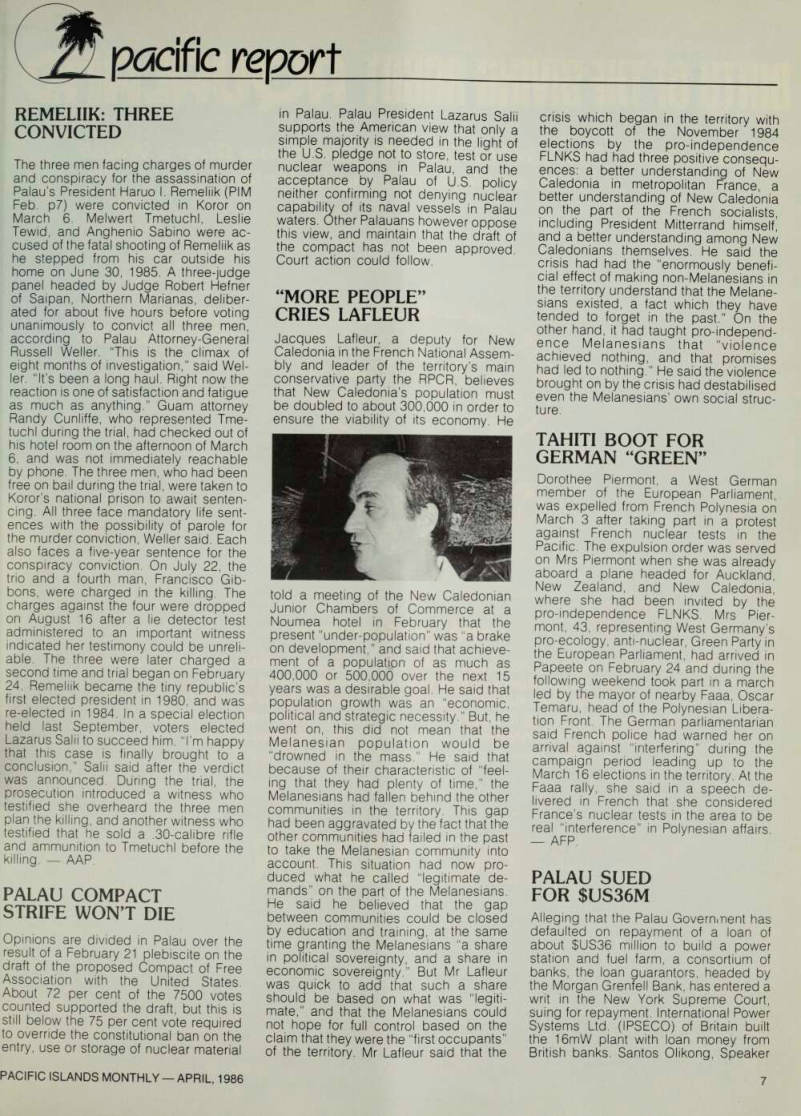
Jacques Lafleur, a deputy for New Caledonia in the French National Assem bly and leader of the territory’s main conservative party the RPCR, believes that New Caledonia’s population must be doubled to about 300,000 in order to ensure the viability of its economy. He
told a meeting of the New Caledonian Junior Chambers of Commerce at a Noumea hotel in February that the present “under-population” was “a brake on development," and said that achieve ment of a population of as much as 400,000 or 500,000 over the next 15 years was a desirable goal. He said that population growth was an “economic, political and strategic necessity.” But, he went on, this did not mean that the Melanesian population would be “drowned in the mass.” He said that because of their characteristic of “feel ing that they had plenty of time,” the Melanesians had fallen behind the other communities in the territory. This gap had been aggravated by the fact that the other communities had failed in the past to take the Melanesian community into account. This situation had now pro duced what he called “legitimate de mands” on the part of the Melanesians.
He said he believed that the gap between communities could be closed by education and training, at the same time granting the Melanesians “a share in political sovereignty, and a share in economic sovereignty.” But Mr Lafleur was quick to add that such a share should be based on what was “legiti mate,” and that the Melanesians could not hope for full control based on the claim that they were the “first occupants" of the territory. Mr Lafleur said that the
crisis which began in the territory with the boycott of the November 1984 elections by the pro-independence FLNKS had had three positive consequ ences: a better understanding of New Caledonia in metropolitan France, a better understanding of New Caledonia on the part of the French socialists, including President Mitterrand himself! and a better understanding among New Caledonians themselves. He said the crisis had had the “enormously benefi cial effect of making non-Melanesians in the territory understand that the Melane sians existed, a fact which they have tended to forget in the past.” On the other hand, it had taught pro-independ ence Melanesians that “violence achieved nothing, and that promises had led to nothing.” He said the violence brought on by the crisis had destabilised even the Melanesians’ own social struc ture.
Tahiti Boot For
German “Green”
Dorothee Piermont, a West German member of the European Parliament, was expelled from French Polynesia on March 3 after taking part in a protest against French nuclear tests in the Pacific. The expulsion order was served on Mrs Piermont when she was already aboard a plane headed for Auckland, New Zealand, and New Caledonia, where she had been invited by the pro-independence FLNKS. Mrs Pier mont, 43, representing West Germany’s pro-ecology, anti-nuclear, Green Party in the European Parliament, had arrived in Papeete on February 24 and during the following weekend took part in a march led by the mayor of nearby Faaa, Oscar Temaru, head of the Polynesian Libera tion Front. The German parliamentarian said French police had warned her on arrival against “interfering” during the campaign period leading up to the March 16 elections in the territory. At the Faaa rally, she said in a speech de livered in French that she considered France’s nuclear tests in the area to be real “interference” in Polynesian affairs.
Afp.
Palau Sued
For Sus36M
Alleging that the Palau Government has defaulted on repayment of a loan of about SUS 36 million to build a power station and fuel farm, a consortium of banks, the loan guarantors, headed by the Morgan Grenfell Bank, has entered a writ in the New York Supreme Court, suing for repayment. International Power Systems Ltd. (IPSECO) of Britain built the 16mW plant with loan money from British banks. Santos Olikong, Speaker
or paiau s Mouse or Delegates, said IPSECO had promised that the sale of power and fuel would be enough to pay for the loan. “IPSECO is breaking my heart,” said Mr Olikong. “It was sup posed to be self-paying, but instead it is costing about 15 cents a second.” By early December last year, the debt was estimated to have grown to $35,885,623.43, and it was reported that Palau would begin paying $62,500 in quarterly interest by March, 1986.
“Islands ’B6”
In Victoria B.C.
A conference entitled Islands 'B6 Conference of the Islands of the World, will be held in Victoria, British Columbia, Canada, from May 8-10. The conference will take place in the context of Vancouv er’s massive Expo 'B6, which runs from May 2 to October 13. The islands conference will be on the three themes: Islands Past; Islands Present: Appropri ate Technology for Islands Development Today; and Islands Future. A conference brochure says of the final session: “Because of their geographical isolation
and related transportation costs, the industrial age largely bypassed the islands of the world. In the new, de centralised age of technology, islands societies should be able to compete more successfully for lightweight, in formation-based, exportable industries.
But can they?” Announced speakers at the sessions of Islands 'B6 include Dr James Boutilier, Dr Peter Baskerville, Dr Neville Hall, Dr Bryan Farrell, Dr Te’o Fairbairn, Dr David Lowenthal, Dr Michael P. Hamnett, Dr Robert C. Kiste, and Felipe Bole.
Exxon Windfall
For A.Samoa
The government of American Samoa stands to receive a sum of $U5372,000 from the fund of $2.1 billion that the Exxon Corporation must pay to the U.S. federal government for overcharges on crude oil during the period when oil was subject to federal price controls. The money will be distributed to all 50 states the District of Columbia, and the insular possessions of the U.S. The formula for allotment is based on each entity's consumption of refined petroleum pro ducts between January, 1975, and Janu ary, 1981, when price controls were lifted. The states and territories must agree to use their portion of the fund for certain energy conservation programs.
American bamoas congressman Fofo I.
Sunia said: “I am very pleased with this announcement. The money awarded to American Samoa will enable the territo rial government to greatly strengthen its efforts toward making the islands more energy-efficient.”
Divorce Airline
Style (1)
The Vanuatu Government is discussing the future of its international airline, Air Vanuatu, with Air Pacific, Air Nauru and Air Caledonie following the termination by Ansett Airlines of Australia of its agreement with the government to man age and operate Air Vanuatu. Talks between Ansett and the government over a new agreement broke down over the government’s insistence on payment of royalties by Ansett. While visiting London, Vanuatu Prime Minister Fr Wal ter Uni said his government may ask the Australian Government to intervene in the dispute with Ansett, Fr Lini said Air Hong Kong had entered the discussion, and two Port-Vila businessmen, John King, formerly with Ansett and Tom Bayer, might introduce a new venture.
Divorce Airline
Style (2)
The three-year contract with Dutch air line KLM to manage Air Niugini ended in March and KLM will not renew the contract because it does not agree with the conditions imposed by the Papua New Guinea Government, which is put ting out tenders for a new management contract.
Si2M Lawsuit Is Finally
Settled
A SUSI 2 million 6-year-old lawsuit filed against the Pacific Daily News by the president of the Marshall Islands has been settled out of court. The settlement was announced jointly by President Amata Kabua and the Gannett Co., the newspaper’s owner. The suit stemmed from reports published in 1978 when the Marshall Islands and other islands in the Trust Territory of the Pacific Islands were forming their own governments.
The reports said the Republic of Nauru made secret and illegal loans to the Marshall Islands Political Status Com mission and alleged that the Nauru government agreed to make a SUS6OO,OOO loan to back a Marshalls separatist movement. A US District Court jury in Honolulu last November (PIM December 1985, page 7) found the articles false and defamatory. However, the defendants were found not liable as the reports were not published reckless ly or with malice. The joint statement said: “With the experience of this lawsuit behind them, the parties agree that the loan was made to support the self
government process.” The statement said the loan was not negotiated or authorised in a secret fashion
Tuvalu’S ‘No’
To Republic
A select committee of the Tuvalu Parlia ment has been canvassing the people of the country’s nine atolls for their views on whether the country should remain an independent constitutional monarchy with the British reigning monarch as its head and the Westminster type of parliament, or become a republic like Kiribati, Vanuatu and Nauru. The com munity of only one atoll wanted a republic, but the committee reported general consensus on the issue of preserving Tuvaluan customs and tradi tions. The Tuvaluan news-sheet Tuvalu Echoes commented; “It is crucial at this stage for the committee to draw a solid line between Tuvalu customs and tradi tions, and the fundamental rights of an individual. Anyone will agree in principle that there are certain aspects of Tuvalu customs and tradition which are totally in conflict with rights of an individual."
Stamps, Money,
Talks In Tonga
A five-day philatelic management semi nar, sponsored by the Canadian Gov ernment and a Canadian philatelic ex pert, Frank Platters, was held in Nukualo fa, Tonga’s capital, in March. Several island countries, who have relied on the international stamp market for much of their income, were represented at the seminar. Methods of arresting the de cline ifl their stamp sales were dis cussed.
Cooks Fertility
God A Winner
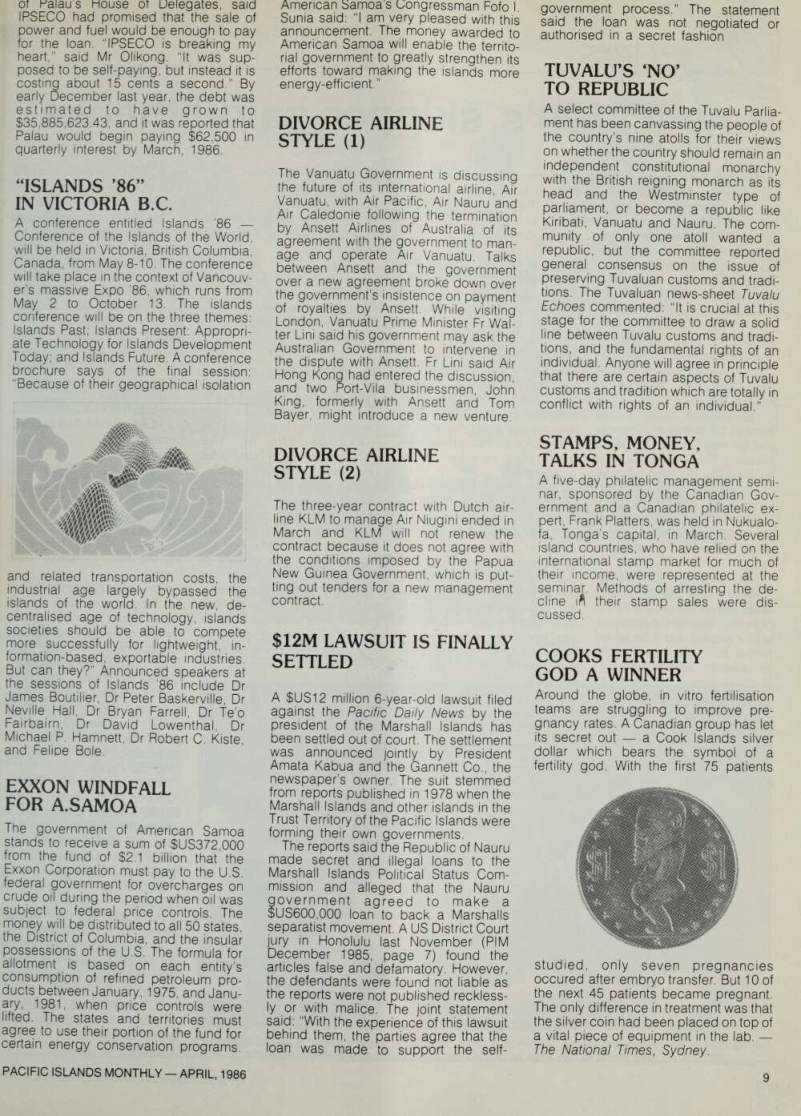
Around the globe, in vitro fertilisation teams are struggling to improve pre gnancy rates. A Canadian group has let its secret out a Cook Islands silver dollar which bears the symbol of a fertility god. With the first 75 patients
studied, only seven pregnancies occured after embryo transfer. But 10 of the next 45 patients became pregnant.
The only difference in treatment was that the silver coin had been placed on top of a vital piece of equipment in the lab.
The National Times, Sydney.