The honeymoon
is over
Papua New Guinea’s three million people are gov erned by 19 provincial assemblies and a national government as well as local government councils.
Veteran PNG politician and former Governor-General Sir John Guise says it’s gone too far.
The introduction of native Local Government Councils in PNG in about 1948 was seen by many as a first step towards giving the local people some say in the administtation of their areas.
The system, however, came under the heavy hand of the District Commissioner whose authority was exercised through his Local Government Officer, in most cases the ADC, who became the senior local govern ment adviser in that particular council area.
The councils were and still are bodies elected by the village people. They have pow ers to raise head taxes from the people. These normally aver aged out at K 5 or K 6 per year for males and K 1 or K 2 for females.
The councils were also given minor court powers to settle village disputes, assisted by council constables who had limited powers to arrest head tax defaulters. The councils were also given authority to engage in cash crop deve lopment.
However, the court powers and the authority for economic development were later with drawn in new legislation follow ing the report of a Canberra appointed inquiry which was never made public.
There are numerous com plaints by village tax payers regarding the use of their money for small village projects such as water wells, water sup
ply systems, water tanks and aid posts with a lack of assist ance to projects such as bread and scone baking by village women’s groups.
Villagers not only pay council head tax. They are required to pay their provincial community and high school fees as well as medical and Parents and Citi zens Association fees.
Copra and coffee producers must contribute to their respec tive stabilisation funds, while villages also contribute to the upkeep of their churches and pastors. And you don’t have to be an expert to realise that if there is more than one Christian denomination in a village, the financial burden doubles.
It is a wonder, then, that the Central Provincial Government in its dictatorial fashion, has imposed on the people a fur ther head tax for 1986.
And this was done, it sems, without seeking the views of the people. It is worth recalling the old adage that you can’t fool all of the people all of the time a barbed reminder to those in temporary power in the Central province where elections are not far off.
Which brings this column to a final analysis of the growing patterns of difficulty that must be confronted with courage if the silent majority the voters are to feel secure in their everyday lives. These are; •Goods and services for the people are mostly in the realm of imagination.
•We are the most heavily taxed and over-regulated people in the whole of the South Pacific. •Our economic structure and develolpment strategy, as well as our resources on land sea and air seem to be heavily dependent on and directed by rich and powerful foreign inves tors.
This may not augur well for the development of a strong national middle class commun ity which is vitally important for the country’s economic stabil ity. Our development direction must be altered to an all national course, or we may face
the anger of our people in the not-too-distant future. •Our beautiful homeland has inherited through “democratic” exercises so many levels of government that it has become unworkable and top heavy. It is horribly insensitive to the aspirations and will of the majority and is unable to “de liver the goods.”
It is clear that we must face this challenge with honesty, sincerity and courage. We should realise that the warning bells are already sounding.
The ten year honeymoon is over.
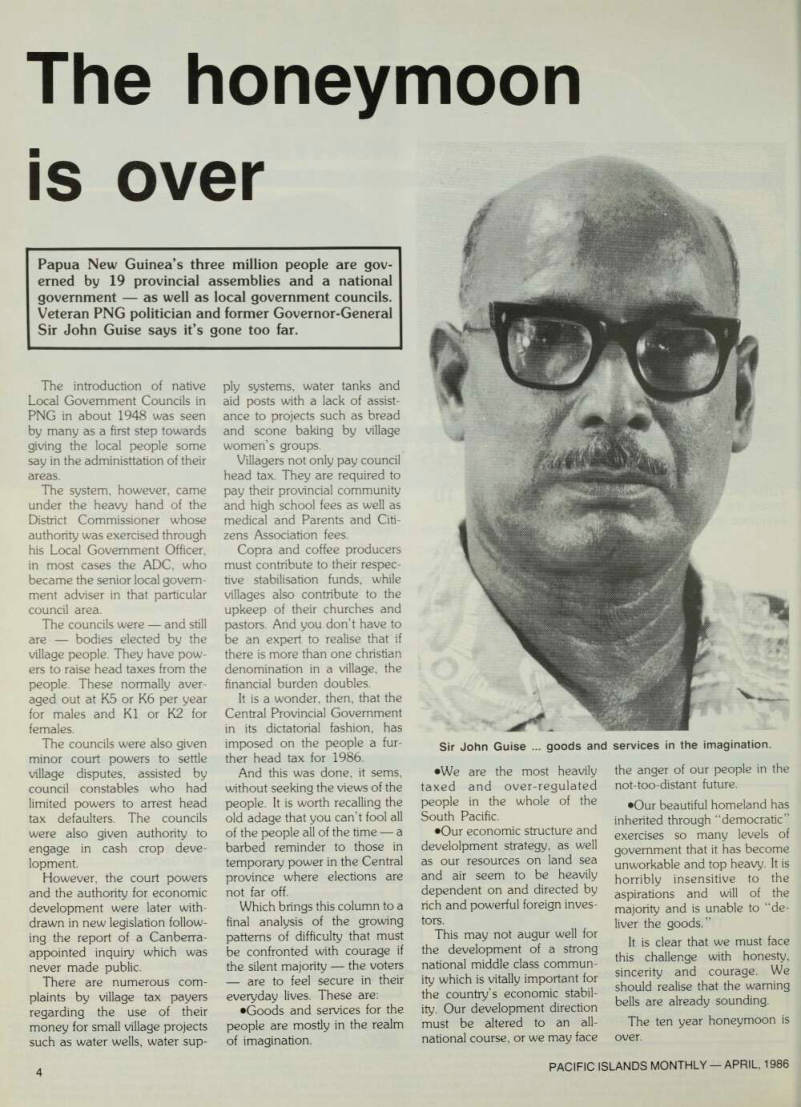
Sir John Guise ... goods and services in the imagination.