yachts
pp. 51-52 · Read in the full issue
Ian G. Menzies Re
ports from Darwin , Australia:
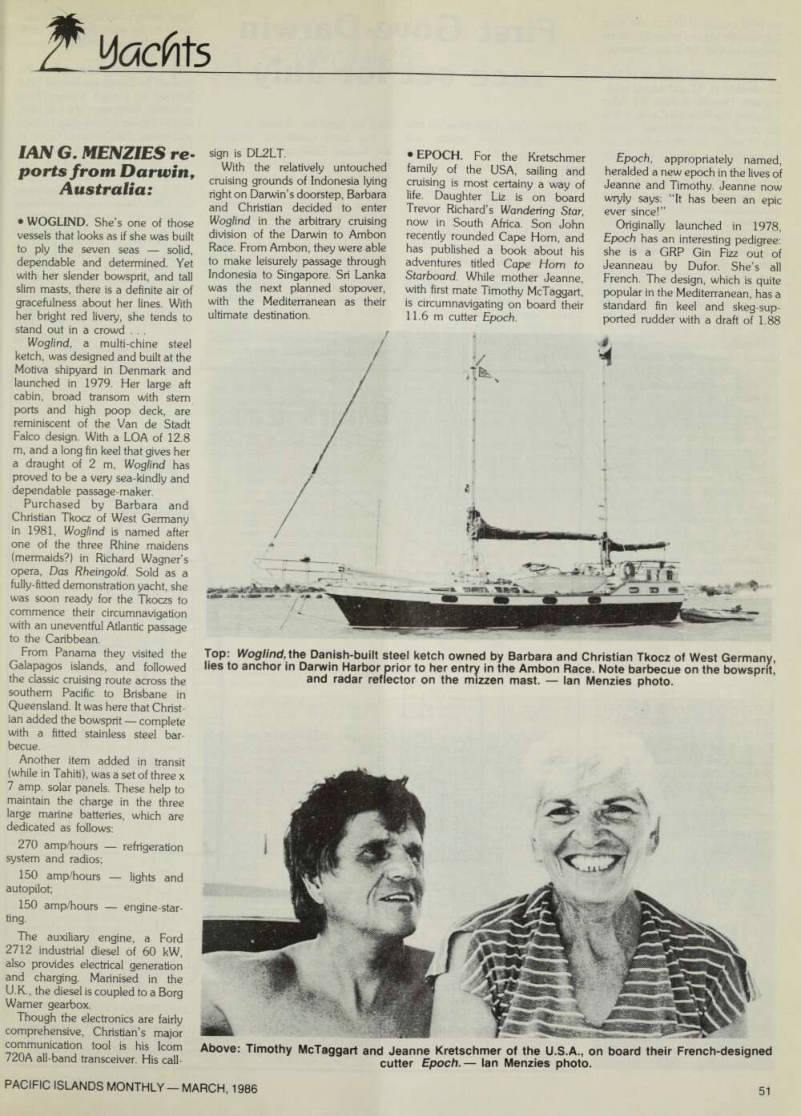
• WOGLIND. She’s one of those vessels that looks as if she was built to ply the seven seas solid, dependable and determined. Yet with her slender bowsprit, and tall slim masts, there is a definite air of gracefulness about her lines. With her bright red livery, she tends to stand out in a crowd . . .
Woglind, a multi-chine steel ketch, was designed and built at the Motiva shipyard in Denmark and launched in 1979. Her large aft cabin, broad transom with stem ports and high poop deck, are reminiscent of the Van de Stadt Falco design. With a LOA of 12.8 m, and a long fin keel that gives her a draught of 2 m, Woglind has proved to be a very sea-kindly and dependable passage-maker.
Purchased by Barbara and Christian Tkocz of West Germany in 1981, Woglind is named after one of the three Rhine maidens (mermaids?) in Richard Wagner’s opera, Das Rheingold. Sold as a fully-fitted demonstration yacht, she was soon ready for the Tkoczs to commence their circumnavigation with an uneventful Atlantic passage to the Caribbean.
From Panama they visited the Galapagos islands, and followed the classic cruising route across the southern Pacific to Brisbane in Queensland. It was here that Christ ian added the bowsprit complete with a fitted stainless steel bar becue.
Another item added in transit (while in Tahiti), was a set of three x 7 amp. solar panels. These help to maintain the charge in the three large marine batteries, which are dedicated as follows: 270 amp/hours refrigeration system and radios; 150 amp/hours lights and autopilot; 150 amp/hours engine-star ting.
The auxiliary engine, a Ford 2712 industrial diesel of 60 kW, also provides electrical generation and charging. Marinised in the U.K., the diesel is coupled to a Borg Warner gearbox.
Though the electronics are fairly comprehensive, Christian’s major communication tool is his Icom 720 A all-band transceiver. His call
sign is DL2LT.
With the relatively untouched cruising grounds of Indonesia lying right on Darwin’s doorstep, Barbara and Christian decided to enter Woglind in the arbitrary cruising division of the Darwin to Ambon Race. From Ambon, they were able to make leisurely passage through Indonesia to Singapore. Sri Lanka was the next planned stopover, with the Mediterranean as their ultimate destination.
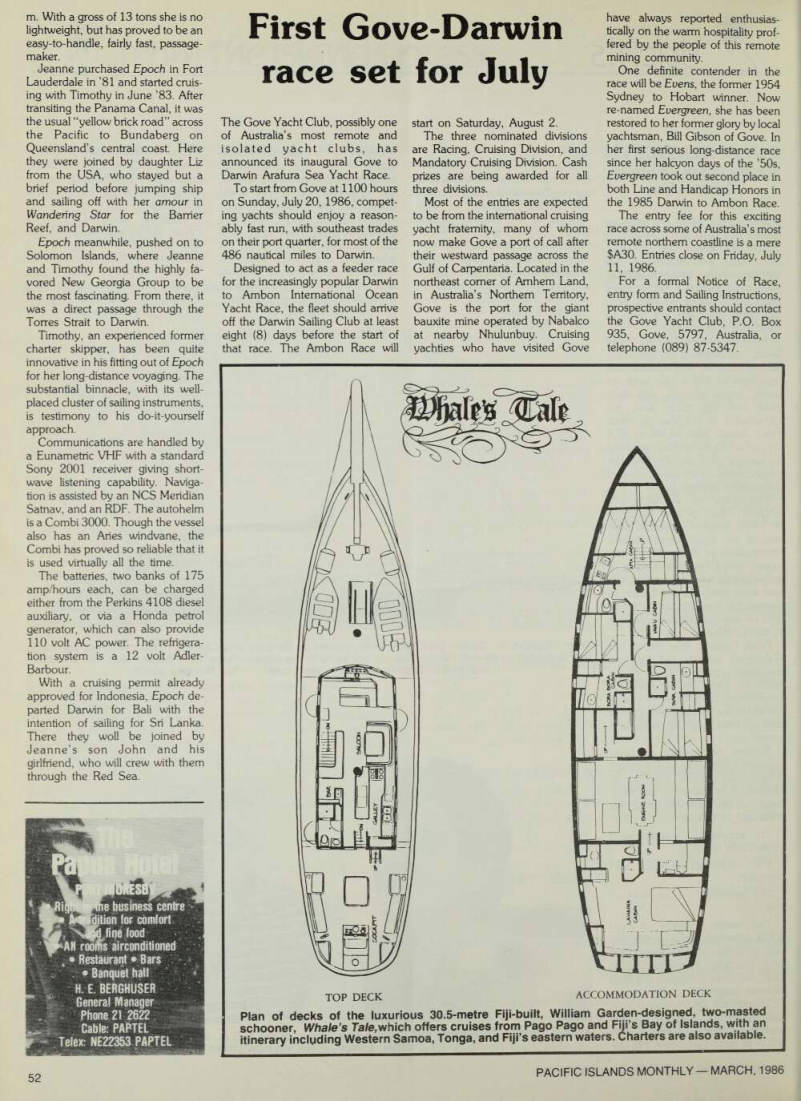
• EPOCH. For the Kretschmer family of the USA, sailing and cruising is most certainy a way of life. Daughter Liz is on board Trevor Richard’s Wandering Star, now in South Africa. Son John recently rounded Cape Horn, and has published a book about his adventures titled Cape Horn to Starboard. While mother Jeanne, with first mate Timothy McTaggart, is circumnavigating on board their 11.6 m cutter Epoch.
Epoch, appropriately named, heralded a new epoch in the lives of Jeanne and Timothy. Jeanne now wryly says; “It has been an epic ever since!”
Originally launched in 1978, Epoch has an interesting pedigree: she is a GRP Gin Fizz out of Jeanneau by Dufor. She’s all French. The design, which is quite popular in the Mediterranean, has a standard fin keel and skeg-sup ported rudder with a draft of 1.88
Top: Woglind, the Danish-built steel ketch owned by Barbara and Christian Tkocz of West Germany, lies to anchor in Darwin Harbor prior to her entry in the Ambon Race. Note barbecue on the bowsprit, and radar reflector on the mizzen mast. - Ian Menzies photo.
Above: Timothy McTaggart and Jeanne Kretschmer of the U.S.A., on board their French-designed cutter Epoch. - Ian Menzies photo.
m. With a gross of 13 tons she is no lightweight, but has proved to be an easy-to-handle, fairly fast, passage maker.
Jeanne purchased Epoch in Fort Lauderdale in ’Bl and started cruis ing with Timothy in June ’B3. After transiting the Panama Canal, it was the usual “yellow brick road” across the Pacific to Bundaberg on Queensland’s central coast. Here they were joined by daughter Liz from the USA, who stayed but a brief period before jumping ship and sailing off with her amour in Wandering Star for the Barrier Reef, and Darwin.
Epoch meanwhile, pushed on to Solomon Islands, where Jeanne and Timothy found the highly fa vored New Georgia Group to be the most fascinating. From there, it was a direct passage through the Torres Strait to Darwin.
Timothy, an experienced former charter skipper, has been quite innovative in his fitting out of Epoch for her long-distance voyaging. The substantial binnacle, with its well placed cluster of sailing instruments, is testimony to his do-it-yourself approach.
Communications are handled by a Eunametric VHF with a standard Sony 2001 receiver giving short wave listening capability. Naviga tion is assisted by an NCS Meridian Satnav, and an RDF. The autohelm is a Combi 3000. Though the vessel also has an Aries windvane, the Combi has proved so reliable that it is used virtually all the time.
The batteries, two banks of 175 amp/hours each, can be charged either from the Perkins 4108 diesel auxiliary, or via a Honda petrol generator, which can also provide 110 volt AC power. The refrigera tion system is a 12 volt Adler- Barbour.
With a cruising permit already approved for Indonesia, Epoch de parted Darwin for Bali with the intention of sailing for Sri Lanka.
There they woll be joined by Jeanne’s son John and his girlfriend, who will crew with them through the Red Sea.