Compact: Reagan
p. 47 · Read in the full issue
signs at last
Completion of the long-drawn out legal and political processes leading up to the self-govern ment of the elements of the US-administered Trust Terri tory of the Pacific seems to be approaching.
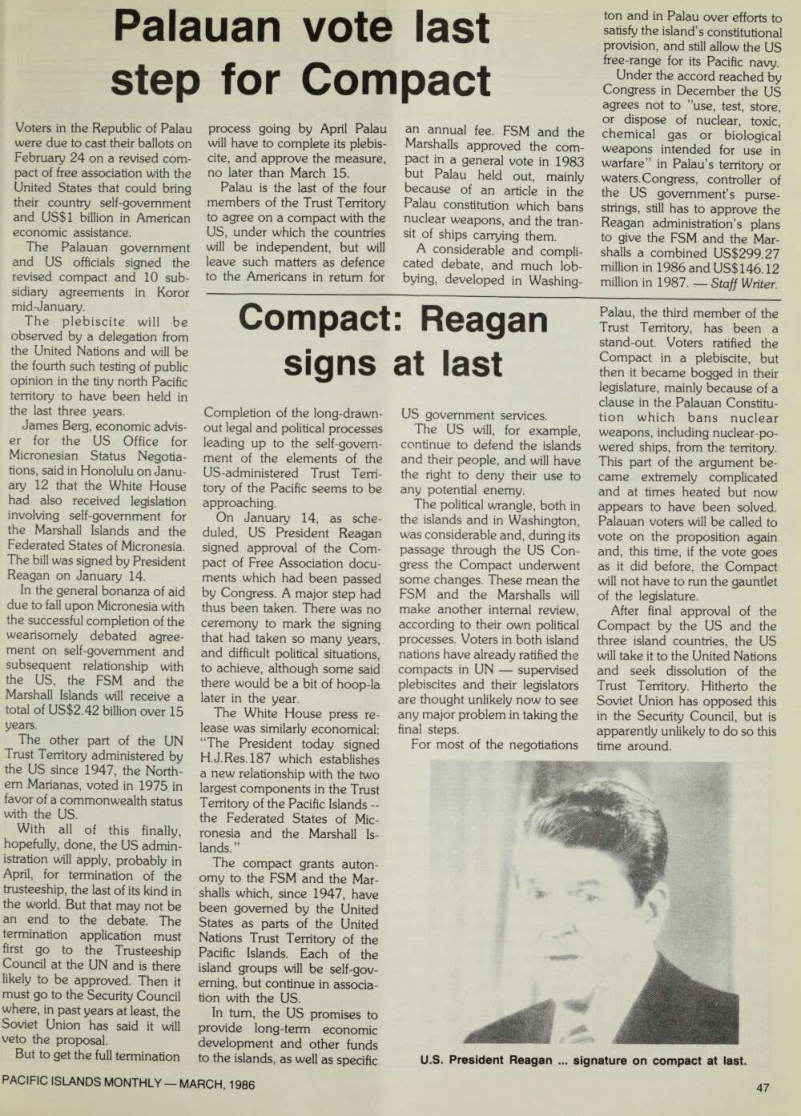
On January 14, as sche duled, US President Reagan signed approval of the Com pact of Free Association docu ments which had been passed by Congress. A major step had thus been taken. There was no ceremony to mark the signing that had taken so many years, and difficult political situations, to achieve, although some said there would be a bit of hoop-la later in the year.
The White House press re lease was similarly economical: “The President today signed H.J.Res.lB7 which establishes a new relationship with the two largest components in the Trust Territory of the Pacific Islands the Federated States of Mic ronesia and the Marshall Is lands.”
The compact grants auton omy to the FSM and the Mar shalls which, since 1947, have been governed by the United States as parts of the United Nations Trust Territory of the Pacific Islands. Each of the island groups will be self-gov erning, but continue in associa tion with the US.
In turn, the US promises to provide long-term economic development and other funds to the islands, as well as specific
US government services.
The US will, for example, continue to defend the islands and their people, and will have the right to deny their use to any potential enemy.
The political wrangle, both in the islands and in Washington, was considerable and, during its passage through the US Con gress the Compact underwent some changes. These mean the FSM and the Marshalls will make another internal review, according to their own political processes. Voters in both island nations have already ratified the compacts in UN supervised plebiscites and their legislators are thought unlikely now to see any major problem in taking the final steps.
For most of the negotiations
Palau, the third member of the Trust Territory, has been a stand-out. Voters ratified the Compact in a plebiscite, but then it became bogged in their legislature, mainly because of a clause in the Palauan Constitu tion which bans nuclear weapons, including nuclear-po wered ships, from the territory.
This part of the argument be came extremely complicated and at times heated but now appears to have been solved.
Palauan voters will be called to vote on the proposition again and, this time, if the vote goes as it did before, the Compact will not have to run the gauntlet of the legislature.
After final approval of the Compact by the US and the three island countries, the US will take it to the United Nations and seek dissolution of the Trust Territory. Hitherto the Soviet Union has opposed this in the Security Council, but is apparently unlikely to do so this time around.
U.S. President Reagan ... signature on compact at last.