gold’ bonanza
pp. 25-26 · Read in the full issue
Fiji looks to 'green gold’ bonanza
In Fiji they call pine “green gold” and now the fledgling industry is taking the first steps in an industrial phase that will give the trees the chance to spin their treasure.
After long negotiations and stacks of agreements, construc tion has begun of a multi million dollar pinewood proces sing complex on a 16.5 hectare site at Drasa, near Fiji’s second city of Lautoka, capital of the Western Division on the main island of Viti Levu.
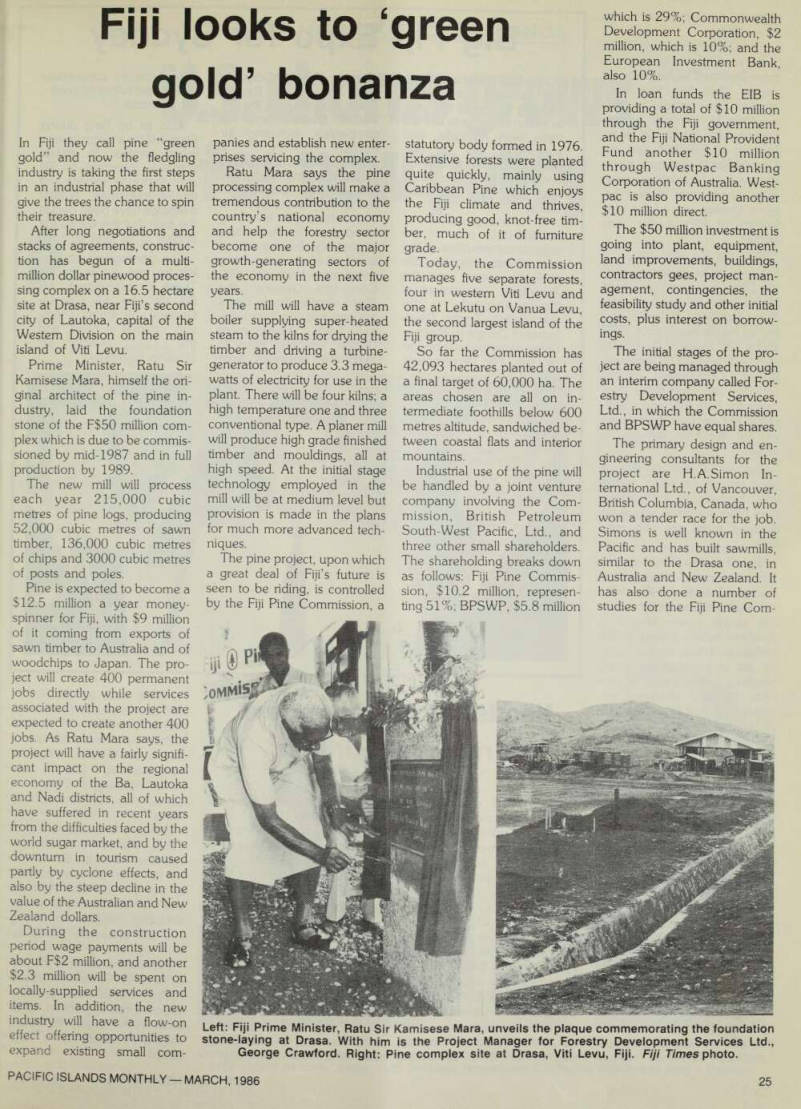
Prime Minister, Ratu Sir Kamisese Mara, himself the ori ginal architect of the pine in dustry, laid the foundation stone of the Fsso million com plex which is due to be commis sioned by mid-1987 and in full production by 1989.
The new mill will process each year 215,000 cubic metres of pine logs, producing 52,000 cubic metres of sawn timber, 136,000 cubic metres of chips and 3000 cubic metres of posts and poles.
Pine is expected to become a $12.5 million a year money spinner for Fiji, with $9 million of it coming from exports of sawn timber to Australia and of woodchips to Japan. The pro ject will create 400 permanent jobs directly while services associated with the project are expected to create another 400 jobs. As Ratu Mara says, the project will have a fairly signifi cant impact on the regional economy of the Ba, Lautoka and Nadi districts, all of which have suffered in recent years from the difficulties faced by the world sugar market, and by the downturn in tourism caused partly by cyclone effects, and also by the steep decline in the value of the Australian and New Zealand dollars.
During the construction period wage payments will be about Fs2 million, and another $2.3 million will be spent on locally-supplied services and items. In addition, the new industry will have a flow-on effect offering opportunities to expand existing small com
panics and establish new enter prises servicing the complex.
Ratu Mara says the pine processing complex will make a tremendous contribution to the country’s national economy and help the forestry sector become one of the major growth-generating sectors of the economy in the next five years.
The mill will have a steam boiler supplying super-heated steam to the kilns for drying the timber and driving a turbine generator to produce 3.3 mega watts of electricity for use in the plant. There will be four kilns; a high temperature one and three conventional type. A planer mill will produce high grade finished timber and mouldings, all at high speed. At the initial stage technology employed in the mill will be at medium level but provision is made in the plans for much more advanced tech niques.
The pine project, upon which a great deal of Fiji’s future is seen to be riding, is controlled by the Fiji Pine Commission, a
statutory body formed in 1976.
Extensive forests were planted quite quickly, mainly using Caribbean Pine which enjoys the Fiji climate and thrives, producing good, knot-free tim ber, much of it of furniture grade.
Today, the Commission manages five separate forests, four in western Viti Levu and one at Lekutu on Vanua Levu, the second largest island of the Fiji group.
So far the Commission has 42,093 hectares planted out of a final target of 60,000 ha. The areas chosen are all on in termediate foothills below 600 metres altitude, sandwiched be tween coastal flats and interior mountains.
Industrial use of the pine will be handled by a joint venture company involving the Com mission, British Petroleum South-West Pacific, Ltd., and three other small shareholders.
The shareholding breaks down as follows: Fiji Pine Commis sion, $10.2 million, represen ting 51%; BPSWP, $5.8 million
which is 29%; Commonwealth Development Corporation, $2 million, which is 10%; and the European Investment Bank, also 10%.
In loan funds the EIB is providing a total of $lO million through the Fiji government, and the Fiji National Provident Fund another $lO million through Westpac Banking Corporation of Australia. West pac is also providing another $lO million direct.
The $5O million investment is going into plant, equipment, land improvements, buildings, contractors gees, project man agement, contingencies, the feasibility study and other initial costs, plus interest on borrow ings.
The initial stages of the pro ject are being managed through an interim company called For estry Development Services, Ltd., in which the Commission and BPSWP have equal shares.
The primary design and en gineering consultants for the project are H.A.Simon In ternational Ltd., of Vancouver, British Columbia, Canada, who won a tender race for the job.
Simons is well known in the Pacific and has built sawmills, similar to the Drasa one, in Australia and New Zealand. It has also done a number of studies for the Fiji Pine Corn-
Left: Fiji Prime Minister, Ratu Sir Kamisese Mara, unveils the plaque commemorating the foundation stone-laying at Drasa. With him is the Project Manager for Forestry Development Services Ltd., George Crawford. Right: Pine complex site at Drasa, Viti Levu, Fiji. Fiji Times photo.
mission over the four years from 1980.
The Commission believes its main markets for its products from Drasa will be Australia and Japan. Marketing trips have already been made to both countries by the joint venture project team leader, Dr Wynn Ingram, of BPSWP and the Commission’s general mana ger, Andrew Drysdale, who was formerly manager of Blue La goon Cruises, one of the best known of Fiji’s tourist com panies.
Although the pine project is not seen to be underway until the Drasa mill complex opens for business, Fiji has been reg ularly exporting pulplogs and peeled logs to Japan since 1980 and is well aware of the quality standards applied by Japanese buyers. Commission experts feel they can meet those stan dards for both logs and wood chips, but say their main target will be the chip industry in Japan.
Australia should provide a good market for sawn timber and. because of competition from other countries, standards required there are also very high.
The Forestry Development Services project manager is George Crawford, who was involved with the first commer cial atomic power station in Scotland before joining British Prtroleum where he has work ed for more than 20 years, handling a wide variety of pro jects. He is a chartered en gineer, a Fellow of the Institute of Mechanical Engineers and a Member of the British Institute of Management.
Native owners of land on which the pine stands are repre sented on the Commission’s board, and also on the board of F.D.S. Ltd. Because of their involvement with the project, the Commission has been run ning management courses for the landowners and hopes that the skills they learn there will support them should they wish to go into business providing subsidiary services for the pine project. This idea also seems to be catching on: recently some of the landowners formed a company to operate forklift trucks on contract to the Com
mission.
Firoz Shaheem in
Lautoka.