begins to thaw
p. 15 · Read in the full issue
Russia: The frost begins to thaw
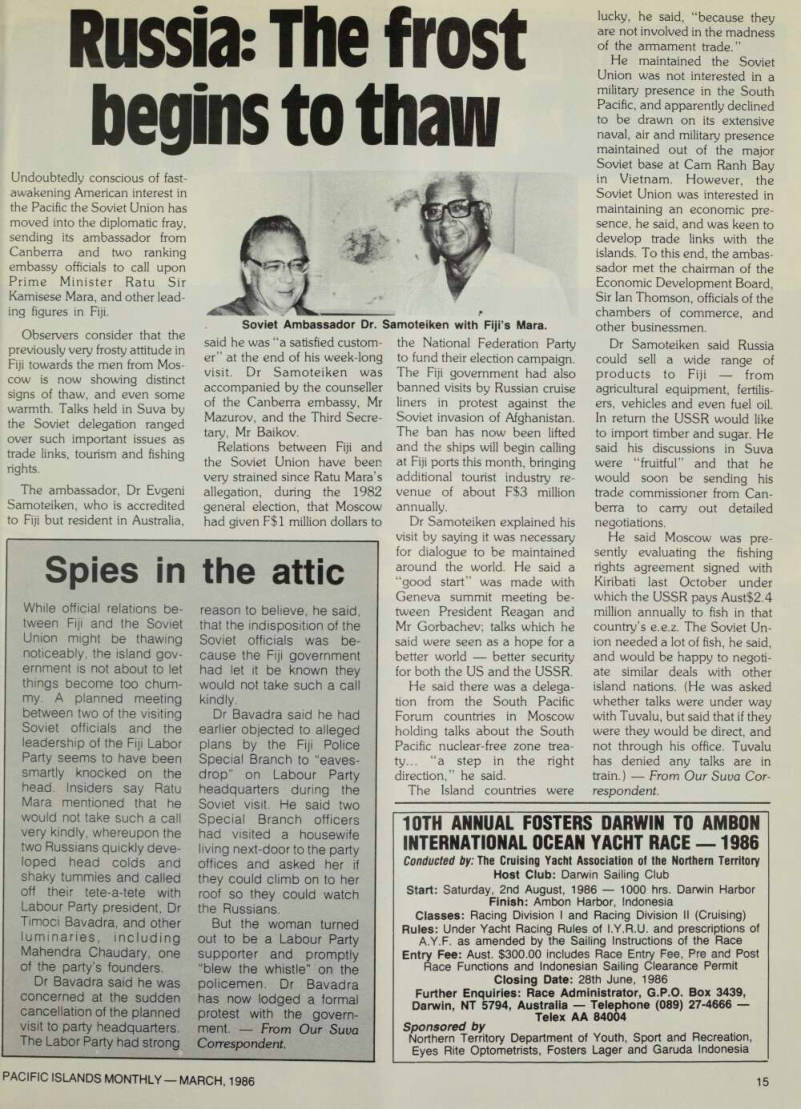
Undoubtedly conscious of fast awakening American interest in the Pacific the Soviet Union has moved into the diplomatic fray, sending its ambassador from Canberra and two ranking embassy officials to call upon Prime Minister Ratu Sir Kamisese Mara, and other lead ing figures in Fiji.
Observers consider that the previously very frosty attitude in Fiji towards the men from Mos cow is now showing distinct signs of thaw, and even some warmth. Talks held in Suva by the Soviet delegation ranged over such important issues as trade links, tourism and fishing rights.
The ambassador, Dr Evgeni Samoteiken, who is accredited to Fiji but resident in Australia,
said he was “a satisfied custom er” at the end of his week-long visit. Dr Samoteiken was accompanied by the counseller of the Canberra embassy, Mr Mazurov, and the Third Secre tary, Mr Baikov.
Relations between Fiji and the Soviet Union have been very strained since Ratu Mara’s allegation, during the 1982 general election, that Moscow had given Fsl million dollars to
the National Federation Party to fund their election campaign.
The Fiji government had also banned visits by Russian cruise liners in protest against the Soviet invasion of Afghanistan.
The ban has now been lifted and the ships will begin calling at Fiji ports this month, bringing additional tourist industry re venue of about Fs3 million annually.
Dr Samoteiken explained his visit by saying it was necessary for dialogue to be maintained around the world. He said a “good start” was made with Geneva summit meeting be tween President Reagan and Mr Gorbachev; talks which he said were seen as a hope for a better world better security for both the US and the USSR.
He said there was a delega tion from the South Pacific Forum countries in Moscow holding talks about the South Pacific nuclear-free zone trea ty... “a step in the right direction,” he said.
The Island countries were
lucky, he said, “because they are not involved in the madness of the armament trade.”
He maintained the Soviet Union was not interested in a military presence in the South Pacific, and apparently declined to be drawn on its extensive naval, air and military presence maintained out of the major Soviet base at Cam Ranh Bay in Vietnam. However, the Soviet Union was interested in maintaining an economic pre sence, he said, and was keen to develop trade links with the islands. To this end, the ambas sador met the chairman of the Economic Development Board, Sir lan Thomson, officials of the chambers of commerce, and other businessmen.
Dr Samoteiken said Russia could sell a wide range of products to Fiji from agricultural equipment, fertilis ers, vehicles and even fuel oil.
In return the USSR would like to import timber and sugar. He said his discussions in Suva were “fruitful” and that he would soon be sending his trade commissioner from Can berra to carry out detailed negotiations.
He said Moscow was pre sently evaluating the fishing rights agreement signed with Kiribati last October under which the USSR pays Austs2.4 million annually to fish in that country’s e.e.z. The Soviet Un ion needed a lot of fish, he said, and would be happy to negoti ate similar deals with other island nations. (He was asked whether talks were under way with Tuvalu, but said that if they were they would be direct, and not through his office. Tuvalu has denied any talks are in train.) From Our Suva Cor respondent.
Soviet Ambassador Dr. Samoteiken with Fiji’s Mara.