to terrorism
pp. 12-14 · Read in the full issue
OPM may turn to terrorism
While PNG Prime Minister, Paias Wingti, appears to have won himself a “breather” by bringing in the United Nations to help with his festering problem with the 10,000 Irian Jayan refugees camped on his border, the sad fact is that the situation is becoming worse. DENIS REINHARDT has been to the border and has interviewed the Roman Catholic Bishop of Vanimo, John Etheridge, who says the Free Papua New Guinea Movement is now beginning to look and act like a terrorist unit.
Nestling on the slope behind the post office at Vanimo, Papua New Guinea’s nearest major centre to the Irian Jaya border, is an unpretentious Ro man Catholic church. Several of the fluorescent lights hang loose and the paint is peeling.
The altar is a simple, spartan affair, the antithesis of Rome’s opulence.
For Bishop John Etheridge, these are irrelevancies in his wider struggle for what he be lieves is the preservation of human rights among the
Melanesians of Irian Jaya — not only the thousands who have crossed from the troubled In donesian province, but the many more on the other side.
Bishop Etheridge hopes one day to visit Irian Jaya, particu larly its capital, Jayapura, less than 100 km away, to see for himself.
Meantime, he is set on a path which has seen him threatened with deportation, questioned by fellow bishops and used by successive administrations in Port Moresby as a conduit to the OPM, or Free Papua Move
ment, which is seeking inde pendence for Irian Jaya.
Perhaps the most traumatic moment for the Adelaide-born electrician turned prelate came not when former Industrial De velopment Minister, Karl Stack called on the floor of the PNG parliament for Etheridge’s prompt expulsion from the country, but when residents of the nearby Blackwater refugee camp rioted and attacked gov ernment property last October after authorities forcibly de ported 12 of their number back to Jayapura.
Etheridge bitterly resents he was unable to prevent both the violent deportation and the vio lent reaction. Had the Somare government remained in office, there was an inevitability about an open clash between his church and the state.
“I was never told officially by the government that I would be deported... but it was an official recommendation of the border committee,” recalls Etheridge, these days with a far more positive attitude towards Port Moresby.
He regards the Wingti gov
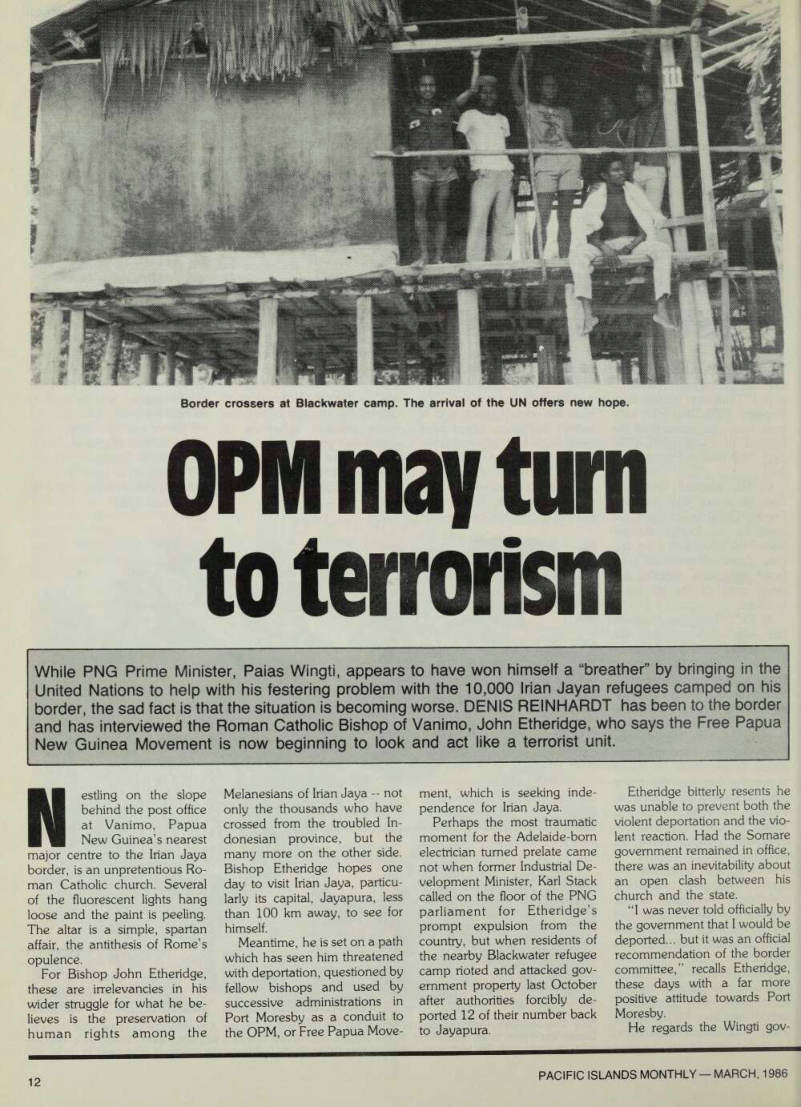
Border crossers at Blackwater camp. The arrival of the UN offers new hope.
ernment’s initiative of officially inviting the United Nations High Commissioner for Re fugees to determine the indi vidual status of the 10,000 Irianese camped inside Papua New Guinea’s frontiers as a major breakthrough. The Wing ti government’s avowed aim of resettling the refugees away from the border, pending de termination of their future status is what Etheridge “has been praying for.”
“To me it is a tremendous breakthrough. For the last two years I have been asking and
praying for the United Nations to be allowed to get completely involved with these people, so that in a sense they are handed over to a completely neutral body for them to work out who is a genuine refugee and who is not. I agree it is one of the biggest things to happen in Papua New Guinea for many many years.”
Etheridge is concerned how ever that Prime Minister Wing ti’s ideas on resettlement may
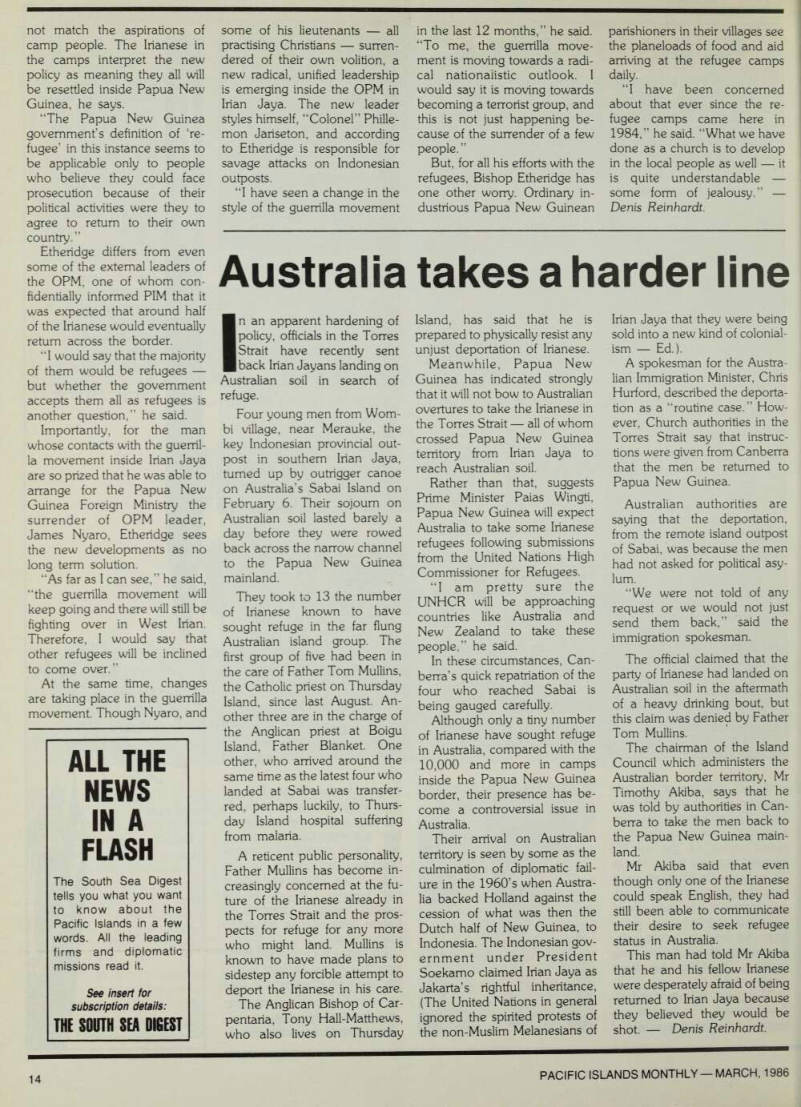
Bishop John Etheridge ... "a tremendous breakthrough."
not match the aspirations of camp people. The Irianese in the camps interpret the new policy as meaning they all will be resettled inside Papua New Guinea, he says.
“The Papua New Guinea government’s definition of ‘re fugee’ in this instance seems to be applicable only to people who believe they could face prosecution because of their political activities were they to agree to return to their own country. ”
Etheridge differs from even some of the external leaders of the OPM, one of whom con fidentially informed PIM that it was expected that around half of the Irianese would eventually return across the border.
“I would say that the majority of them would be refugees but whether the government accepts them all as refugees is another question,” he said.
Importantly, for the man whose contacts with the guerril la movement inside Irian Jaya are so prized that he was able to arrange for the Papua New Guinea Foreign Ministry the surrender of OPM leader, James Nyaro, Etheridge sees the new developments as no long term solution.
“As far as I can see,” he said, “the guerrilla movement will keep going and there will still be fighting over in West Irian.
Therefore, I would say that other refugees will be inclined to come over.”
At the same time, changes are taking place in the guerrilla movement. Though Nyaro, and
some of his lieutenants all practising Christians surren dered of their own volition, a new radical, unified leadership is emerging inside the OPM in Irian Jaya. The new leader styles himself, “Colonel” Phille mon Jariseton, and according to Etheridge is responsible for savage attacks on Indonesian outposts.
“I have seen a change in the style of the guerrilla movement
in the last 12 months,” he said.
“To me, the guerrilla move ment is moving towards a radi cal nationalistic outlook. I would say it is moving towards becoming a terrorist group, and this is not just happening be cause of the surrender of a few people. ”
But, for all his efforts with the refugees, Bishop Etheridge has one other worry. Ordinary in dustrious Papua New Guinean
parishioners in their villages see the planeloads of food and aid arriving at the refugee camps daily.
“I have been concerned about that ever since the re fugee camps came here in 1984,” he said. “What we have done as a church is to develop in the local people as well it is quite understandable some form of jealousy.”
Denis Reinhardt.