pacific report
pp. 7-9 · Read in the full issue
Wolfowitz On
N-Free Zone
The United States recognises the rights of the drafters of the Nuclear Free Zone Proposal, said US Assistant Secretary of State for Asia/Pacific Affairs, Dr Paul D.
Wolfowitz. Speaking via a satellite link to the Sydney conference of the Australian Institute for International Affairs, Dr Wol fowitz, recently nominated as the next US ambassador to Indonesia, said that while there was little nuclear threat in the region it was ”in the common interest to keep it that way.” He also said that small island nations, particularly Micronesia had grown accustomed to a high degree of outside aid. It would take time, he said, for them to achieve their goals.
Meanwhile it was important “that doors not only to the US but to Australia and New Zealand markets are not closed in their faces.” Russell Hunter.
Tunaboat Fees
Fixed By Islands
The Solomon Islands Government in February announced it will impose a fee of $1.5 million a year on any United States tunaboat wanting to fish in its 200-mile exclusive economic zone. A government spokesman said the fee had been confirmed at the recent Forum fisheries talks in Hawaii attended by 16 South Pacific countries. The Solomons figure is the highest in the region: Papua New Guinea is asking $1.3 million per U.S. tunaboat, while the Federated States of Micronesia has set its fee at $1 million. The high fees have been set in response to poaching in the western Pacific. Such activity led to the U.S. boat Jeanette Diana being confiscated by Solomon Islands authorities in late 1984.
It was later resold to its owners for $770,000.
Hayden Raps
Flnks Man
Australia’s Minister for Foreign Affairs Bill Hayden said ir> January that he had nstructed his department to speak to the lead of the FLNKS information office in Australia, John Peu, about comments he A/as reported to have made. Mr Peu had Deen quoted in a newspaper report as suggesting that elements of the New Caledonian independence movement night accept an invitation to visit Libya in xder to “push the Australian Govern nent to take action” in favor of the Kanak struggle. Mr Hayden said that, if re- Dorted accurately, Mr Peu’s remarks were offensive. Referring to Mr Peu’s eported reference to “blackmail of the
Australian Government,” he commented that the government was not in the habit of succumbing to pressures or threat from any quarter. Mr Hayden said he had instructed his department to speak to Mr Peu to seek clarification of his reported remarks, to express the gov ernment’s concern at the statements attributed to him and to remind him once again of the government’s views on the question of New Caledonia. He said that were the government to conclude that the FLNKS representative in Australia was advocating a course which seemed likely to lead to a new level of violence in New Caledonia, the government would have to reconsider its earlier agreement to the establishment in Australia of an FLNKS information office.
‘Lumiere’ Man
Fined Snziooo
Michel Auguste Four, arrested in New Zealand in December for trying to smug gle ammunition to New Caledonia on board the freighter He de Lumiere (PIM Feb p 7), is a former French paratrooper, Auckland police announced on February 4. Four, 29, was convicted and fined SNZIOOO for the offence. The 5500 rounds of ammunition and seven maga zines were found on the ship during a routine Customs search in Auckland.
Four said they had been destined for sale on the black market in New Cale donia.
Nan Madol On
‘Landmark’ List
Pohnpei’s Nan Madol ruins have been designated a U.S. National Historic Landmark by the Secretary of the In terior, according to a letter from Interior Chief Historian Edwin Bearss to Pohnpei Governor Resio Moses. The designation automatically places the property on the National Register of Historic Places, and extends the safeguards and benefits of U.S. historical protection laws to the site,
according to the governor’s office. Com prising 93 islets surrounded by canals, the ruins are constructed of roughly hewn logs of basalt rock. The largest walled complex is about the size of a football field. The walls are as high as six metres, and one basalt log is reported to weigh more than 2300 kg. Archeologists estimate that building of the Nan Madol complex began around 1000 AD and lasted until 1200. The ruins were in use until 1700 and were finally abandoned around 1825. Archeologists say that only a very well-organised society could have planned and executed the con struction.
Forum Group
Visits N-Powers
A delegation of the South Pacific Forum arrived in Washington in mid-February, completing its round of visits to the capitals of the five nuclear weapons powers. Earlier, it had visited Peking, London, Paris and Moscow. The delega tion’s purpose was to explain the pur pose of the Forum’s nuclear-free Pacific treaty, and if possible to persuade the nuclear powers to sign it.
Sydney Festival
Of Pacific Films
Headed simply "Dennis O’Rourke”, a display ad appearing in the Australian weekly The National Times in February was a tribute to this well-known film maker from 46 of his peers, themselves acclaimed producers of documentary films, many of which were shot in South Pacific countries. As the ad stated, it was run to mark the premiere of O’Rourke's latest film, Half Life, which looks at the effects of the US atomic testing program on the people of Rongelap in the Marshall Islands. (Unlike the practice during earlier tests at Bikini, when everyone within a 500 km radius was evacuated, the "Bravo” test of March 1, 1954 was performed regardless of the population on Rongelap, 200 km away); O’Rourke, having interviewed the Islan ders, as well as Americans involved with the hydrogen bomb test, has produced a highly critical and convincing film which suggests that the Marshallese were used as guinea pigs. The film makers’ ad continued: "We congratulate you and your collaborators for your work over the past 10 years. The crisis in the Pacific, which your films reveal with clarity and artistry, is of vital concern. As a film-maker, you have brought in ternational attention to the Pacific region.
We recognise and applaud your achievement”. For the fortnight preced ing Half Life’s premiere at the Sydney Opera House, the first Asia-Pacific Film Festival was staged at the Chauvel Cinema, owned by the government
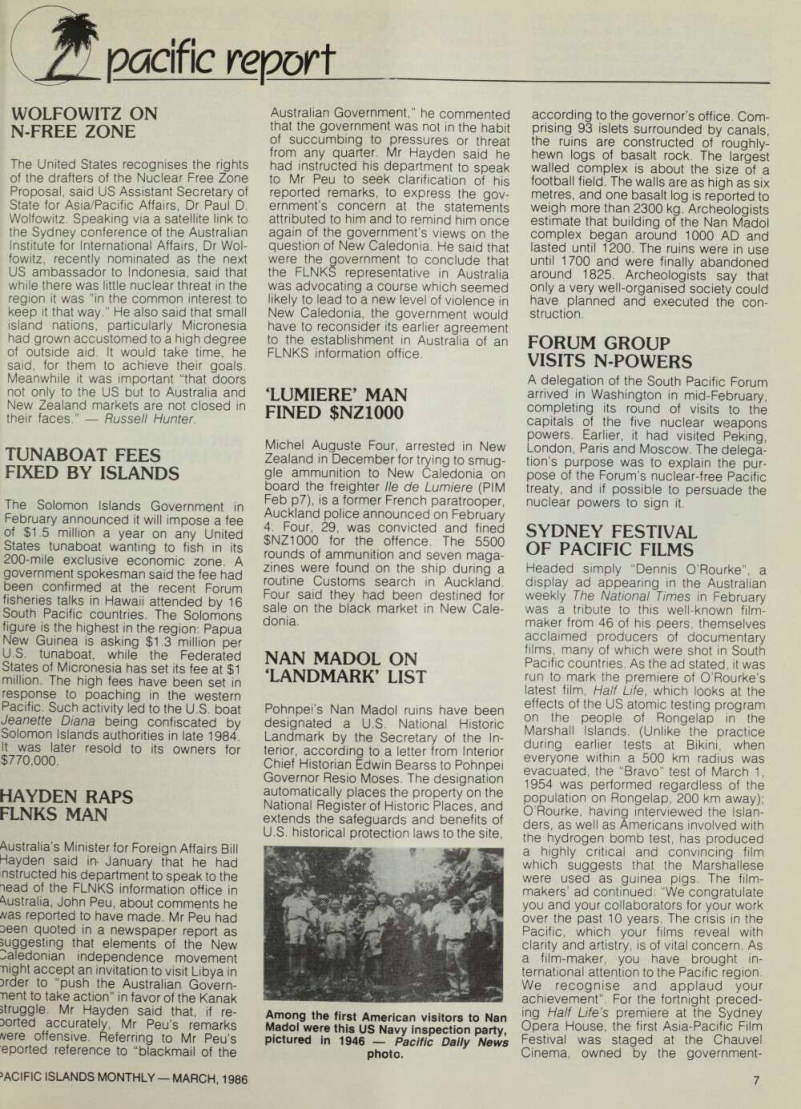
Among the first American visitors to Nan Madol were this US Navy inspection party, pictured in 1946 - Pacific Daily News photo.
funded Australian Film Institute. The festival’s spirit reflected the sentiments expressed in the ad; close co-operation, between both indigenous and European film-makers, geared towards publicising what they saw as the main problems afflicting the Pacific (and, to an extent, Asian) region. In brief, these could be described as the determination of out side peoples mostly, but not exclu sively Western to dominate, even eradicate, the cultural and political rights of the traditional residents of Australia, New Zealand, Papua New Guinea, New Caledonia, East Timor and West Papua (Irian Jaya). Twenty-three films were screened during the festival, mostly documentaries, but with some features.
Well-known visitors included Maori director Merata Mita whose film Patu, about the strong opposition to the 1981 South African rugby team’s tour of New Zealand, received much acclaim (she came to Sydney with assistance from the Australian Film Commission’s Women’s Film Fund); Albert Toro, actor from PNG’s North Solomons province and star of Tukana: Robert Bropho, an
Aboriginal from Western Australia whose Munda Nyuringu (made with Ms. Jan Roberts) documents how the rightful owners of the land where Perth was built became fringe-dwellers; Geoff Murphy, often called New Zealand’s leading director, whose dramatised film Utu portrays the land wars between Maoris and white settlers in the 1870 s; and Dennis O’Rourke, who might be called a visitor because he has spent most of the past decade away from Australia. Two of his films were screened at the festival Couldn’t Be Fairer, about Aboriginal dispossession in north Queensland and Shark Callers ofKontu, looking at the last owners of “shark knowledge” in PNG’s New Ireland province. During his com ments about Shark Callers , Dennis O’Rouke perhaps spoke for all film makers represented in the festival when he said that with “committed” films, as distinct from those made purely with commercial motives, the director usually finds that “the film makes him, or her, rather than vice versa”. Illustrating his point, he explained that while he had initially gone to New Ireland to make a “sort of straight ethnographic film", he
soon realised that the real film lay in the clash between a newly-established fun damentalist Christian sect and the ancient spiritual tradition. “The film be gan to dictate its own direction, quite apart from my original idea. As a film-maker, one has to be sensitive to this and flexible enough to change accordingly." He said that the clash between custom and modernity occurs in every PNG village, and “I could have made a similar film in many places. The only difference is that the shark-calling ritual is a very dramatic symbol of this conflict and was resolved in an unfortun ate way, with the new belief system triumphing absolutely," The shark calling and catching ritual disappeared about two years ago, not long after the film was made. So in one sense, O’Rourke got there just in time, thanks to his friend, local resident Stephen Madana formerly a journalist with the Times of PNG, who alerted the Australian. Even sadder were the films about Pacific peoples colo nised in every sense by alien culture and prohibited, by law and sometimes milit ary power too, from having the right to self-determination. While Aborigines, Maoris and to an extent the Kanaks of New Caledonia can legally protest against their disenfranshisement, and even make films about it, the opportunity is denied to the East Timorese and the Melanesians of Irian Jaya. The Republic of Indonesia insists that the two pro vinces are irreversibly part of the mainly- Asian state, while the people themselves say their birthright, and aspirations, lie to the east, in the Pacific. The films about the 1975 Indonesian takeover of East Timor, which had already declared its independence from colonial Portugal, and the “Transmigration” scheme, which aims to settle millions of people from crowded Java in outlying provinces, including Irian, again raised serious concerns about the plight of the inhabi tants. On behalf of the festival’s organ isers. the Solidarity Network for Asia and the Pacific (SNAP), Bob Burns said the fortnight was highly successful, a con clusion drawn from “the number of bottoms on seats at the Chauvel, and the keen audience participation in the dis cussions which followed the screen ings”. It seems likely that the first Asia-Pacific Film Festival will not be the last, and at this early stage Mr Burns is urging all Pacific film-makers to plan towards participating next year. Robin Osborne in Sydney.
Help For Nz’S
Islander Jobless
A SNZ2.S million increase in funding for the Pacific Islands Employment Deve lopment Scheme has been announced by New Zealand’s Minister of Pacific Island Affairs, Richard Prebble. “The PI EDS is a pilot project which uses the potential of island communities to help solve the problems of high unemploy ment experienced by Pacific Island people resident in New Zealand,” said Mr Prebble. “The Pacific Island com munities have reacted very positively to
the $250,000 granted to the scheme in 1985. A wide range of worthwhile pro posals have come forward. Funds for REDS will be distributed through the Pacific Island Employment Development Board. The board will examine projects proposed, allocate the funds and moni tor and evaluate the scheme.” The government has called for nominations for the board, which will have up to six members drawn from the Pacific Island communities. It is particularly looking for people with experience in business, or in employment issues.
Malaria Shake-Up
In Png
A new policy to control malaria in Papua New Guinea is to be introduced by provincial governments at a cost of about SA3 million. Under the program, anti-malarial drugs will be distributed to all major hospitals, health centres and rural aid posts. In addition, the health department has decided to reintroduce DDT spraying, which was abandoned some years ago because of its high cost.
The spray will be used in the Highlands and coastal regions where the health department considers it most effective.
Air Pacific
To Upgrade?
The chief executive of Air Pacific, Mr John Schaap, has said that the airline’s economic performance this year would depend on increased tourist traffic in the region. Mr Schaap said if forecasts that more tourists would visit the southwest Pacific in 1000 were correct, then this would be reflected in a rise in passenger traffic. This would allow the airline to upgrade existing services and strengthen the management team. Air Pacific is being managed by Australia’s overseas airline, Qantas, under a three year contract.
Qantas Girds
Up For Fight
Australia’s overseas airline, Qantas, is preparing for a possible price war on Pacific routes as the giant American company, United Airlines, takes over the services of Pan American in the region.
Following the deal to take over Pan Am’s Pacific routes, United begins services in 1986. A Qantas spokesman said an airfare price war could not be not be ruled out after United settled into its new routes. He said the Pacific routes repre sented only three per cent of United’s total operation, and the company could afford to take on Qantas, which holds 30 per cent of the market. However, the spokesman said he believed Qantas would be prepared to match any price reductions that United may offer.
Sir Vijay Singh
Explains ...
The chief executive of the Fiji Cane Growers’ Council, Sir Vijay Singh, bought half: a page in The Fiji Times of January 17 to put his version of what he
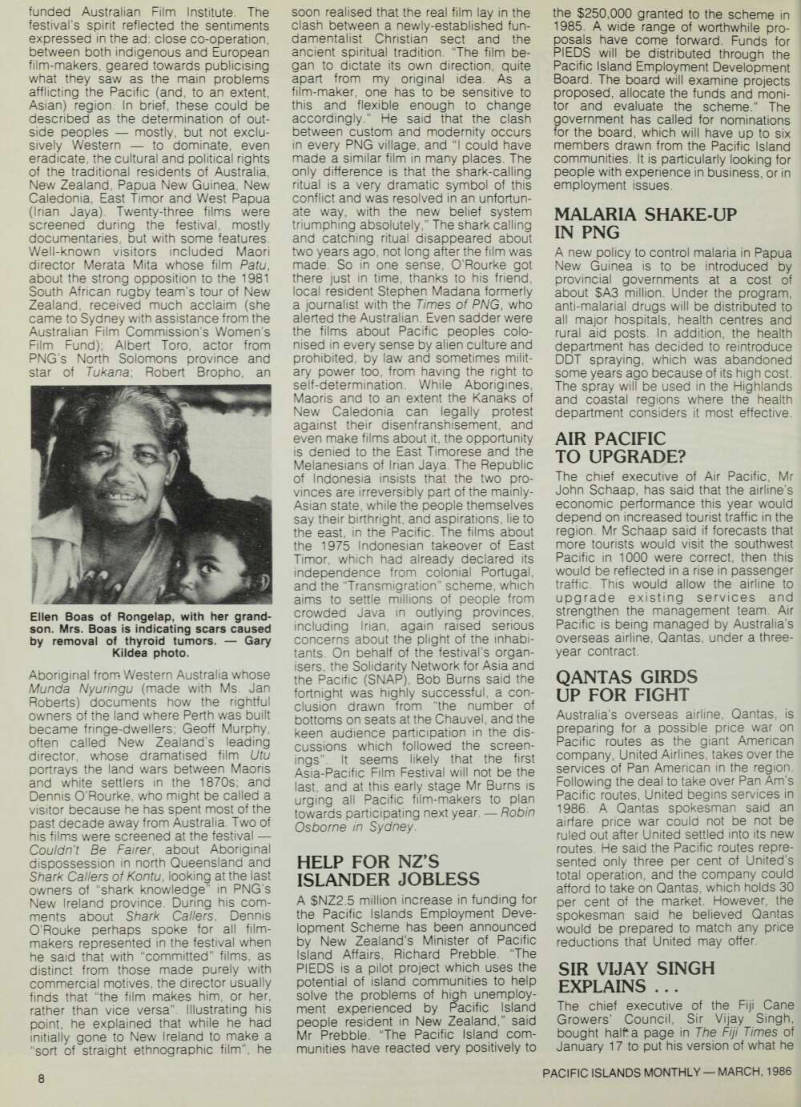
Ellen Boas of Rongelap, with her grand son. Mrs. Boas is indicating scars caused by removal of thyroid tumors. - Gary Kildea photo.
described as “sensational” articles in the newspaper concerning the purchase of his “company car.” (See page 41 this issue). He said the Council had ordered a Toyota Crown Super saloon for him but that on second thoughts he had decided it might “appear ostentatious.” He went on to explain that he did not wish to give the impression that the executive of the Council sat in air conditioned offices in Suva while the farmers themselves sweated it out in the fields. Consequent ly, he said, he had decided that Mr Bahn Singh, the other senior executive, should also be given a car so that he could join
in Sir Vijay’s effort to establish close communication with growers and pro vide them with the support they needed.
Indeed, said Sir Vijay, his board of directors had decided it was important that cane farmers be advised to find other crops to widen their financial base and lessen their vulnerability to the vagaries of the world sugar market. It was highly likely, therefore, he indicated, that the aid personnel, as he described them, would also need transport. Sir Vijay’s disappointment with The Fiji Times extended further, he said, and involved their articles saying that some cane growers were ploughing in their crops. This was not true, he said. A further story suggesting that some cane farmers were calling for the disband ment of the Council was also incorrect, Sir Vijay asserted. “The plight of the farmers is real and grave indeed,” wrote Sir Vijay. “We need to consider calmly and rationally the means at our disposal for helping them, and ... the SCGC would welcome constructive proposals. The Fiji Times is as welcome as anyone to offer suggestions that would alleviate the cane farmers’ hardship. So far it has not done so.” In a footnote to the report covering Sir Vijay’s complaints about the newspaper’s coverage the editor com mented: “ The Fiji Times stands by its reports.”
Big Air Terminal
Project In Pohnpei
[he state of Pohnpei in the Federated States of Micronesia is to build a nulti-mitlion dollar international airport. \ statement from the Pohnpei gov ernors office said the new air terminal vas being built in an effort to attract ivestors, tourists and visitors. It said the :ost of the project would be about >USI4 million, and construction was 'xpected to take a year to complete, he statement said funds for the terminal /ould be made available by the U.S.
Federal Aviation Authority and the De partment of Interior, as well as the Pohnpei state.
Indonesia-U.S.
Aircraft Deal
The United States has promised to buy Indonesian-made small planes for use by its Pacific Island territory, Guam. The official Indonesian newsagency, Antara, said a memorandum of understanding had been signed for the purchase of the 18-seater CN-212. Indonesia produces the plane under licence from the Span ish company Construcciones Aeronauti cas. Antara did not say how many aircraft were involved in the agreement, but it noted that the deal was subject to approval by the U.S. Federal Aviation Authority.
French Ship
For Ccof/Sopac
One of France’s most advanced ships, the Jean Charcot, has arrived in the South Pacific to conduct surveys around Fiji, Tonga, Vanuatu and Tahiti. The French Embassy in Suva, where the ship is berthed, said a series of five cruises would yield data about mineral re sources in the economic zones of Fiji, Tonga and Vanuatu, and an assessment of the level of hydrothermal activity around Fiji and Tonga. The Jean Char cot is working under the sponsorship of the Committee for the Co-ordination of Joint Prospecting for Mineral Resources in the South Pacific Offshore Area (CCOP/SOPAC), an agency operated by Pacific Island governments.
France, Fiji In
Ethnology Study
A three-year research program on Fijian ethnology undertaken in co-operation with the French Government has been completed. At a brief ceremony in Suva in January the French Ambassador to Fiji Daniel Dupont presented the govern ment with more than 1300 cassettes and transcripts of Fijian customs and tradi tions. They were compiled by Dr Solange Petit-Skinner who was in charge of the project. The presentation also included a book entitled Fijian Protocol, by Dr Petit-Skinner.
Suva Independents
To Join Labour?
The five independent councillors on Suva City Council are planning to join the Labour Party. Four of the five held a lengthy secret meeting with the Labour Party's senior officials on January 31, at the party’s headquarters in Suva. At the meeting were Independents Cr Navin Maharaj, Cr Navin Chandra, Cr Ashok Patel and Cr R, D. Patel. Cr Pramod Kapadia was missing. Representing the
Labour Party were its president, Dr Timoci Bavadra, the Labour Lord Mayor of Suva, Cr Bob Kumar, assistant secre tary Mahendra Chaudhry, vice-presi dent Dr Tupeni Baba, vice-president Joeli Kalou, and Mrs Emma Druavesi.
The meeting discussed the terms both sides will have to agree to if the Independents were to join Labour,
Isabel Province
Makes Request . ..
Premier Jason Leguhavi of Solomon Islands’ Isabel Province has asked the Australian Conservation Foundation for advice on how to enact legislation that will ensure protection of the environ ment, control land use and deve lopment, and prevent unwanted incur sions by trans-national companies. The province is one of the largest in the Solomons, and also one of the least
developed. Mr Leguhavi is a former schoolmate of Premier Job Dudley Tausinga of Western Province, which contains the islands of New Georgia and Kolombangara, scene of the major log ging activities of Pacific Lever Timbers.
Writing in the ACF journal Habitat, Fred Sargent says: “Locals in New Georgia in 1984 took direct action against PLT which led to the destruction of a million dollars worth of PLT equipment ... Mr Tausinga was elected to the provincial assembly on the issue of conservation and is the founder of the country’s first conservation group.”
Png, Israel, To
Swap Envoys
Papua New Guinea and Israel are to exchange resident ambassadors in the near future, an Israeli Foreign Ministry official said in Jerusalem. The official was briefing reporters on talks between the Israeli Foreign Minister, Yitzhak Sha mir, and the visiting former PNG Prime Minister, Michael Somare.
Fiji Nudges
700.000 According to an estimate prepared by the Fiji Bureau of Statistics, Fiji’s popula tion at the end of 1984 had increased by 13.000 in the course of the year to 691,000, with Indians comprising half the population, indigenous Fijians 45 per cent, and all others five per cent.
Crown departing?
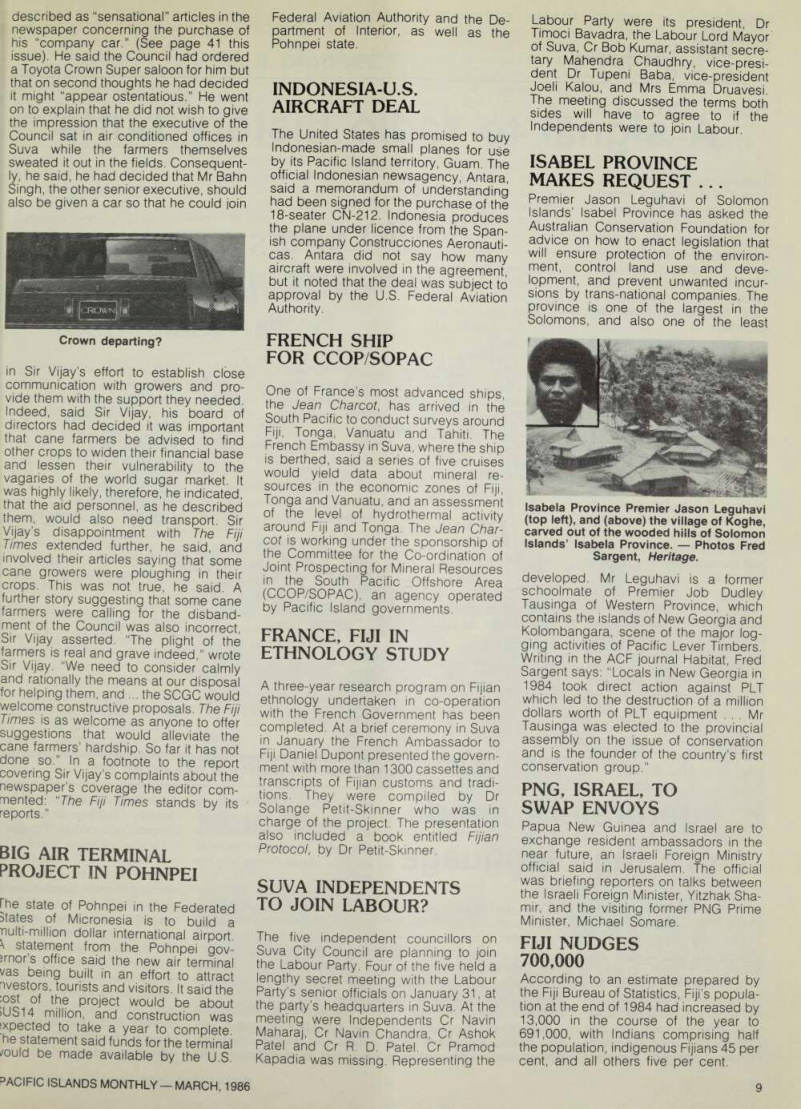
Isabela Province Premier Jason Leguhavi (top left), and (above) the village of Koghe, carved out of the wooded hills of Solomon Islands’ Isabela Province. Photos Fred Sargent, Heritage.