Pitcairn jetty
pp. 25-26 · Read in the full issue
the month
Fragile Link
The saga of the Pitcairn jetty
What made the Bounty mutineers choose Pit cairn back in 1790 was its isolation and inaccessibility. Their choice was judicious, as shown by the fact that their hiding place was not discovered until 18 years later.
Today, however, this original asset has become the most serious liability for the fewer than 50 descendants living on the two-mile-long, one-mile wide rock.
The most serious complaint of the Pitcairners concerns the tremendous difficulties they often have in unloading cargo and passengers from passing ships. We published not long ago (PIM Sept. ’B3, p 23) an account of the risks and hard ships the islanders must endure trying to steer their undecked longboats through the boister ous seas of Bounty Bay which, in fact, is nothing but a tiny indentation in the straight, boul der-strewn northern coastline.
It is little wonder that the islanders worry about how to cope with accidental injuries and medical emergencies. For as things stand the outcome of such events depends mainly on the chance of having the patient picked up by a conveniently passing vessel, and then surviv ing the long trip to Tahiti or New Zealand.
All sorts of schemes have been proposed to improve Pit cairn’s communications with the outside world. The wildest, and therefore the most publicised, was hatched in 1982, when the self-styled “hill billy millionaire from the back woods of Virginia”, “Smiley”
Ratcliff Jr., declared himself willing to pay for an internatio nal airport on the raised Hen derson atoll, 103 nautical miles north-east of Pitcairn (and part of the dependency). From there, the intrepid air travellers were to be ferried across to Pitcairn by a fleet of helicopters, also provided by “Smiley”.
As the administering British Government soon found out, no major airline was in the least interested in opening a regular service to this lonely outpost, in
spite of its undoubted romantic appeal. It also became clear that even a genuine American multi-millionaire would be un able to meet the staggering costs of such a crazy enterprise.
A more feasible and consid erably cheaper solution, which for a long time has been (so to speak) in the air, would be to link Pitcairn with the eastern most island in French Polynesia, Mangareva, which has a full-scale international airport regularly serviced from
Tahiti. The cost of building an airstrip on Pitcairn Island to establish such a 515-kilometre air link with Mangareva, using 12 or 24-seater planes, would, of course, be much less prohibi tive.
The catch here is that the only suitable level site on Pit cairn is the fertile farmland in the half-mile-wide Aute Valley.
But perhaps this difficulty should not be taken too seriously given that the Pitcair ners have long been living mainly on imported food, which costs them about $U525,000 a year money they earn from sales of their carvings and stamps. It can even be argued that this income could be greatly increased if and when a regular air service began bringing in tourists to be lodged, naturally, in a locally operated Bounty Hotel, with a fully licensed Bloody Bligh bar and lounge . . .
In its infinite wisdom the British Government decided back in the 1970 s to go slow on any tourist development scheme, and instead to give top priority to the strengthening of Pitcairn’s lifeline, i.e., the con struction of a jetty in Bounty Bay, where the islanders were still crashlanding on the rocky beach, and in between landings spending inordinate time on boat repair work. The task was entrusted to a team of Royal Engineers, who disembarked at the end of May, 1976 and promptly hired the whole avail able male work force, consisting of the 18 adult men.
The blueprint used by the commanding officer was as straightlined and square as an
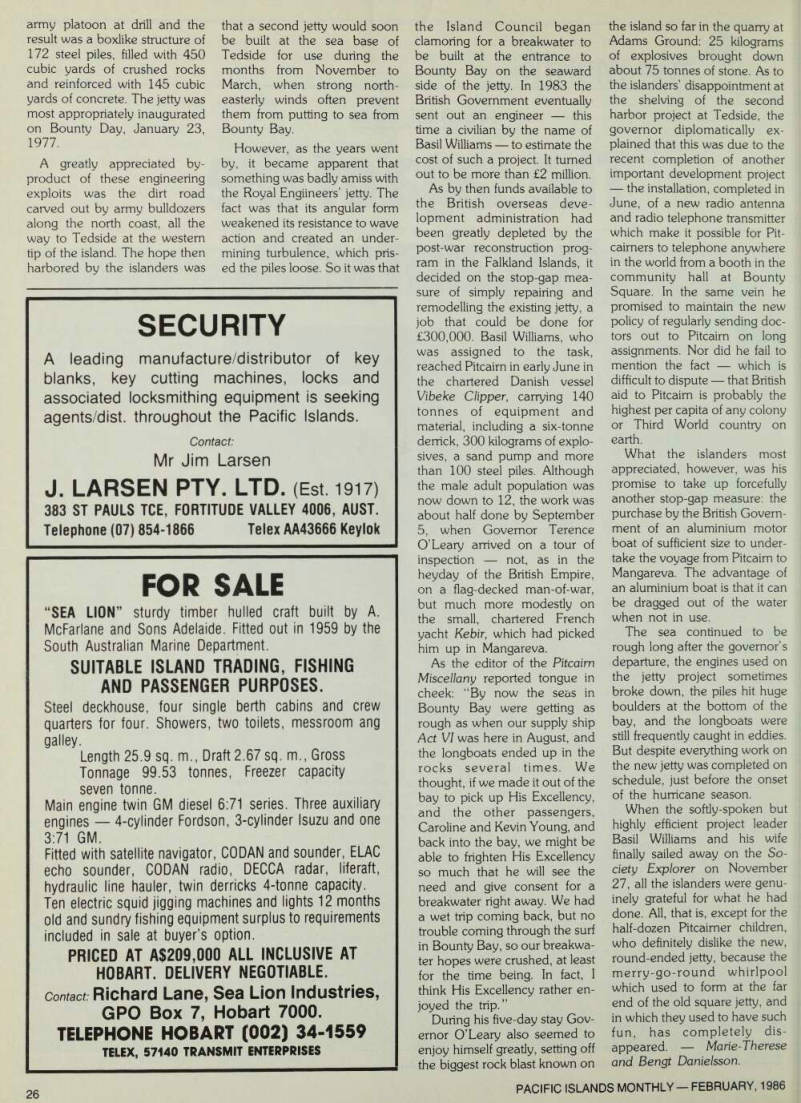
The Pitcairn Island jetty built by the Royal Engineers in 1976. Its square shape caused turbulence in the surrounding water, which eventually undermined it. Above: The remodelled jetty, with its rounded form, has caused the old whirlpool to disappear. Only the half-dozen Pitcairner children are complaining ...
army platoon at drill and the result was a boxlike structure of 172 steel piles, filled with 450 cubic yards of crushed rocks and reinforced with 145 cubic yards of concrete. The jetty was most appropriately inaugurated on Bounty Day, January 23, 1977.
A greatly appreciated byproduct of these engineering exploits was the dirt road carved out by army bulldozers along the north coast, all the way to Tedside at the western tip of the island. The hope then harbored by the islanders was
that a second jetty would soon be built at the sea base of Tedside for use during the months from November to March, when strong north easterly winds often prevent them from putting to sea from Bounty Bay.
However, as the years went by, it became apparent that something was badly amiss with the Royal Engineers’ jetty. The fact was that its angular form weakened its resistance to wave action and created an under mining turbulence, which pris ed the piles loose. So it was that
the Island Council began clamoring for a breakwater to be built at the entrance to Bounty Bay on the seaward side of the jetty. In 1983 the British Government eventually sent out an engineer this time a civilian by the name of Basil Williams to estimate the cost of such a project. It turned out to be more than £2 million.
As by then funds available to the British overseas deve lopment administration had been greatly depleted by the post-war reconstruction prog ram in the Falkland Islands, it decided on the stop-gap mea sure of simply repairing and remodelling the existing jetty, a job that could be done for £300,000. Basil Williams, who was assigned to the task, reached Pitcairn in early June in the chartered Danish vessel Vibeke Clipper, carrying 140 tonnes of equipment and material, including a six-tonne derrick, 300 kilograms of explo sives, a sand pump and more than 100 steel piles. Although the male adult population was now down to 12, the work was about half done by September 5, when Governor Terence O’Leary arrived on a tour of inspection not, as in the heyday of the British Empire, on a flag-decked man-of-war, but much more modestly on the small, chartered French yacht Kebir, which had picked him up in Mangareva.
As the editor of the Pitcairn Miscellany reported tongue in cheek; “By now the seas in Bounty Bay were getting as rough as when our supply ship Act VI was here in August, and the longboats ended up in the rocks several times. We thought, if we made it out of the bay to pick up His Excellency, and the other passengers, Caroline and Kevin Young, and back into the bay, we might be able to frighten His Excellency so much that he will see the need and give consent for a breakwater right away. We had a wet trip coming back, but no trouble coming through the surf in Bounty Bay, so our breakwa ter hopes were crushed, at least for the time being. In fact, I think His Excellency rather en joyed the trip.”
During his five-day stay Gov ernor O’Leary also seemed to enjoy himself greatly, setting off the biggest rock blast known on
the island so far in the quarry at Adams Ground: 25 kilograms of explosives brought down about 75 tonnes of stone. As to the islanders’ disappointment at the shelving of the second harbor project at Tedside, the governor diplomatically ex plained that this was due to the recent completion of another important development project the installation, completed in June, of a new radio antenna and radio telephone transmitter which make it possible for Pit cairners to telephone anywhere in the world from a booth in the community hall at Bounty Square. In the same vein he promised to maintain the new policy of regularly sending doc tors out to Pitcairn on long assignments. Nor did he fail to mention the fact which is difficult to dispute that British aid to Pitcairn is probably the highest per capita of any colony or Third World country on earth.
What the islanders most appreciated, however, was his promise to take up forcefully another stop-gap measure; the purchase by the British Govern ment of an aluminium motor boat of sufficient size to under take the voyage from Pitcairn to Mangareva. The advantage of an aluminium boat is that it can be dragged out of the water when not in use.
The sea continued to be rough long after the governor’s departure, the engines used on the jetty project sometimes broke down, the piles hit huge boulders at the bottom of the bay, and the longboats were still frequently caught in eddies.
But despite everything work on the new jetty was completed on schedule, just before the onset of the hurricane season.
When the softly-spoken but highly efficient project leader Basil Williams and his wife finally sailed away on the So ciety Explorer on November 27, all the islanders were genu inely grateful for what he had done. All, that is, except for the half-dozen Pitcairner children, who definitely dislike the new, round-ended jetty, because the
merry-go-round whirlpool
which used to form at the far end of the old square jetty, and in which they used to have such fun, has completely dis appeared. Marie-Therese and Bengt Danielsson.