Aviation rivals vie for
pp. 22-24 · Read in the full issue
Battle Of The Airlines
Aviation rivals vie for Pacific Iinks
When the prime minis ter of New Zealand, Mr David Lange, stepped off the Air New Zealand Boeing 747 at Faleolo airport in December for the official opening of the air port extensions, the one key question question was brushed aside in what some saw as evidence of a certain pomposity from which the leader has lately been seen as occasionally suffering.
A Samoan reporter had asked, in line with keen local speculation, whether Mr Lange had come to buy Polynesian Airlines for Air New Zealand.
The brush-off was swift: “No.
And I have not walked on water to get here, either,” said the prime minister.
Subsequent events show that the diligent Samoan reporter was on to a good thing. Air New Zealand had not only expressed interest in the Auckland-Apia route, but had gone so far as to give the Western Samoan gov ernment a set of options for a virtual take-over of the service.
Aviation industry-watchers thus assume that Air New Zea land is seeking to clip Ansett’s wings on that route at least (bearing in mind also that Ansett has reached agreement with the Cooks Islands govern ment to run their airline, starting about April) and has apparently put in a bid to provide the sort of management and aircraft leasing role that Ansett current ly provides with Polynesian Air lines.
With Auckland now playing host to the largest Polynesian population in the world, the air route from Apia carries about 25,000 passengers a year on four Boeing 737 flights a week,
two of them operated by Polynesian, and two by Air New Zealand.
About three months ago Ansett, which provides techni cal and management support for Polynesian Airlines, pre sented the Samoan govern ment with a new proposition based upon use of a Boeing 767. Now that Faleolo airport has been upgraded Ansett is very keen to use this much larger and more modem twin jet type on the Pacific routes, for reasons of efficiency and profitability.
Cook Islands International Airlines (C.1.1.A.), will use the aircraft, and it would make sense if Polynesian shared the type. In that fashion Ansett’s sales organisation could con ceivably offer a one-stop Boeing 767 service from Syd ney through to Tahiti with passengers going out of Austra lia on a CL LA. flight and joining a Polynesian flight in Rarotonga. The larger, wide bodied jet would be more attractive to tourists, better able to cater to larger tour groups, offer greater freight capacity and would be more efficient to operate.
Additionally there is the possibility of such a network being expanded quite consider ably by extending the routes to take in Hawaii. On this there might be a problem with what civil aviation authorities call their “90-minute rule,” which says that no twin-jet may oper ate on a route which takes it further than 90 minutes from an adequate alternate airfield, but there is pressure from the in ternational airlines and aircraft manufacturers to amend this standard. Several of the cur-
rently most popular aircraft in the world, the Boeing 767, Boeing 757 and Airbus 320, are all twin-jets of great reliabil ity and efficiency.
Ansett apparently has told the Western Samoan govern ment that it would require the assurance of a 10-year operat ing contract if it were to set about establishing a link with Hawaii. Given the number of Samoans now in Honolulu, and the high hopes of the govern ment of establishing trade in fish and fresh vegetables with the lucrative Hawaiian hotel
and restaurant trade, such a condition might not be seen as any great impediment to a deal.
But, back in Air New Zea land’s headquarters, a number of highly-competitive execu tives have been watching Ansett’s steady expansion into the South Pacific with very sharp eyes and are pushing their airline and their govern ment to do something about what they regard as an invasion of their especial territory. Air New Zealand’s slogan is, they point out, “The Pacific’s Num ber One.”
Thus they listened warily when Cook Islands prime minister, Sir Thomas Davis, breezed through Auckland on his way to Sydney and talks with Ansett’s top management about the finer points of the C.1.1.A. deal. Thomas spoke of a regular Sydney-Rarotonga service, a possible extension to North America (possibly through Papeete), and, the big bombshell for Air New Zealand
(sharing of the Auckland-Raro tonga service).
Air New Zealand, which also operates Boeing 7675, has already announced plans to provide four flights a week from Auckland to Rarotonga as soon as all their new aircraft are in service.
Sir Thomas believes C.1.1.A. will have the right to share the available traffic with Air New
Zealand, i.e. to run two of the projected four Boeing 767 flights. He reasons that since the Cook Islands has now taken over from New Zealand re sponsibility for its civil aviation that it has full right to apportion its international landing rights.
New Zealand’s minister for transport, Richard Prebble, re sponded sharply, leaving few in any doubt about his thoughts on that idea, and on Ansett’s Pacific Island surrogate airlines.
New Zealand would be total ly opposed to any proposals for Ansett to fly that route as C.1.1.A. or in any other guise, he said. Nor did the Australian government recognise Ansett as an international airline, he said.
Industry observers riposted that what Mr Prebble thought was only one facet of a very complicated situation in which sovereign Pacific island nations might get considerably humpty if anyone tried to put a spoke in their ambitions and aspirations, not to mention their pride in having their very own in ternational airline in their very own livery.
But, as everyone in the travel industry recognises now, if all of its innovative plans bear fruit, Ansett stands to develop a very extensive network of trans pacific air services at a time when international interest in the region is growing very rapidly.
Transport industry commen tators point out that Ansett’s recent efforts seem to be follow ing the pattern established years ago by Thomas Nation wide Transport, which is one of the major shareholders in Ansett Transport Industries. Sir Peter Abeles, boss of TNT, first made his name in Australian trans-continental trucking and then in international shipping by similar techniques. He has many financial interests now but says firmly whenever he is asked that transport in all its forms is his major occupation and that he will continue to develop that aspect of his enter prises so long as he continues to work.
Before taking over the Union Steam Ship Company of New Zealand Sir Peter’s freight for warding business in that coun-
try had sound control of much of the trans-Tasman cargo, put ting freight forwarders in the somewhat unusual position of being able to call a few shots with shipping companies.
No one has suggested that Ansett will eventually gobble up the airlines it now operates for island governments. While the arrangements have sometimes developed hiccoughs, the gen eral impression is that Ansett runs a very efficient operation, is conscious of the benefits of cooperating with island govern ments, and that few would do as well as they continue to do.
Indeed, Ansett has embarked on a major program of offering “off-the-shelf” airlines all around the world, and has had talks with people in India, East Asia, the U.S., and elsewhere, including China.
They have world-wide book ing networks and sales agents and, from their Ansett Airlines base, can offer a degree of knowledge and technical and management expertise which no island government could build on its own, as Fiji disco vered with its brave, but un fortunate, experiment with a DC-10 service to Hawaii.
A weakness in Mr Prebble’s case is that it appears to depend upon the proposition that Air New Zealand has given the Western Samoan government.
Does Air New Zealand want to do an Ansett with Polynesian Airlines? Air New Zealand will not disclose what it has offered and neither will the Samoan government until the matter has been considered.
(And, given the sudden change of prime ministers in Western Samoa while the rest of the world digested its Christ mas dinner, very little may be taken for granted in Apia these days).
However, it is understood that Air New Zealand’s has offered a variety of options based on the use of different types of aircraft - presumably Boeing 737, 767 and 747, the types currently operated by Air New Zealand - and some alternative runs and connec tions.
The extension of Faleolo Air port to take larger wide-bodied jets has prompted these moves and it may be useful to record that aid for this project came from three sources Australia, Japan and New Zealand.
There are no public sugges tions that Japan is about to get landing rights in Samoa for Japan Air Lines or any other Japanese airline, although the keen interest being shown by the domestic carrier, All Nippon Airlines, in southern internatio nal routes is well noted. Former prime minister Tofilau Eti Alesa na was among those who be lieved that flights to Japan, as well as to Honolulu and further east should be planned. “But probably charter flights first,” he said recently. There was similar talk in airline circles in Tokyo a few months ago.
But, before either Samoa, or the Cooks for that matter, can properly develop their airlines they will need somewhere to put the passengers. Both coun tries need more hotels and better and better facilities for tourists. Neither has anything like the plant required to attract major Japanese, American, or even Australian, tour groups.
Much discussion has gone into the topic, and several plans have been mooted in both countries.
The enormous, and prosper ous, population of Japan appears to be the key to this further, needed, development.
There is a demand there for new destinations and a market could be fairly rapidly esta lished, say tourist industry ex perts.
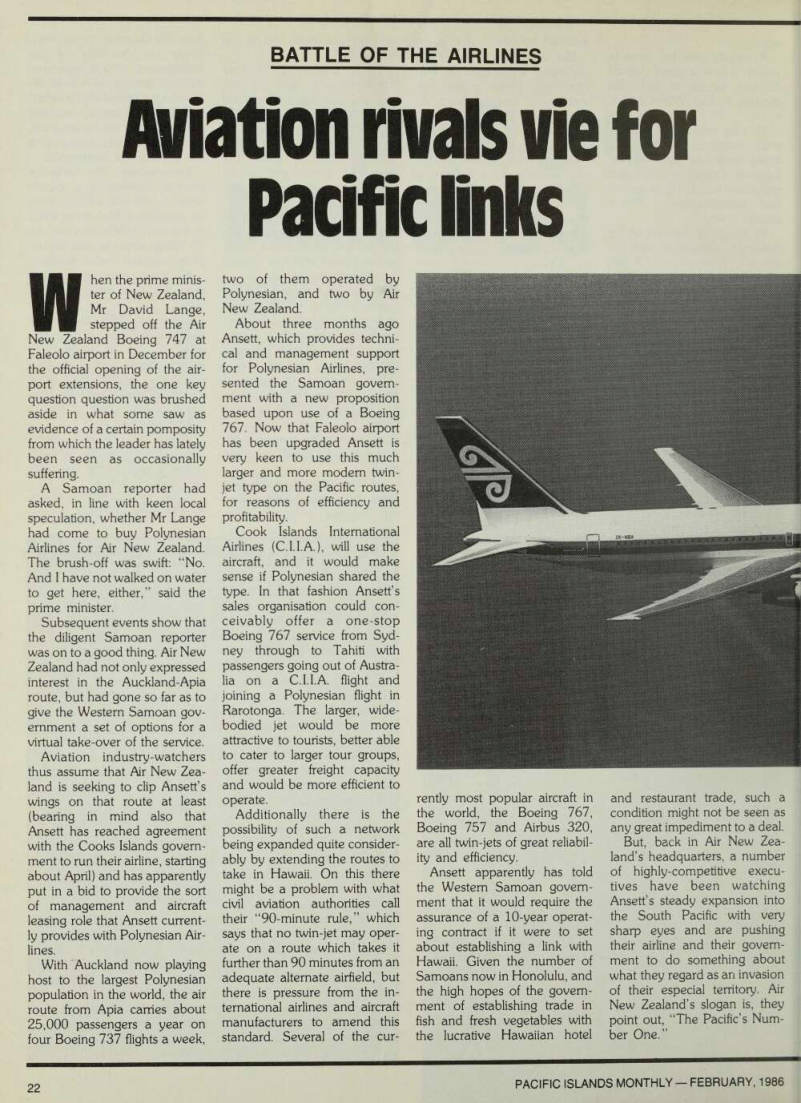
Air New Zealand was first into the Pacific with Boeing 767 airliners, the type Ansett will provide for Cook Islands In ternational Airlines. Qantas has also bought the type.
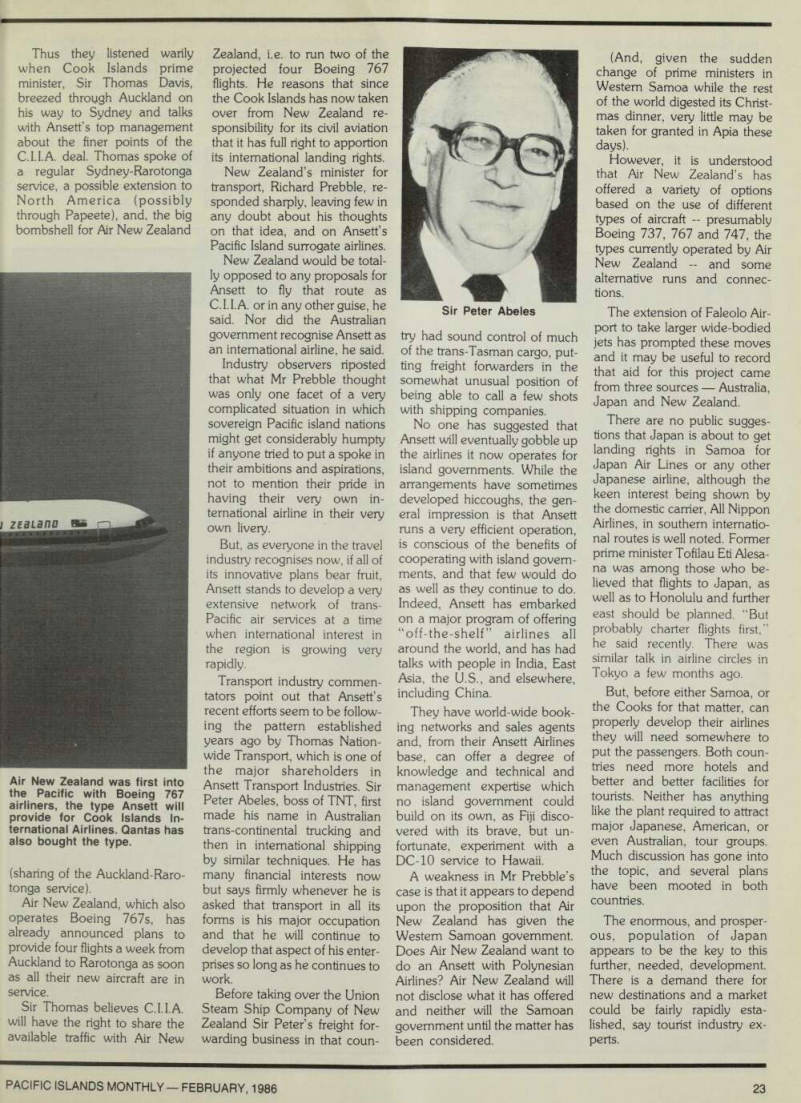
Sir Peter Abeles
But, as anyone who has dealt with them will attest, Japanese tourists are demanding and very quality-conscious. They like tour coaches to be precisely on time, to the minute, not the half-hour, hotel staff to be po lite, quick, and efficient, drinks to be cold and food to their taste, rooms to be spotlessly clean and fully-equipped, down to slippers and clean-pressed
yu/cata (cotton robes always provided in even the cheapest Japanese inn).
None of these things are impossible for the Pacific, and if the Japanese decide they like a place, then they can visit by their thousands. Millions of Japanese, and especially honeymooners, have a lotus eating vision of the Pacific as a region of space, sunshine,
diamond-white beaches, sake clear waters, beautiful coral reefs, and smiling friendly people all the things they find so hard to get in their own crowded, organised, industrialised, high-technology homeland.
The Japanese have already discovered Queensland, New Zealand, New Caledonia (although the political trouble
has put that into the back ground to a large extent), and Fiji. They are beginning to find Tahiti, although the airline links are more difficult for them. If on-ground facilities can be pro vided there would appear to be no reason why Western Samoa and the Cook Islands should not be next on the list. Roy Vaughan in Auckland and Staff Writers in Sydney.