haunt Wingti
pp. 20-21 · Read in the full issue
Opm Digs In
Han Jaya refugees haunt Wingti
Ten thousand border crossers can’t be wrong or can they?
Villagers from Irian Jaya who have fled to camps along the PNG border claim their homes and food gardens have been destroyed by In donesian soldiers carrying out reprisal raids in the hunt for Free Papua Movement (OPM) guerrillas. They tell of being sprayed by indiscriminate machinegun fire and claim they will be killed if they return.
But others claim the camps are merely a useful breeding ground and hiding place for the rebels and a “safe” area for their families. To prove it, they point to the attack on an In donesian fact-finding delega tion last year at Blackwater, one of the jungle camps.
This is the continuing dilem ma facing the PNG government as it tussles with a legacy of colonialism that has turned into a thorn in the flesh; the border which has divided a Melanesian land in two and put half under Indonesian rule.
The very human problem of 10,000 people living in the makeshift camps the number has gradually swelled since trouble flared two years ago and the activities of the OPM has now landed in the laps of Paias Wingti and Sir Julius Chan, successors to the former government of Michael So mare.
Mr Somare’s cabinet handled the border issue very gingerly, realising the delicacy of the domestic political problem it presented to a government far from sure of its numbers in parliament and very aware of the trouble it could make for itself by appearing either too
conciliatory towards the In donesians, or too welcoming to the OPM.
Mr Wingti has pledged to take action on the border crossers but has already indicated they would be en couraged to return.
“We hope to be able to formulate a phased and co operative program for the reintegration of Irian Jayan bor der-crossers into their families,” he said.
The government would de monstrate firmness of purpose but care and compassion, he said, adding that no genuine refugee would be forced to return against his or her will.
This is not so very different from statements made by the former Somare government, although it appeared to be split on the issue. The then Foreign Minister, Rabbie Namaliu, said Australia and other countries should take some responsibility, while Somare himself main tained it was a problem for PNG and Indonesia alone and would be solved without out side help.
However, a submission to Wingti’s National Executive Council by the present foreign minister, Legu Vagi, in Decem ber was rejected as “the same old stuff as presented to So mare. ” He was ordered to draw up a new one.
The rejected submission in cluded, among other things, a call to settle some crossers in
Png.
There is no doubt that such a move would be a popular electoral decision in PNG. De spite assurances from Jakarta that no harm would befall any crossers who returned, many Papua New Guineans remain
very sceptical.
They believe their Melane sian brothers are suffering under the continued influx of transmigrasi (transported im migrants) from Java who are robbing them of their land and the chances of jobs and ad vancement in Irian Jayan cities.
Politicians report that many villagers in border electorates have offered to give land to Irian Jayans if they are allowed to settle in the country.
But if the 10,000 now camped along the length of the east-west border are allowed to stay, how many more might follow in search of a “better life” on the PNG side?
The way out for the politi cians when there are no palat able solutions to a problem is simply to use the old diplomatic
ploy of doing nothing: sit tight until something happens to force your hand. That is what Somare did for over a year.
Meanwhile, one orders in quiries, consults experts and petitions other countries.
Wingti’s government appears to be following a similar path.
Unlike the economic problems at home, to which the new prime minister immediately took the surgeon’s knife, cutting out at least some of the cancer ous waste in public spending, the border problem is, accor ding to Mr Vagi, “complex and sensitive and requiring a care ful, cautious approach.”
The border was one issue on which Mr Wingti, who had not hesitated to sally forth to the attack while in Opposition, had remained uncharacteristically
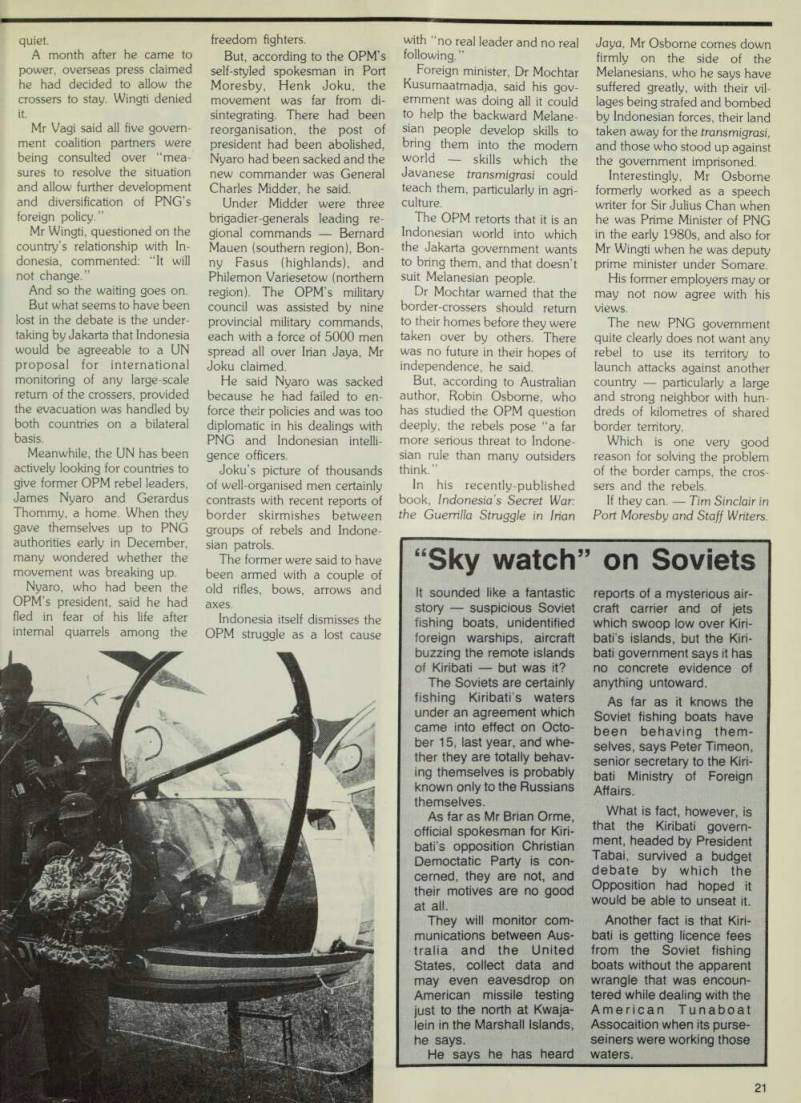
Few photographs are available of the men Indonesia sends to Irian Jaya. This is one, from the excellent book, The Lost World of Irian Jaya by Robert Mitton. He notes: “The army act like bandit dictators. They have instruc tions from Jakarta to ‘civilise’ the people ..."
quiet.
A month after he came to power, overseas press claimed he had decided to allow the crossers to stay. Wingti denied it.
Mr Vagi said all five govern ment coalition partners were being consulted over “mea sures to resolve the situation and allow further development and diversification of PNG’s foreign policy.”
Mr Wingti, questioned on the country’s relationship with In donesia, commented: “It will not change.”
And so the waiting goes on.
But what seems to have been lost in the debate is the under taking by Jakarta that Indonesia would be agreeable to a UN proposal for international monitoring of any large-scale return of the crossers, provided the evacuation was handled by both countries on a bilateral basis.
Meanwhile, the UN has been actively looking for countries to give former OPM rebel leaders, James Nyaro and Gerardus Thommy, a home. When they gave themselves up to PNG authorities early in December, many wondered whether the movement was breaking up.
Nyaro, who had been the OPM’s president, said he had fled in fear of his life after internal quarrels among the
freedom fighters.
But, according to the OPM’s self-styled spokesman in Port Moresby, Henk Joku, the movement was far from di sintegrating. There had been reorganisation, the post of president had been abolished, Nyaro had been sacked and the new commander was General Charles Midder, he said.
Under Midder were three brigadier-generals leading re gional commands Bernard Mauen (southern region), Bon ny Fasus (highlands), and Philemon Variesetow (northern region). The OPM’s military council was assisted by nine provincial military commands, each with a force of 5000 men spread all over Irian Jaya, Mr Joku claimed.
He said Nyaro was sacked because he had failed to en force their policies and was too diplomatic in his dealings with PNG and Indonesian intelli gence officers.
Joku’s picture of thousands of well-organised men certainly contrasts with recent reports of border skirmishes between groups of rebels and Indone sian patrols.
The former were said to have been armed with a couple of old rifles, bows, arrows and axes.
Indonesia itself dismisses the OPM struggle as a lost cause
with no real leader and no real
following.”
Foreign minister, Dr Mochtar Kusumaatmadja, said his government was doing all it could to help the backward Melanesian people develop skills to bring them into the modern world skills which the Javanese transmigrasi could teach them, particularly in agriculture.
The OPM retorts that it is an Indonesian world into which the Jakarta government wants to bring them, and that doesn’t suit Melanesian people.
Dr Mochtar warned that the border-crossers should return to their homes before they were taken over by others. There was no future in their hopes of independence, he said.
But, according to Australian author, Robin Osborne, who has studied the OPM question deeply, the rebels pose “a far more serious threat to Indonesian rule than many outsiders think.”
In his recently-published book, Indonesia’s Secret IVar: the Guerrilla Struggle in Irian
Jaya, Mr Osborne comes down firmly on the side of the Melanesians, who he says have suffered greatly, with their vil lages being strafed and bombed by Indonesian forces, their land taken away for the transmigrasi, and those who stood up against the government imprisoned.
Interestingly, Mr Osborne formerly worked as a speech writer for Sir Julius Chan when he was Prime Minister of PNG in the early 1980 s, and also for Mr Wingti when he was deputy prime minister under Somare.
His former employers may or may not now agree with his views.
The new PNG government quite clearly does not want any rebel to use its territory to launch attacks against another country particularly a large and strong neighbor with hun dreds of kilometres of shared border territory, Which is one very good reason for solving the problem of the border camps, the cros sers and the rebels, If they can.— Tim Sinclair in Port Moresby and Staff Writers.