Big blimps could pe[?]nce on poachers
pp. 14-18 · Read in the full issue

Sky Spies Over Pacific Fisheries
Since the days of the pre- World War II German Hindenberg and the Brit ish RlOl, lighter-than-air craft have had a bad name. No self-respecting review of our century would consider itself complete without a photograph of the giant bon-fire into which the hydrogen-filled Hindenberg was turned by a spark of static electricity.
Not only were they ill-starred by such accidents, but airships were left behind in technologi cal development by aeroplanes which, boosted by the war, and subsequent defence needs, shed their propellers for jets in a rush for speed which took them past the sound barrier and into the black vastness of space.
But, back on earth, not every defence planner was interested in bullet-speed or radar-dod ging surveillance exercises on the frail fringes of Earth’s atmosphere. Some sought eco nomy of operation, endurance, and the steady, needle-keen eye of an eagle able to stay aloft for hours, even days, on end.
It is on this level that the airship has regained internatio nal attention. New technology, giving greater safety and re liability, has already been built into the new models. Use of helium gas which is inert, in stead of explosive hydrogen, has removed the fire-flash risk.
Both the British and the American governments are now studying their application in a wide range of uses. None has yet been tried in the Pacific, but officials in some countries, and in some multi-national re gional bodies, have been con sidering the promise of the airship in the very important area of fisheries surveillance, disaster response in the aftermath of hurricanes, search and rescue and other remote area uses.
Piracy is still a Pacific activity, but today the pirates come looking for a different kind of treasure tunafish, yet the battle against the marauders remains as serious as it was in the days of Bully Hayes.
With the fairly imminent completion of a multi nation fisheries agreement by the United States, and similar arrangements with other Pacific fishing nations, like Japan and South Korea, some sort of order should soon be brought to the industry. Yet, by the history and nature of the work, as well as the people involved, poaching probably will still go on.
Surveillance will be essential to maintain whatev er serenity may be brought to a most vexed and complicated situation. Yet, not even the biggest of the Pacific countries can really afford a navy large enough to mount a proper guard over the millions of square kilometres of water inside their 200-mile radius exclusive economic zones. Boats are really too slow, and conventional aircraft, like the work horse Lockheed Orions used by Australia and New Zealand for coastal surveillance, too expensive.
But an answer may lie in the brand-new genera tion of airships being built and offered around the world.
Airship Industries, Ltd., of Britain, part of the Bond Corporation of Western Austra lia, which makes the Skyship series of lighter-than-air craft, is now engaged in preparing a proposal for interested Pacific countries and international or ganisations with Pacific respon sibilities.
In the U.S. they have teamed with Westinghouse Electric Corporation to produce a prop osal to meet the US Navy’s requirement for a Battle Surveillance Airship System
(Bsas).
In Britain they are working with Ferranti Computer Sys tems, Ltd., on a project to meet the Royal Navy’s Offshore Pat rol Vehicle (OPV-3) competi tion.
The Airship Industries Sky
ship 600 has also been offered to the US Coast Guard to meet that service’s call for a lighter than-air craft capable of re maining airborne on station for several weeks, be capable of in-flight replenishment and of detecting and identifying air, surface and sub-surface targets.
While the requirements of the vast areas of the Pacific are different in detail from those of European waters, the Royal Navy’s OPV-3 specificiation seems to embody much that might be needed for fisheries surveillance. There might there fore be a chance of the Islands obtaining machines built in fair ly large numbers, with conse quent savings in cost, and advantage in recruiting and training of aircrew and electro nic technicians.
About half a dozen Skyships are already operating, and one has been sold outright to Nikko Trading Company of Tokyo, which is the procurement divi sion of Japan Air Lines. Others are operating on lease-charter arrangements in Europe. The Skyship 500 has been certified by the British Civil Aviation Authority, to carry fare-paying passengers, under the same rules as the CAA approves aircraft like the Boeing 747 or Concorde.
Two models are currently in production, the Skyship 500 and 600. The 600 has been designed for what defence gurus call, in their jargon, the “Offshore Tapestry Control Vehicle,” by which they seem to mean, simply, an airborne platform, jammed with all sorts of electronics, capable of seeing almost anything moving about on the rich tapestry of the ocean’s surface or sub surface.
The 600 Sentinel, as it is called, has already been tested
by the French Navy and is under review by a number of other nations. It has an endur ance of 35 hours, can hold a stationary hover, or cruise at over 50 mph.
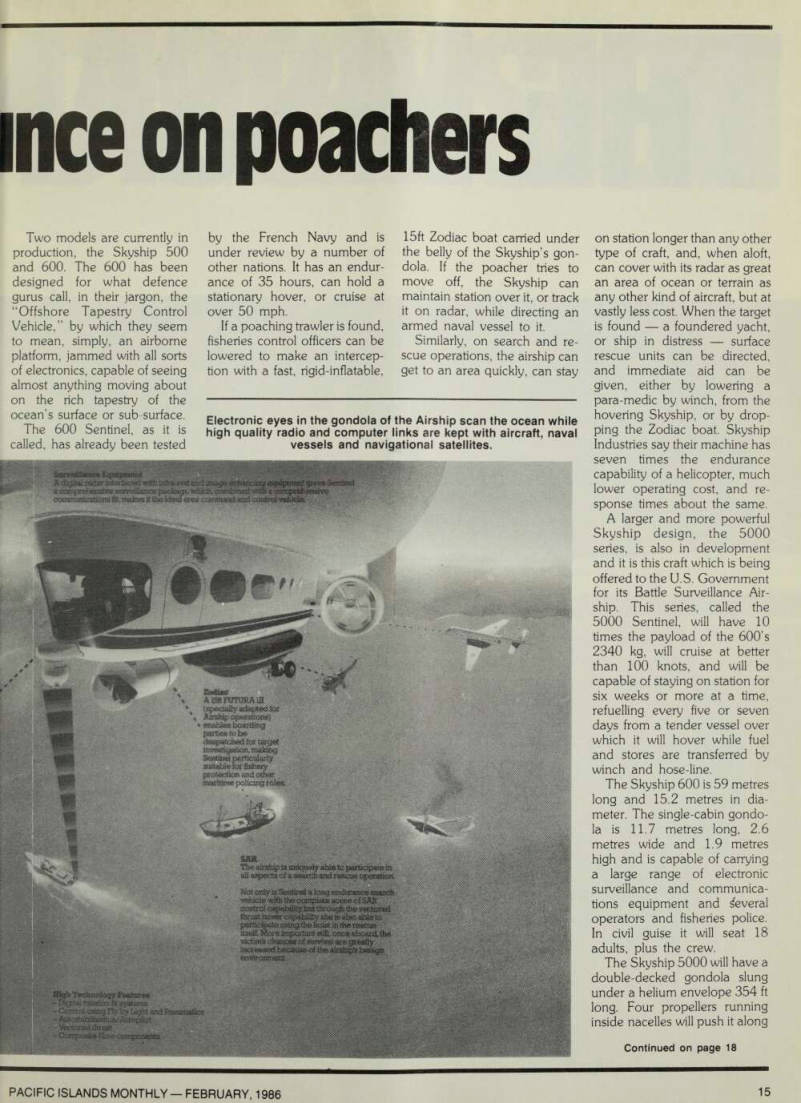
If a poaching trawler is found, fisheries control officers can be lowered to make an intercep tion with a fast, rigid-inflatable,
15ft Zodiac boat carried under the belly of the Skyship’s gon dola. If the poacher tries to move off, the Skyship can maintain station over it, or track it on radar, while directing an armed naval vessel to it.
Similarly, on search and re scue operations, the airship can get to an area quickly, can stay
on station longer than any other type of craft, and, when aloft, can cover with its radar as great an area of ocean or terrain as any other kind of aircraft, but at vastly less cost. When the target is found a foundered yacht, or ship in distress surface rescue units can be directed, and immediate aid can be given, either by lowering a para-medic by winch, from the hovering Skyship, or by drop ping the Zodiac boat. Skyship Industries say their machine has seven times the endurance capability of a helicopter, much lower operating cost, and re sponse times about the same.
A larger and more powerful Skyship design, the 5000 series, is also in development and it is this craft which is being offered to the U.S. Government for its Battle Surveillance Air ship. This series, called the 5000 Sentinel, will have 10 times the payload of the 600’s 2340 kg, will cruise at better than 100 knots, and will be capable of staying on station for six weeks or more at a time, refuelling every five or seven days from a tender vessel over which it will hover while fuel and stores are transferred by winch and hose-line.
The Skyship 600 is 59 metres long and 15.2 metres in dia meter. The single-cabin gondo la is 11.7 metres long, 2.6 metres wide and 1.9 metres high and is capable of carrying a large range of electronic surveillance and communica tions equipment and Several operators and fisheries police.
In civil guise it will seat 18 adults, plus the crew.
The Skyship 5000 will have a double-decked gondola slung under a helium envelope 354 ft long. Four propellers running inside nacelles will push it along
Continued on page 18
Electronic eyes in the gondola of the Airship scan the ocean while high quality radio and computer links are kept with aircraft, naval vessels and navigational satellites.
at better than 100 knots, hold it in a stationary hover, or lift it vertically from a ship’s deck or a small landing field. There will be little or no vibration or engine noise as the craft flies at up to 8000 ft, enabling vast areas of the earth’s surface and sky to be swept by early warning radars of various kinds.
Electronic links to space satel lites, and direct radio and digital electronic beams, will bring the Skyship Sentinel into contact with jet bombers or fighters, with surface ships and sub marines. Sonar buoys dropped from the gondola will enable it to detect enemy submarines homing on a friendly fleet or shore.
Yet, despite its huge size, the 5000 Sentinel, like the smaller 600 series, will be very difficult to see on radar screens. The big gas envelopes are made of composite materials . . . enor mously strong plastics like Kev lar ... and are protected by radar absorbent materials. With all but one of its engines shut down for ultra-long-range cruis ing the craft’s noise level will also be very low.
One design of the 5000 Sentinel provides it with a varie ty of self-defence items, includ ing missiles and decoys. Equal ly, say its designers, it will be very hard to put out of action.
The helium pressure inside the envelope is only 0.1 psi over atmosphere, meaning leakage rate would be slow, and not explosive.
Armor-piercing shells, and even missiles would pass straight through, probably fail ing to do serious damage.
The Skyship 5000 will have four very powerful aero-en gines, but the small Skyship 600 suggested for fisheries surveillance work in the Pacific has the advantage of using two highly reliable auto engines (at the moment turbo-charged Porsche units), maintenance of which would not present very serious problems to mechanics in even quite small island coun tries.
The Skyship design is of conventional non-rigid con-
figuration and makes extensive use of advanced high-strength, light-weight materials such as Kevlar, glass-reinforced plastic and honeycomb sandwich composites. The envelope material, which is a high strength, low-permeability polyester, was developed speci fically for the airships.
The gondola is suspended from the hull by a system of Kevlar cables, with the load spread over the top of the hull by a series of four “curtains.”
One of the most important design features of the craft are two air cells called ballonets which maintain the pressure and thus the shape of the hull by compensating for the expan sion and contraction of the helium lift gas. Also, because air weighs more than the helium, changing the amount of air in each ballonet allows the airship to be trimmed fore and aft. The ballonets are inflated with air from scoops mounted in the slipstream behind each prop eller. The nose of the hull is reinforced with a glass fibre nose cone to provide a strong, single-point mooring system.
Skyship 600 made its maiden flight in March, 1984. It has been tested by the French Navy, apparently coming through with flying colors. A
review of the test, in Jane’s Defence Weekly of May 11, 1985, said that it had been possible to hover accurately enough to rescue a target as small as a swimming survivor and that as far as “quality of the rescue is concerned, airships have a considerable advantage over the helicopter”.
“Using a helicopter the victim has to suffer hurricane force winds and associated searing spray created by the rotor downwash, coupled with con siderable engine noise. In the airship gravity is safely over come by natural means, engine power requirements are low, and the lift and subsequent ride are gentle At that point the French were due to hold two more series of trials of the Skyship, and the US Coastguard was also to hold an operational evaluation. The US has a history of using naval airships (which they call “blimps”) and Airship Indus tries is optimistic about winning a contract from the Coastguard, possibly in conjunction with the US Customs for use in rescue mode as well as in the battle against such as drug-smugglers.
In addition to this American activity, the airships are being studied by the British Ministry of Defence, and other authori
ties in need of offshore surveill ance craft.
No trials have been held, or have yet been mooted for the Pacific. Yet. with a growing need for surveillance of the enormous areas enclosed by their exclusive economic zones, and a shortage of both funds and expert personnel, the air ship is being seen by some back-room thinkers in the re gional organisations as a way to solve quite a few problems.
At the moment most atten tion is being paid in Europe and the US. The US Navy, for example, is reported to have earmarked between US$2.5 million and $5 million for air ship studies in 1985 and 1986.
They are already reliable and capable machines. That much appears to have been thor oughly established by tests so far. They are also more econo mically efficient, and much fas ter, than surface craft.
The Pacific Islands need an efficient surveillance system able to operate efficiently and economically over enormous areas of ocean.
It just could be that the airship will find its way on to our palm-fronded shores to be come a large and valued police man of a principal and vital asset.
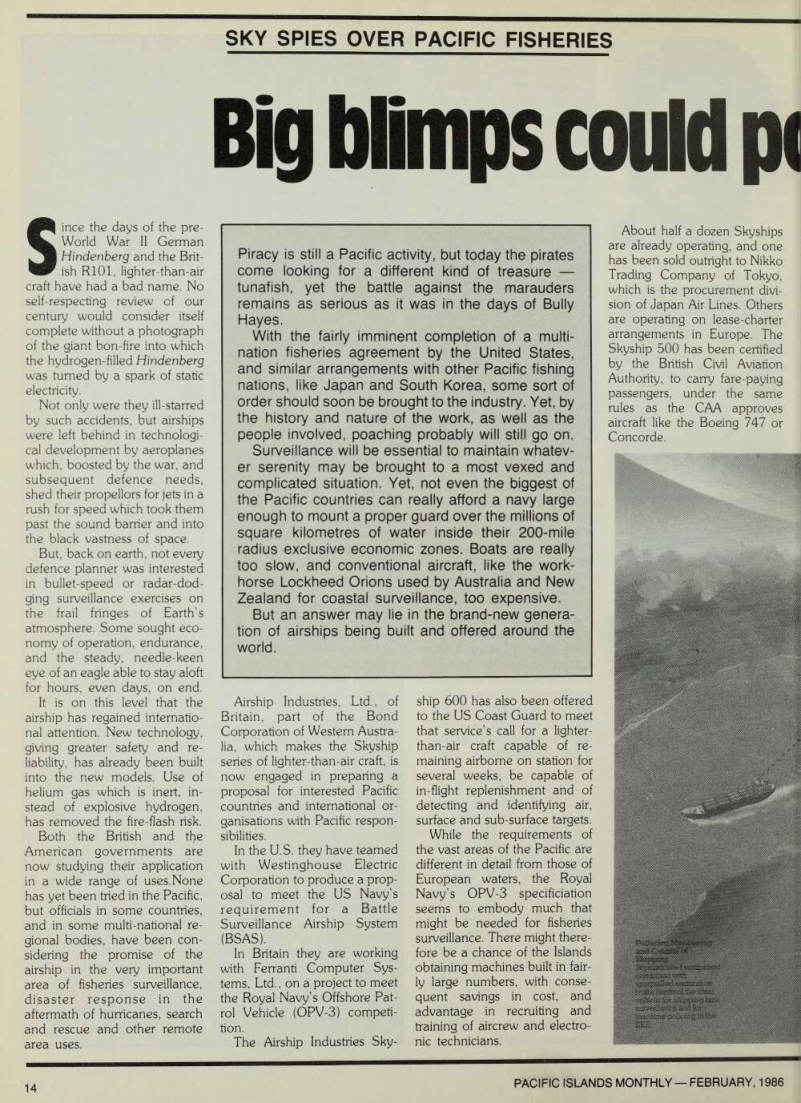
Fast inboard-outboard rigid inflatable boat carried under the Airship allows direct inspection of suspect trawlers.