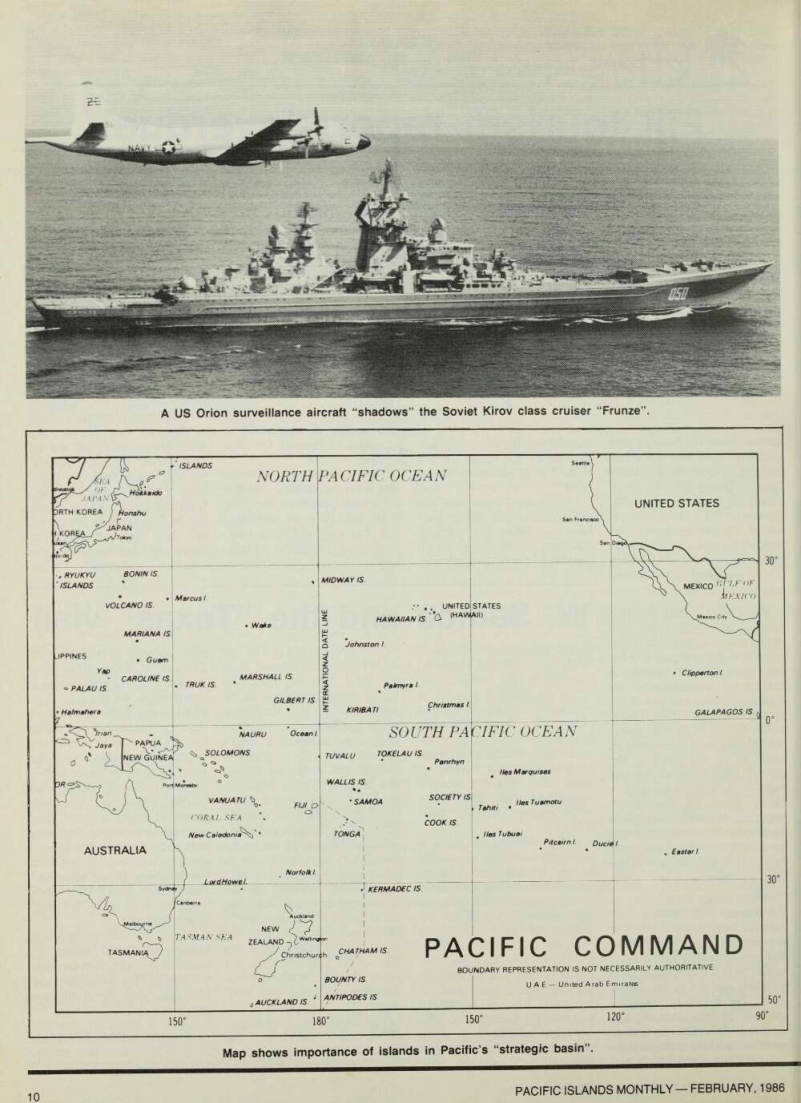
A US Orion surveillance aircraft “shadows” the Soviet Kirov class cruiser “Frunze”.
pp. 10-13 · Read in the full issue
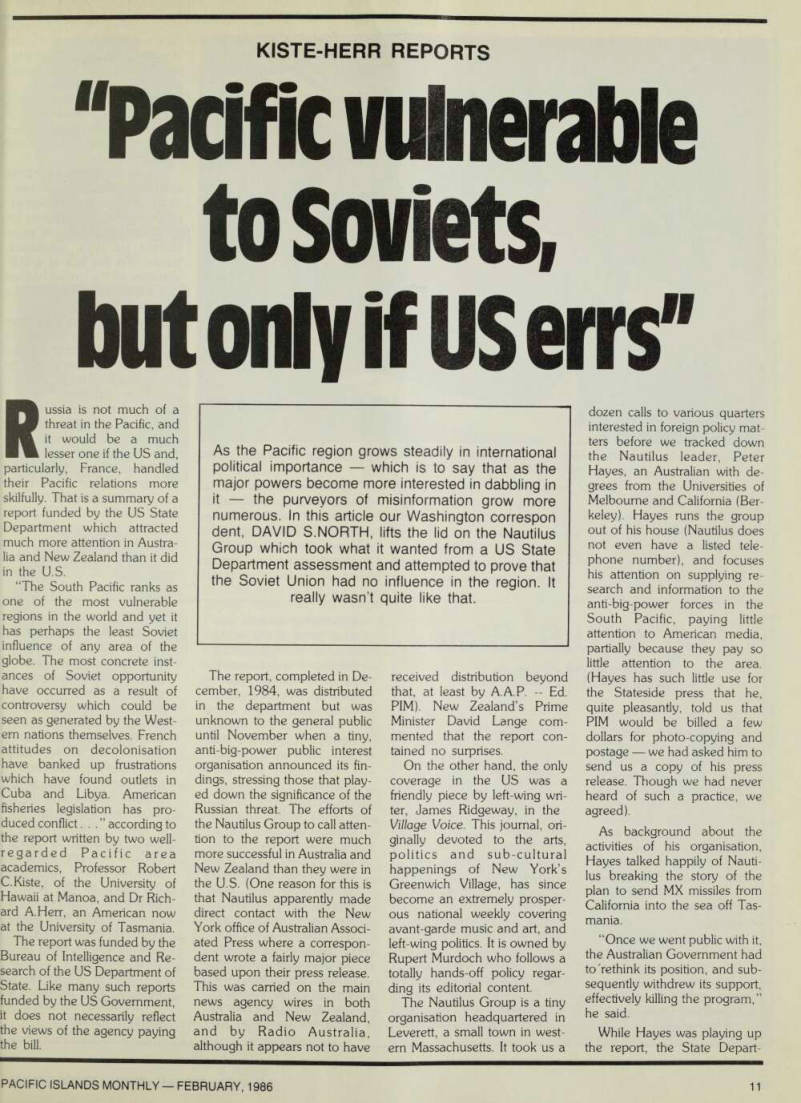
Map shows importance of islands in Pacific’s “strategic basin”.
Kiste-Herr Reports
"Pacific vulnerable to Soviets, but only if us errs”
Russia is not much of a threat in the Pacific, and it would be a much lesser one if the US and, particularly, France, handled their Pacific relations more skilfully. That is a summary of a report funded by the US State Department which attracted much more attention in Austra lia and New Zealand than it did in the U.S.
“The South Pacific ranks as one of the most vulnerable regions in the world and yet it has perhaps the least Soviet influence of any area of the globe. The most concrete inst ances of Soviet opportunity have occurred as a result of controversy which could be seen as generated by the West ern nations themselves. French attitudes on decolonisation have banked up frustrations which have found outlets in Cuba and Libya. American fisheries legislation has pro duced conflict. . .” according to the report written by two well regarded Pacific area academics, Professor Robert C.Kiste, of the University of Hawaii at Manoa, and Dr Rich ard A. Herr, an American now at the University of Tasmania.
The report was funded by the Bureau of Intelligence and Re search of the US Department of State. Like many such reports funded by the US Government, it does not necessarily reflect the views of the agency paying the bill.
As the Pacific region grows steadily in international political importance which is to say that as the major powers become more interested in dabbling in it the purveyors of misinformation grow more numerous. In this article our Washington correspon dent, DAVID S.NORTH, lifts the lid on the Nautilus Group which took what it wanted from a US State Department assessment and attempted to prove that the Soviet Union had no influence in the region. It really wasn’t quite like that.
The report, completed in De cember, 1984, was distributed in the department but was unknown to the general public until November when a tiny, anti-big-power public interest organisation announced its fin dings, stressing those that play ed down the significance of the Russian threat. The efforts of the Nautilus Group to call atten tion to the report were much more successful in Australia and New Zealand than they were in the U.S. (One reason for this is that Nautilus apparently made direct contact with the New York office of Australian Associ ated Press where a correspon dent wrote a fairly major piece based upon their press release.
This was carried on the main news agency wires in both Australia and New Zealand, and by Radio Australia, although it appears not to have
received distribution beyond that, at least by A.A.P. - Ed.
PIM). New Zealand’s Prime Minister David Lange com mented that the report con tained no surprises.
On the other hand, the only coverage in the US was a friendly piece by left-wing wri ter, James Ridgeway, in the Village Voice. This journal, ori ginally devoted to the arts, politics and sub-cultural happenings of New York’s Greenwich Village, has since become an extremely prosper ous national weekly covering avant-garde music and art, and left-wing politics. It is owned by Rupert Murdoch who follows a totally hands-off policy regar ding its editorial content.
The Nautilus Group is a tiny organisation headquartered in Leverett, a small town in west ern Massachusetts. It took us a
dozen calls to various quarters interested in foreign policy mat ters before we tracked down the Nautilus leader, Peter Hayes, an Australian with de grees from the Universities of Melbourne and California (Ber keley). Hayes runs the group out of his house (Nautilus does not even have a listed tele phone number), and focuses his attention on supplying re search and information to the anti-big-power forces in the South Pacific, paying little attention to American media, partially because they pay so little attention to the area. (Hayes has such little use for the Stateside press that he, quite pleasantly, told us that PIM would be billed a few dollars for photo-copying and postage we had asked him to send us a copy of his press release. Though we had never heard of such a practice, we agreed).
As background about the activities of his organisation, Hayes talked happily of Nauti lus breaking the story of the plan to send MX missiles from California into the sea off Tas mania.
“Once we went public with it, the Australian Government had to'rethink its position, and sub sequently withdrew its support, effectively killing the program,” he said.
While Hayes was playing up the report, the State Depart-
ment moved in the other direction. A cloddish State De partment press officer, in November, responded to a question about the study by pretending (or at least we hope he was pretending) that he did
not know the location of Kiriba ti; then he added insult to injury by mispronouncing the senior author’s name, making it all sound like the “Kissed Her” report. (Professor Kiste's name rhymes with diced, not fist.)
The report itself is a sober, detailed, 77-page study of the prospects of the Pacific Island nations and other jurisdictions in the area served by the South Pacific Commission. Entitled “The Potential for Soviet
Penetration of the South Pacific Islands; An Assessment,” it sug gests that Russian opportunities are extremely limited, under present circumstances, and would be even more so if it were not for ham-handed (our word, not theirs), U.S. and French policies.
Among the American policies cited were the U.S. over-reac tion to the seizing of the Jeanet te Diana, the rigid system for distributing allocations of sugar imports (at high, subsidised, prices) and the lack of a U.S. signature on the United Nations Convention on the Law of the Sea.
Regarding the Jeanette Diana the authors wrote; “In this case a traditional external friend, the US. finds itself in confrontation with a regional state, the Solomons, over a conflict of their domestic laws over fisheries. This dispute is particularly unfortunate from the American perspective since the Solomons had proved itself a sympathetic friend prior to the arrest of the Jeanette Diana in June, 1984.
“The Solomons banned Soviet vessels from its ports following the invasion of Afgha nistan, took the lead in ESCAP
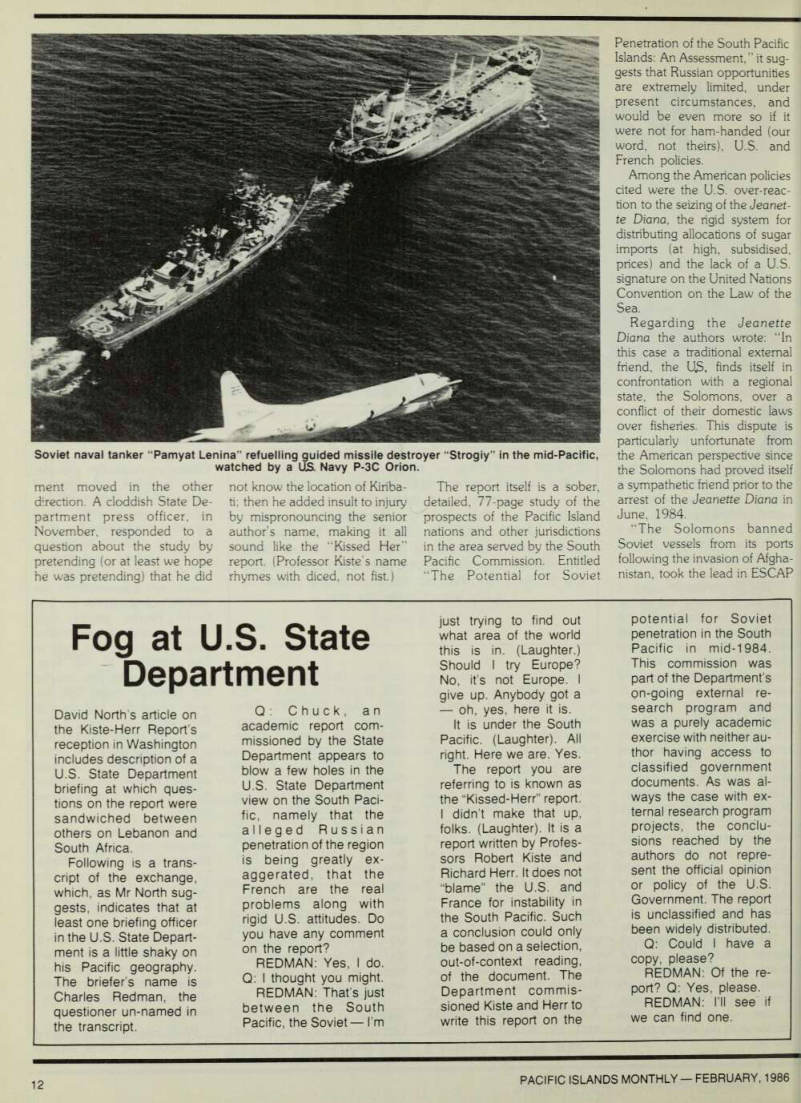
Soviet naval tanker “Pamyat Lenina” refuelling guided missile destroyer “Strogiy” in the mid-Pacific, watched by a US. Navy P-3C Orion.
in defeating attempts to revive the overturned Soviet offer of oceanographic aid through CCOP/SOPAC, and had agreed to the establishment of a small resident US mission in Honiara. ”
Kiste and Herr also suggest that the Russians have not been either terribly skilled or terribly interested in the area; further, they devote some attention to potential threats to the island states from Western-based freebooters and criminal ele ments.
One of the most interesting sections of the report speaks of
the lack of institutional memory and momentum in the making of foreign policy in the island nations. Staffing is minimal, or, as they point out: “Personalities play a crucial role in South Pacific foreign policy-making not only because the staffs are thin and thus there are fewer individuals involved in any particular decision, but also be cause the lines of responsibility are very short. An issue moves from the clerk who receives the telex to the foreign minister (often the prime minister), in two or three steps.”
As to the major threats to the area, Kiste and Herr concluded with the following assessment; “Vulnerability remains nonetheless a key issue ... a physical threat (whatever the sources) was less to be feared by the Pacific Islands under current circumstances than eco nomic domination (again, whatever the source). Econo mic vulnerability thus remains the perceived essence of the micro-state dilemma in the South Pacific regardless of the post-Grenada concerns of physical threat for insular mic ro-states elsewhere.” “Fac tors which have enhanced the Soviet potential for penetration of other areas of the world are largely absent in the South Pacific. Extensive social discon tent, weak democratic institu tions, deep ideological cleav ages particularly as expressed in political parties or trade union movements and the like cur rently offer negligible opportu nities for the Soviets or surro gates to establish and develop a physical presence in the is lands.”
Although the Kiste-Herr re port is a public document, obtaining it is awkward. One must journey (as we did), or write, to a warehouse-type buil ding some dozen miles south of Washington DC, where an obscure arm of the US Depart ment of Commerce will, for U 5519.45, make a photocopy of the document for you. (Write to Sales Desk, National Techni cal Information Service, US De partment of Commerce, Springfield, Va., 22161, USA, and ask for accession number ADA 153015.) David S.
North, in Washington.
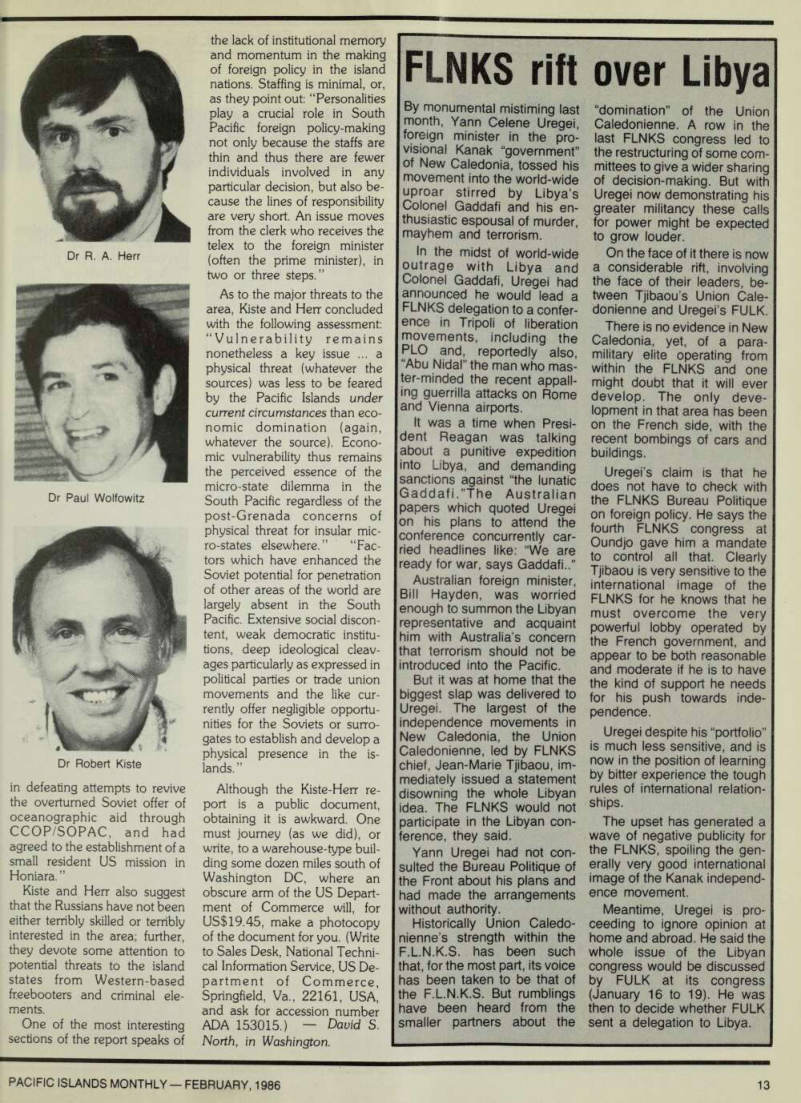
Dr R. A. Herr
Dr Paul Wolfowitz
Dr Robert Kiste