pacific report
pp. 7-8 · Read in the full issue
Dark Secret Of
Tle De Lumiere'
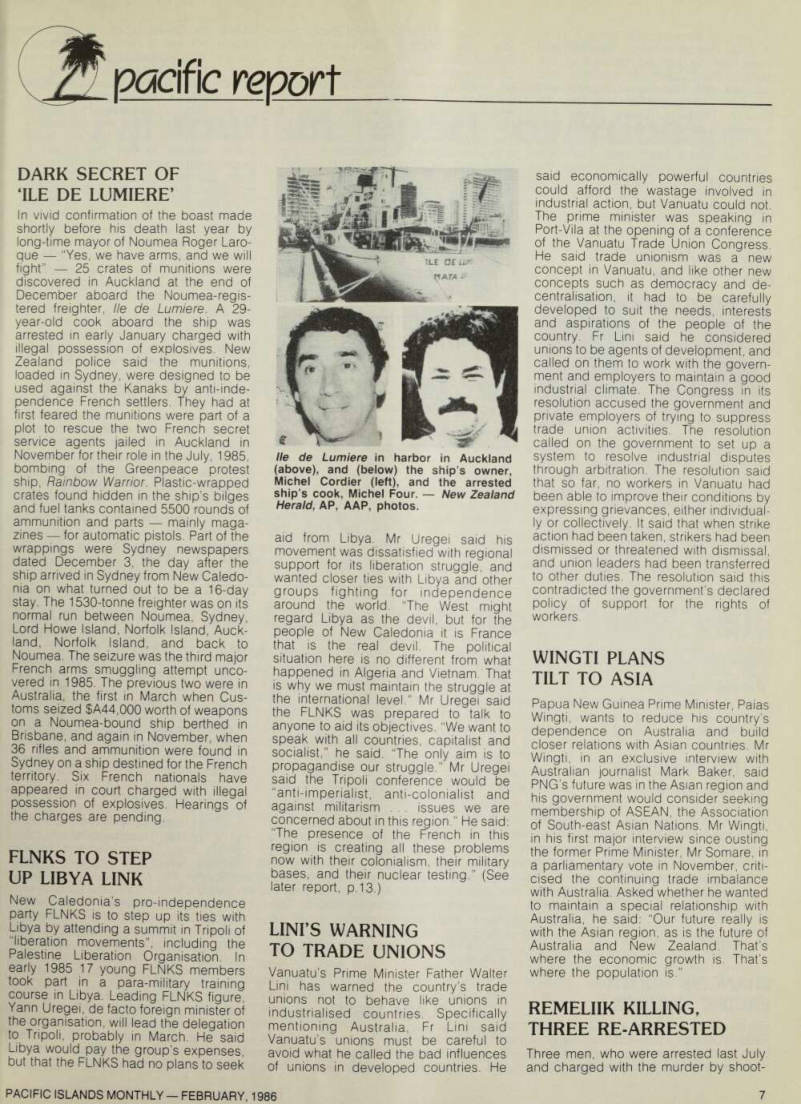
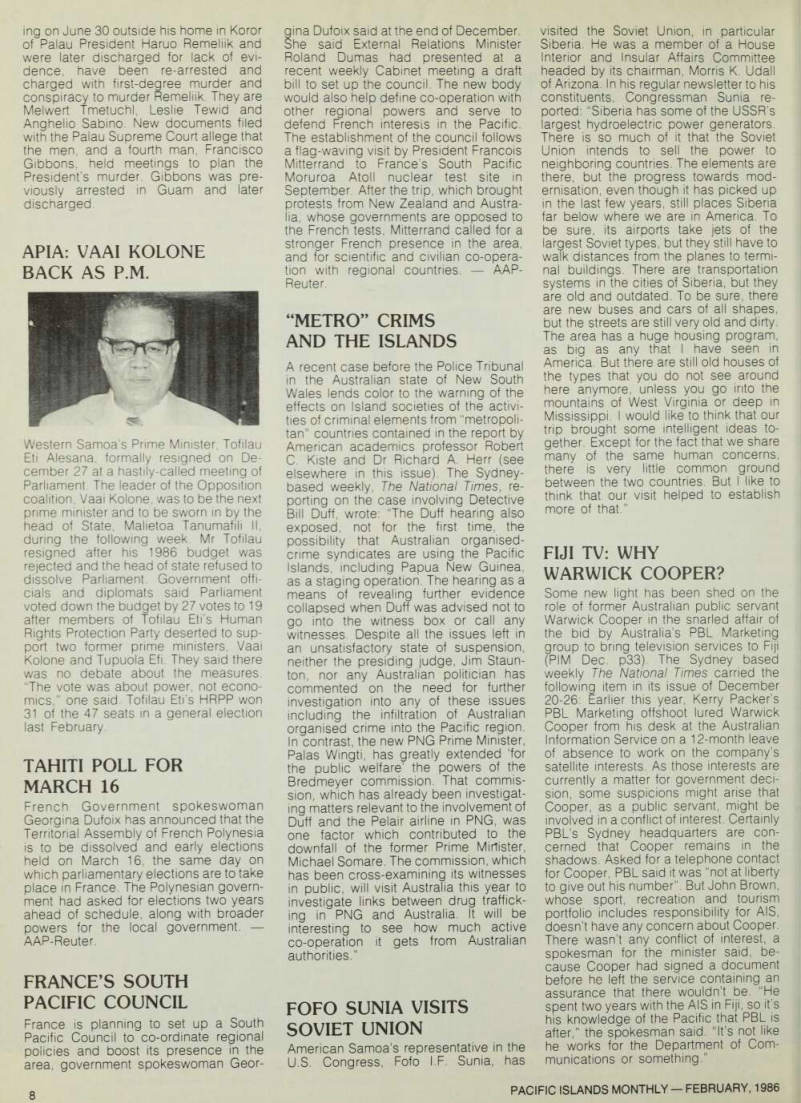
In vivid confirmation of the boast made shortly before his death last year by long-time mayor of Noumea Roger baro que “Yes, we have arms, and we will fight” 25 crates of munitions were discovered in Auckland at the end of December aboard the Noumea-regis tered freighter, lie de Lumiere. A 29year-old cook aboard the ship was arrested in early January charged with illegal possession of explosives. New Zealand police said the munitions, loaded in Sydney, were designed to be used against the Kanaks by anti-inde pendence French settlers. They had at first feared the munitions were part of a plot to rescue the two French secret service agents jailed in Auckland in November for their role in the July, 1985, bombing of the Greenpeace protest ship, Rainbow Warrior. Plastic-wrapped crates found hidden in the ship’s bilges and fuel tanks contained 5500 rounds of ammunition and parts mainly maga zines for automatic pistols. Part of the wrappings were Sydney newspapers dated December 3, the day after the ship arrived in Sydney from New Caledo nia on what turned out to be a 16-day stay. The 1530-tonne freighter was on its normal run between Noumea, Sydney, Lord Howe Island, Norfolk Island, Auck land, Norfolk Island, and back to Noumea. The seizure was the third major French arms smuggling attempt unco vered in 1985. The previous two were in Australia, the first in March when Cus toms seized $A44,000 worth of weapons on a Noumea-bound ship berthed in Brisbane, and again in November, when 36 rifles and ammunition were found in Sydney on a ship destined for the French territory. Six French nationals have appeared in court charged with illegal possession of explosives. Hearings of the charges are pending.
Flnks To Step
Up Libya Link
New Caledonia's pro-independence party FLNKS is to step up its ties with Libya by attending a summit in Tripoli of “liberation movements”, including the Palestine Liberation Organisation. In early 1985 17 young FLNKS members took part in a para-military training course in Libya. Leading FLNKS figure, Yann Uregei, de facto foreign minister of the organisation, will lead the delegation to Tripoli, probably in March. He said Libya would pay the group’s expenses, but that the FLNKS had no plans to seek
aid from Libya. Mr Uregei said his movement was dissatisfied with regional support for its liberation struggle, and wanted closer ties with Libya and other groups fighting for independence around the world. “The West might regard Libya as the devil, but for the people of New Caledonia it is France that is the real devil. The political situation here is no different from what happened in Algeria and Vietnam. That is why we must maintain the struggle at the international level.” Mr Uregei said the FLNKS was prepared to talk to anyone to aid its objectives. “We want to speak with all countries, capitalist and socialist,” he said. “The only aim is to propagandise our struggle.” Mr Uregei said the Tripoli conference would be “anti-imperialist, anti-colonialist and against militarism . . . issues we are concerned about in this region.” He said: “The presence of the French in this region is creating all these problems now with their colonialism, their military bases, and their nuclear testing.” (See later report, p. 13.)
Lints Warning
To Trade Unions
Vanuatu’s Prime Minister Father Walter Lini has warned the country’s trade unions not to behave like unions in industrialised countries. Specifically mentioning Australia, Fr Lini said Vanuatu's unions must be careful to avoid what he called the bad influences of unions in developed countries. He
said economically powerful countries could afford the wastage involved in industrial action, but Vanuatu could not.
The prime minister was speaking in Port-Vila at the opening of a conference of the Vanuatu Trade Union Congress.
He said trade unionism was a new concept in Vanuatu, and like other new concepts such as democracy and de centralisation, it had to be carefully developed to suit the needs, interests and aspirations of the people of the country. Fr Lini said he considered unions to be agents of development, and called on them to work with the govern ment and employers to maintain a good industrial climate. The Congress in its resolution accused the government and private employers of trying to suppress trade union activities. The resolution called on the government to set up a system to resolve industrial disputes through arbitration. The resolution said that so far, no workers in Vanuatu had been able to improve their conditions by expressing grievances, either individual ly or collectively. It said that when strike action had been taken, strikers had been dismissed or threatened with dismissal, and union leaders had been transferred to other duties. The resolution said this contradicted the government’s declared policy of support for the rights of workers.
Wingti Plans
Tilt To Asia
Papua New Guinea Prime Minister, Paias Wingti, wants to reduce his country’s dependence on Australia and build closer relations with Asian countries. Mr Wingti, in an exclusive interview with Australian journalist Mark Baker, said PNG’s future was in the Asian region and his government would consider seeking membership of ASEAN, the Association of South-east Asian Nations. Mr Wingti, in his first major interview since ousting the former Prime Minister, Mr Somare, in a parliamentary vote in November, criti cised the continuing trade imbalance with Australia. Asked whether he wanted to maintain a special relationship with Australia, he said: “Our future really is with the Asian region, as is the future of Australia and New Zealand. That’s where the economic growth is. That's where the population is.”
Remeliik Killing,
Three Re-Arrested
Three men, who were arrested last July and charged with the murder by shoot
lie de Lumiere in harbor in Auckland (above), and (below) the ship’s owner, Michel Cordier (left), and the arrested ship’s cook, Michel Four. New Zealand Herald, AP, AAP, photos.
ing on June 30 outside his home in Koror of Palau President Haruo Remeliik and were later discharged for lack of evi dence, have been re-arrested and charged with first-degree murder and conspiracy to murder Remeliik. They are Melwert Tmetuchl, Leslie Tewid and Anghelio Sabino. New documents filed with the Palau Supreme Court allege that the men, and a fourth man, Francisco Gibbons, held meetings to plan the President’s murder. Gibbons was pre viously arrested in Guam and later discharged.
Apia: Vaai Kolone
Back As P.M.
Western Samoa's Prime Minister, Tofilau Eti Alesana, formally resigned on De cember 27 at a hastily-called meeting of Parliament. The leader of the Opposition coalition, Vaai Kolone, was to be the next prime minister and to be sworn in by the head of State, Malietoa Tanumafili 11, during the following week Mr Tofilau resigned after his 1986 budget was rejected and the head of state refused to dissolve Parliament. Government offi cials and diplomats said Parliament voted down the budget by 27 votes to 19 after members of Tofilau Eti’s Human Rights Protection Party deserted to sup port two former prime ministers, Vaai Kolone and Tupuola Efi They said there was no debate about the measures.
“The vote was about power, not econo mics,” one said. Tofilau Eti's HRPP won 31 of the 47 seats in a general election last February,
Tahiti Poll For
March 16
French Government spokeswoman Georgina Dufoix has announced that the Territorial Assembly of French Polynesia is to be dissolved and early elections held on March 16, the same day on which parliamentary elections are to take place in France. The Polynesian govern ment had asked for elections two years ahead of schedule, along with broader powers for the local government.
AAP-Reuter.
France’S South
Pacific Council
France is planning to set up a South Pacific Council to co-ordinate regional policies and boost its presence in the area, government spokeswoman Geor
gina Dufoix said at the end of December.
She said External Relations Minister Roland Dumas had presented at a recent weekly Cabinet meeting a draft bill to set up the council. The new body would also help define co-operation with other regional powers and serve to defend French interests in the Pacific.
The establishment of the council follows a flag-waving visit by President Francois Mitterrand to France’s South Pacific Moruroa Atoll nuclear test site in September. After the trip, which brought protests from New Zealand and Austra lia, whose governments are opposed to the French tests, Mitterrand called for a stronger French presence in the area, and for scientific and civilian co-opera
tion with regional countries.
Aar-
Reuter.
“Metro” Crims
And The Islands
A recent case before the Police Tribunal in the Australian state of New South Wales lends color to the warning of the effects on Island societies of the activi ties of criminal elements from “metropoli tan" countries contained in the report by American academics professor Robert C. Kiste and Dr Richard A. Herr (see elsewhere in this issue). The Sydney based weekly, The National Times, re porting on the case involving Detective Bill Duff, wrote: "The Duff hearing also exposed, not for the first time, the possibility that Australian organised crime syndicates are using the Pacific Islands, including Papua New Guinea, as a staging operation. The hearing as a means of revealing further evidence collapsed when Duff was advised not to go into the witness box or call any witnesses. Despite all the issues left in an unsatisfactory state of suspension, neither the presiding judge, Jim Staun ton, nor any Australian politician has commented on the need for further investigation into any of these issues including the infiltration of Australian organised crime into the Pacific region.
In contrast, the new PNG Prime Minister, Palas Wingti, has greatly extended ‘for the public welfare’ the powers of the Bredmeyer commission. That commis sion, which has already been investigat ing matters relevant to the involvement of Duff and the Pelair airline in PNG, was one factor which contributed to the downfall of the former Prime Minister, Michael Somare. The commission, which has been cross-examining its witnesses in public, will visit Australia this year to investigate links between drug traffick ing in PNG and Australia. It will be interesting to see how much active co-operation it gets from Australian authorities.”
Fofo Sunia Visits
Soviet Union
American Samoa’s representative in the U.S. Congress, Fofo I.F. Sunia, has
visited the Soviet Union, in particular Siberia. He was a member of a House Interior and Insular Affairs Committee headed by its chairman, Morris K. Udall of Arizona. In his regular newsletter to his constituents, Congressman Sunia re ported; “Siberia has some of the USSR’s largest hydroelectric power generators.
There is so much of it that the Soviet Union intends to sell the power to neighboring countries. The elements are there, but the progress towards mod ernisation, even though it has picked up in the last few years, still places Siberia far below where we are in America. To be sure, its airports take jets of the largest Soviet types, but they still have to walk distances from the planes to termi nal buildings. There are transportation systems in the cities of Siberia, but they are old and outdated. To be sure, there are new buses and cars of all shapes, but the streets are still very old and dirty.
The area has a huge housing program, as big as any that 1 have seen in America. But there are still old houses of the types that you do not see around here anymore, unless you go into the mountains of West Virginia or deep in Mississippi. I would like to think that our trip brought some intelligent ideas to gether. Except for the fact that we share many of the same human concerns, there is very little common ground between the two countries. But 1 like to think that our visit helped to establish more of that.”
Fiji Tv: Why
Warwick Cooper?
Some new light has been shed on the role of former Australian public servant Warwick Cooper in the snarled affair of the bid by Australia’s PBL Marketing group to bring television services to Fiji (RIM Dec. p 33). The Sydney based weekly The National Times carried the following item in its issue of December 20-26: Earlier this year, Kerry Packer’s PBL Marketing offshoot lured Warwick Cooper from his desk at the Australian Information Service on a 12-month leave of absence to work on the company’s satellite interests. As those interests are currently a matter for government deci sion, some suspicions might arise that Cooper, as a public servant, might be involved in a conflict of interest. Certainly PBL’s Sydney headquarters are con cerned that Cooper remains in the shadows. Asked for a telephone contact for Cooper, PBL said it was “not at liberty to give out his number". But John Brown, whose sport, recreation and tourism portfolio includes responsibility for AIS, doesn’t have any concern about Cooper.
There wasn't any conflict of interest, a spokesman for the minister said, be cause Cooper had signed a document before he left the service containing an assurance that there wouldn’t be. “He spent two years with the AIS in Fiji, so it’s his knowledge of the Pacific that PBL is after,” the spokesman said. “It’s not like he works for the Department of Com munications or something."