people
pp. 50-51 · Read in the full issue
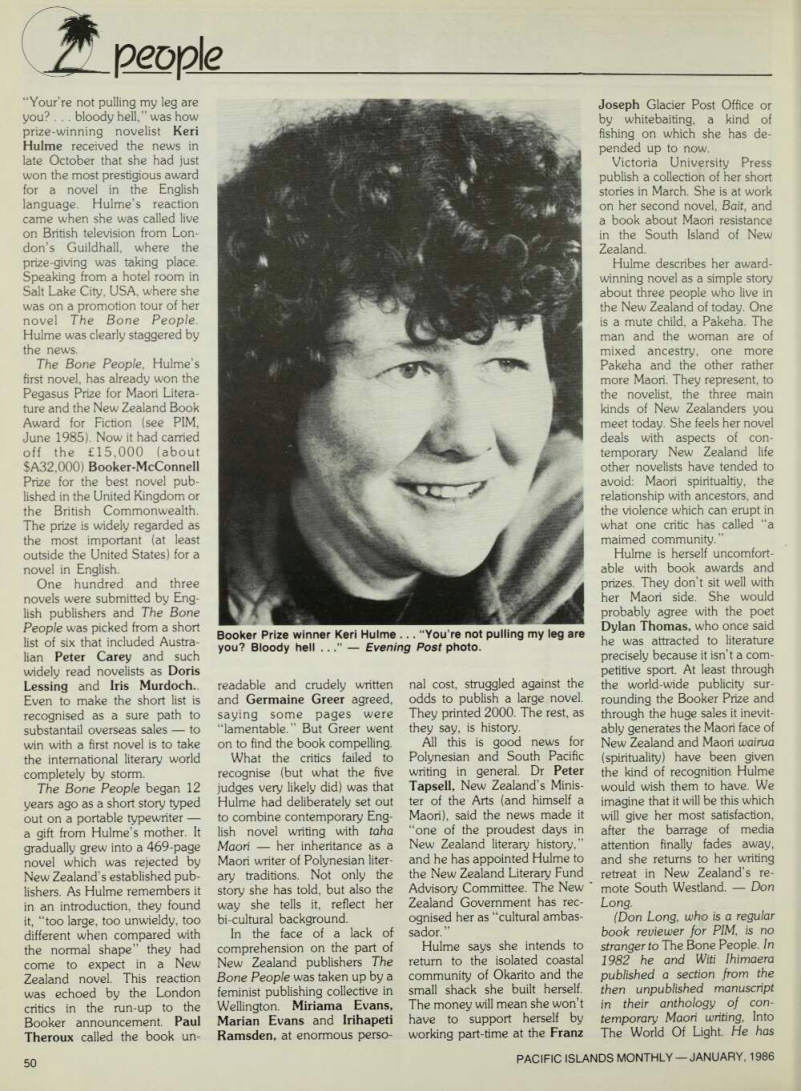
“Your’re not pulling my leg are you? . . . bloody hell,” was how prize-winning novelist Keri Hulme received the news in late October that she had just won the most prestigious award for a novel in the English language. Hulme’s reaction came when she was called live on British television from Lon don’s Guildhall, where the prize-giving was taking place.
Speaking from a hotel room in Salt Lake City, USA, where she was on a promotion tour of her novel The Bone People.
Hulme was clearly staggered by the news.
The Bone People, Hulme’s first novel, has already won the Pegasus Prize for Maori Litera ture and the New Zealand Book Award for Fiction (see PIM, June 1985). Now it had carried off the £15,000 (about $A32,000) Booker-McConnell Prize for the best novel pub lished in the United Kingdom or the British Commonwealth.
The prize is widely regarded as the most important (at least outside the United States) for a novel in English.
One hundred and three novels were submitted by Eng lish publishers and The Bone People was picked from a short list of six that included Austra lian Peter Carey and such widely read novelists as Doris Lessing and Iris Murdoch., Even to make the short list is recognised as a sure path to substantail overseas sales to win with a first novel is to take the international literary world completely by storm.
The Bone People began 12 years ago as a short story typed out on a portable typewriter a gift from Hulme’s mother. It gradually grew into a 469-page novel which was rejected by New Zealand’s established pub lishers. As Hulme remembers it in an introduction, they found it, “too large, too unwieldy, too different when compared with the normal shape” they had come to expect in a New Zealand novel. This reaction was echoed by the London critics in the run-up to the Booker announcement. Paul Theroux called the book un-
readable and crudely written and Germaine Greer agreed, saying some pages were “lamentable.” But Greer went on to find the book compelling.
What the critics failed to recognise (but what the five judges very likely did) was that Hulme had deliberately set out to combine contemporary Eng lish novel writing with taha Maori her inheritance as a Maori writer of Polynesian liter ary traditions. Not only the story she has told, but also the way she tells it, reflect her bi-cultural background.
In the face of a lack of comprehension on the part of New Zealand publishers The Bone People was taken up by a feminist publishing collective in Wellington. Miriama Evans, Marian Evans and Irihapeti Ramsden, at enormous perso
nal cost, struggled against the odds to publish a large novel.
They printed 2000. The rest, as they say, is history.
All this is good news for Polynesian and South Pacific writing in general. Dr Peter Tapsell, New Zealand’s Minis ter of the Arts (and himself a Maori), said the news made it “one of the proudest days in New Zealand literary history,” and he has appointed Hulme to the New Zealand Literary Fund Advisory Committee. The New Zealand Government has rec ognised her as “cultural ambas sador.”
Hulme says she intends to return to the isolated coastal community of Okarito and the small shack she built herself.
The money will mean she won’t have to support herself by working part-time at the Franz
Joseph Glacier Post Office or by whitebaiting, a kind of fishing on which she has de pended up to now.
Victoria University Press publish a collection of her short stories in March. She is at work on her second novel, Bait, and a book about Maori resistance in the South Island of New Zealand.
Hulme describes her award winning novel as a simple story about three people who live in the New Zealand of today. One is a mute child, a Pakeha. The man and the woman are of mixed ancestry, one more Pakeha and the other rather more Maori. They represent, to the novelist, the three main kinds of New Zealanders you meet today. She feels her novel deals with aspects of con temporary New Zealand life other novelists have tended to avoid: Maori spiritualtiy, the relationship with ancestors, and the violence which can erupt in what one critic has called “a maimed community.”
Hulme is herself uncomfort able with book awards and prizes. They don’t sit well with her Maori side. She would probably agree with the poet Dylan Thomas, who once said he was attracted to literature precisely because it isn’t a com petitive sport. At least through the world-wide publicity sur rounding the Booker Prize and through the huge sales it inevit ably generates the Maori face of New Zealand and Maori wairua (spirituality) have been given the kind of recognition Hulme would wish them to have. We imagine that it will be this which will give her most satisfaction, after the barrage of media attention finally fades away, and she returns to her writing retreat in New Zealand’s re
mote South Westland.
Long.
Don
(Don Long, who is a regular book reviewer for PIM, is no stranger to The Bone People. In 1982 he and Witi Ihimaera published a section from the then unpublished manuscript in their anthology of con temporary Maori writing, Into The World Of Light. He has
Booker Prize winner Keri Hulme ... “You’re not pulling my leg are you? Bloody hell ...” Evening Post photo.
known Keri Flulme since 1979 when they were visiting writers together at Flawaii’s East West Center.) A former Fiji Times jounalist has graduated with a BA honors degree in mass media from the University of District of Col umbia in Washington, DC.
Miss Usha Sundar, 29, worked as a reporter on The Fiji Times and was later appointed editor of Fiji Floliday, a monthly travel magazine.
Her major field of study at the university was television and film production.
Miss Sundar, now back in Fiji, says she hopes to work in television in Australia.
During her final year’s stu dies, Miss Sundar worked as a news assistant with KOIN-TV, an affiliate of CBS, in Portland, Oregon.
She worked as field producer and editor during her internship with Newsfeed Network in Washington, DC.
At the university, she won the top freshman award, the presi dential scholar award and a scholarship for academic excell ence.
She was selected for inclu sion in the Who’s Who Among Students in American univer sities and colleges for the 1984- 85 edition.
Tongan single-hander yachts man Viliami (“Tonga Bill”) Fehoko is no longer alone on his first circumnavigation.
Late last year he married Nicole Marthe Lejeunts, a mathematics teacher of the In dian Ocean island of Mauritius.
The marriage was solem nised in the cabin of “Tonga Bill’s” 5.5 metre yacht, Mata Moana.
Captain Walter Ryland has rejoined Fiji’s Islands in the Sun group as master of its 60-metre Seafarer Cruises ship, MV Matthew Flinders.
He returns to the Lautoka based tourist cruise and island resort company after seven months with Blue Lagoon Cruises during which time he was the first captain of the cruiser Yasawa Princess.
Captain Ryland is a Pacific Islands master with 29 years sailing experience. He is origin-
ally from Natewa Bay in Vanua Levu.
Aboard Matthew Flinders he takes over from Captain Arthur Evans, the Islands in the Sun group’s senior master, who has resigned to join a commercial fishing venture.
Captain Ryland began his career as a supercargo aboard the inter-island trader MV Joyita. He worked on the Burns Philp ships Yanuwai, Ratanui and Zephyr as first mate and second mate, and the Ratanui was also the first ship he com manded.
He then joined Marine Pacific as master of the salvage tug Pacific Salvor and spent 14 years on salvage work through out the Pacific. In 1984 he
joined Beachcomber Cruises, part of the Islands in the Sun group, as relieving master.
Captain Ryland said he was very happy to take command of MV Matthew Flinders. “While holiday cruising is completely different to salvage work when I could be at sea up to seven months it offers its own challenges in looking after our overseas visitors and ensur ing that passengers on every cruise enjoy the famous Seafar er Cruises hospitality and island experience,” he said.
The 991-ton Matthew Flin ders departs Lautoka every Sat urday and Wednesday morning on a three-day/three-night cruise through the Mamanuca and Yasawa Islands.
Philip Olive, of Port-Vila’s Malapoa College, was among prize-winners in the 1985 mathematics competition spon sored by the Westpac Banking Corporation, the Canberra Mathematical Association, and the Canberra College of Ad vanced Education.
The annual event attracted 337,000 entrants from Austra lia, New Zealand, Papua New Guinea and the Pacific.
Presenting Philip with a che que for his fine performance in the competition, Westpac’s Port-Vila manager Colin G.
Wise, said that next year he hoped other schools in Vanuatu would compete, in addition to Malapoa.
The competition is the largest in the world in terms of popula tions covered. Sums totalling $A37,000 are distributed to more than 1000 of the most successful entrants.
Donal P. Rounds, A.1.A., has been named associate in the firm of Wimberly Whisenand Allison Tong & Goo Associates Ltd., according to Donald W.
Y. Goo, president.
Rounds, who holds degrees from the University of Redlands (California) and the University of Oregon, was in private prac tice in Medford, Oregon, before joining WWAT&G in 1984.
Licensed to practise architecture in Washington and Oregon, he is past president of the Southern Oregon Chapter, A.1.A., former board member of the Oregon Council of Archi tects, past director of the Ore gon Council of Planners, and former vice-chairman of the Jackson (Oregon) Coupty Plan ning Commission.
He spent the years of World War II in Santo Tomas prison camp in Manila, where he and 4000 others were rescued by the U.S. Ist Cavalry one day before their scheduled execu tion by the Japanese.
WWAT&G is a 90-member 40-year-old architectural and planning firm with a practice that extends from Hawaii throughout the Pacific Rim countries and on the U.S. main land from California to Florida.
The firm specialises in hotels and other leisure facilities, con dominiums and mixed-use faci lities.
Donal P. Rounds ... new associate in WWAT&G.
Captain Walter Ryland in the wheelhouse of MV Matthew Flinders.