Garden of Eden ...
p. 44 · Read in the full issue
Efate s almost secret Garden of Eden ...
Lololima lies almost secretly inside a mass of verdant bush on the island of Efate in Vanuatu. The site was originally called Cascade Ground be cause a series of waterfalls collects there into deep, icy pools. The scenery is idyllic and much in keeping with the com munity who now inhabit the site.
Lololima is a Catholic Train ing Centre, one of three in the Pacific which were founded by the Marist Brothers, based in New Zealand. The centre offers a second chance for young men who, for financial or family reasons, were unable to com plete their secondary educa tion. They are given the opportunity of either returning to their villages as spiritual and community leaders, or going on with their religious studies and possible ordination.
The founder of the centre was Father John Cecil. He came to the priesthood relative ly late in life after graduating from Massey University, New Zealand, and then joining the Marist Order as a missionary.
There are two similar centres in the Pacific, one in the Solomon Islands on Guadalcanal, and
the other in Fiji, established on Taveuni by Father John with the help of students, brothers and priests.
The philosophy of the centres is that of formation that is, the awakening of spir itual qualities which will enable the student to influence and lead others in the way of the Christian faith. The motto of Lololima is “look for the good in man”, and among the brothers and students at Lololi ma one doesn’t have to look too far.
Lololima can only be reached by a tortuous road that winds its way through the bush.
Cattle graze peacefully beneath the aged coconut trees of the old plantation. Suddenly, the endless green gives way to a blazing red poinsettia which guards the outside altar, sur rounded by flowers and shrubs.
A few metres further on you can see grapefruit and pawpaw ripe for picking.
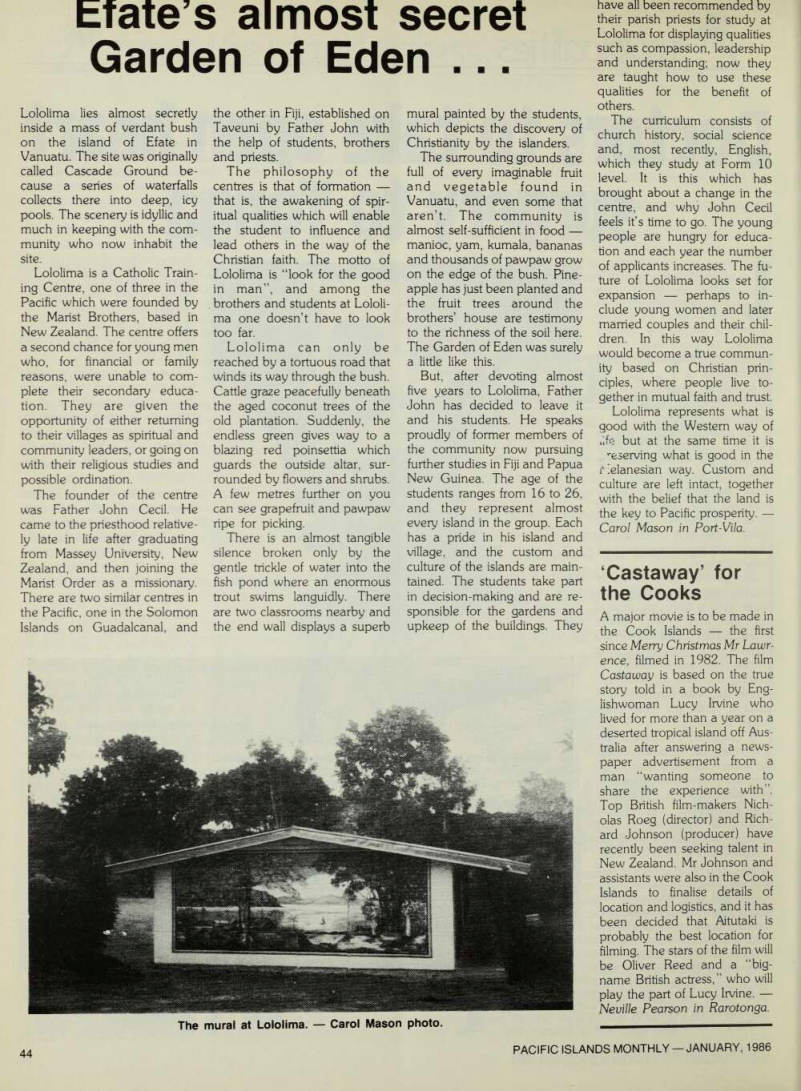
There is an almost tangible silence broken only by the gentle trickle of water into the fish pond where an enormous trout swims languidly. There are two classrooms nearby and the end wall displays a superb
mural painted by the students, which depicts the discovery of Christianity by the islanders.
The surrounding grounds are full of every imaginable fruit and vegetable found in Vanuatu, and even some that aren’t. The community is almost self-sufficient in food manioc, yam, kumala, bananas and thousands of pawpaw grow on the edge of the bush. Pine apple has just been planted and the fruit trees around the brothers’ house are testimony to the richness of the soil here.
The Garden of Eden was surely a little like this.
But, after devoting almost five years to Lololima, Father John has decided to leave it and his students. He speaks proudly of former members of the community now pursuing further studies in Fiji and Papua New Guinea. The age of the students ranges from 16 to 26, and they represent almost every island in the group. Each has a pride in his island and village, and the custom and culture of the islands are main tained. The students take part in decision-making and are re sponsible for the gardens and upkeep of the buildings. They
have all been recommended by their parish priests for study at Lololima for displaying qualities such as compassion, leadership and understanding; now they are taught how to use these qualities for the benefit of others.
The curriculum consists of church history, social science and, most recently, English, which they study at Form 10 level. It is this which has brought about a change in the centre, and why John Cecil feels it’s time to go. The young people are hungry for educa tion and each year the number of applicants increases. The fu ture of Lololima looks set for expansion — perhaps to in clude young women and later married couples and their chil dren. In this way Lololima would become a true commun ity based on Christian prin ciples, where people live to gether in mutual faith and trust.
Lololima represents what is good with the Western way of life but at the same time it is reserving what is good in the Melanesian way. Custom and culture are left intact, together with the belief that the land is the key to Pacific prosperity. —
Carol Mason in Port-Vila.
The mural at Lololima. Carol Mason photo.