enduring imperial thread
pp. 35-36 · Read in the full issue
books
Burns, Philp, 1914-46: The enduring imperial thread
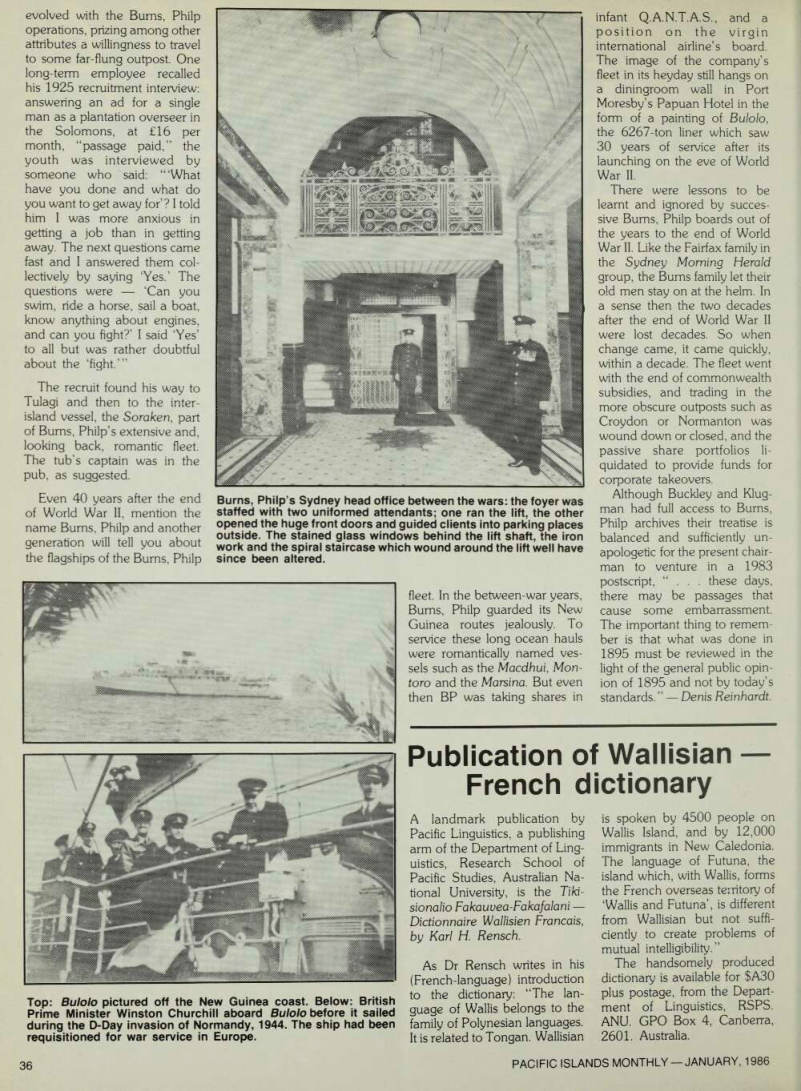
The Australian Presence in the Pacific: Burns, Philp 1914-1946. By Ken Buckley and Kris Klugman. Published by George Allen and Unwin,
1983, Isbn 0 86861 007 0.
Price $19.95.
Anyone with a cursory know ledge of the exploration of the South Pacific would know that it was not until the closing years of the last century that the colonial dismemberment eventuated.
In the forefront of this last soliloquy in the age of imperial ism were the Australians, them selves an emerging identity on a vast, still partly unexplored con tinent.
As Buckley and Klugman note implicitly, Bums, Philp’s guiding characters never lost sight of the effect of political and strategic considerations upon their mercantile liveli hood.
The predecessor volume to this (reviewed PIM Apr’B2 p3B) deals with the emergence of Burns, Philp Ltd. from its 1883 Sydney registration as a com pany to 1914. But it is the period of this study, stretching from the start of one world war to the end of another, which provides the most fascinating insight into an era of intense commercial endeavor matched only by the political guile neces sary to maintain it.
In the earliest days of World War I, chairman, Sir James Burns, foresaw that Germany would lose and focused his attention on preparing for the disposition of German colonial possessions which would fol low. The authors are succinct: “To Bums, it was natural and necessary for Australasia to control the South Pacific and he elaborated this view in contact with British government minis ters and officials, as well as
Australian.” This high-level lob bying brought home to him that Britain’s ally in the Pacific, Japan, also had colonial ambi tions, and to match this long term commercial threat he planned accordingly. Such was Burns, Philp’s political suasion that Prime Minister Billy Hughes agreed to amend the Commonwealth Navigation Act so that the definition of Austra lian coastal trade included Papua and New Guinea. This preserved the territories for
Australian-flag vessels. The Japanese were thus excluded from the important copra traffic.
For at least one Australian the consequence of the com mercial rivalry was fatal. In 1942 when Bums, Philp (South Sea) Ltd. was forced to close its operations in the Gilbert and Ellice Islands Colony due to Japanese occupation, most of the whites were evacuated. A Captain Handley, who had been an officer on Burns, Philp vessels before the war and later
captained the Mangold, was beheaded peremptorily. Years before, Handley had protested to the Japanese naval lieute nant at Jaluit against the exclu sion of a Burns, Philp copra ship by the Japanese.
Apart from being an exhaus tive commercial chronology, the Buckley and Klugman volume outlines the commercial maturity of the company in times of great stress. While substantial funds were frozen in World War 11, ships requisi tioned and the enemy occupied key trading centres and planta tions, Bums, Philp was able to produce solid dividends to shareholders by seizing oppor tunities opened to supply the war effort.
Other centres benefited be cause unlike the uncertainties of copra revenue, local wages and therefore consumer spending was regularly boosted by con struction projects such as air strips and wharf buildings. For example, in the year ended January, 1942, the Pago Pago branch in American Samoa made the extraordinarily high net profit of £12,670 more than any other branch except Suva and Port-Vila.
But the profits didn’t come without a few gripes about the system. James Bums (junior) was a keen critic of taxation and the “maze of regulations” which were part of wartime commercial life.
“In these strenuous and diffi cult times we are all much beset from day to day with trouble some problems which have been increased by many restric tions, price-fixing commissions, Import Procurement Depts., shipping boards, quota embar goes, inward and outward per mits, variations in awards and ‘crossword puzzles’ in taxa tion.”
A certain breed of staff
evolved with the Burns, Philp operations, prizing among other attributes a willingness to travel to some far-flung outpost. One long-term employee recalled his 1925 recruitment interview: answering an ad for a single man as a plantation overseer in the Solomons, at £l6 per month, “passage paid,” the youth was interviewed by someone who said: ‘“What have you done and what do you want to get away for’? I told him I was more anxious in getting a job than in getting away. The next questions came fast and I answered them col lectively by saying ‘Yes.’ The questions were ‘Can you swim, ride a horse, sail a boat, know anything about engines, and can you fight?’ I said ‘Yes’ to all but was rather doubtful about the ‘fight.’”
The recruit found his way to Tulagi and then to the inter island vessel, the Soraken, part of Bums, Philp’s extensive and, looking back, romantic fleet.
The tub’s captain was in the pub, as suggested.
Even 40 years after the end of World War 11, mention the name Bums, Philp and another generation will tell you about the flagships of the Bums, Philp
fleet. In the between-war years, Bums, Philp guarded its New Guinea routes jealously. To service these long ocean hauls were romantically named ves sels such as the Macdhui, Mon toro and the Marsina. But even then BP was taking shares in
infant Q.A.N.T.A.S., and a position on the virgin international airline’s board.
The image of the company’s fleet in its heyday still hangs on a diningroom wall in Port Moresby’s Papuan Hotel in the form of a painting of Bu/o/o, the 6267-ton liner which saw 30 years of service after its launching on the eve of World War 11.
There were lessons to be leamt and ignored by succes sive Bums, Philp boards out of the years to the end of World War 11. Like the Fairfax family in the Sydney Morning Herald group, the Burns family let their old men stay on at the helm. In a sense then the two decades after the end of World War 11 were lost decades. So when change came, it came quickly, within a decade. The fleet went with the end of commonwealth subsidies, and trading in the more obscure outposts such as Croydon or Normanton was wound down or closed, and the passive share portfolios li quidated to provide funds for corporate takeovers.
Although Buckley and Klug man had full access to Bums, Philp archives their treatise is balanced and sufficiently un apologetic for the present chair man to venture in a 1983 postscript, “. . . these days, there may be passages that cause some embarrassment.
The important thing to remem ber is that what was done in 1895 must be reviewed in the light of the general public opin ion of 1895 and not by today’s
standards. ”
Denis Reinhardt.
Top: Bulolo pictured off the New Guinea coast. Below: British Prime Minister Winston Churchill aboard Bulolo before it sailed during the D-Day invasion of Normandy, 1944. The ship had been requisitioned for war service in Europe.
Burns, Philp’s Sydney head office between the wars: the foyer was staffed with two uniformed attendants; one ran the lift, the other opened the huge front doors and guided clients into parking places outside. The stained glass windows behind the lift shaft, the iron work and the spiral staircase which wound around the lift well have since been altered.