Hot competition for aircraft orders
p. 32 · Read in the full issue
aircraft orders
Competition continues strongly among international aircraft manufacturers for the contract to replace Air Pacific’s Ban deirante 18-seat, turboprop feeder planes and take the airline’s domestic services into better strata of operation.
At the same time the manu facturers believe that in the region there is a potential mar ket of 30 or 40 turbo-prop aircraft of 30 to 60 seat capacity in the next 10 years. Fiji’s decision on which type to buy could therefore be seen as significant. Half a dozen conten ders are in the field. Saab of Sweden, with their Saab-Fair child SF34O, British Aerospace with their new ATP. Short Brothers of Belfast, with their Short 360, Fokker of the Netherlands, with the F5O, and the ATR-42, which is a product of Aerospatiale of France and Aeritalia of Italy.
Saab’s SF34O is a 35-seat, twin turbo-prop airliner, 79 of
which will be in service in various parts of the world by the end of this year. The type has so far carried a million passengers with despatch re liability approaching 99 per cent, says Saab.
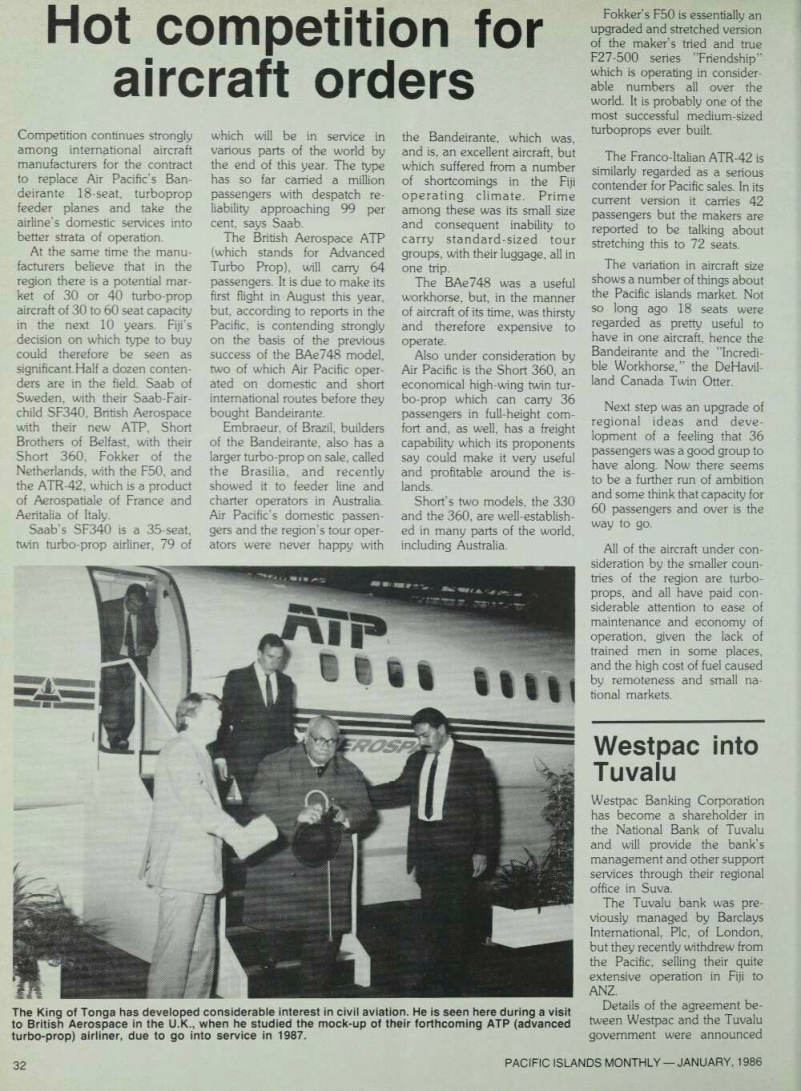
The British Aerospace ATP (which stands for Advanced Turbo Prop), will carry 64 passengers. It is due to make its first flight in August this year, but, according to reports in the Pacific, is contending strongly on the basis of the previous success of the 8Ae748 model, two of which Air Pacific oper ated on domestic and short international routes before they bought Bandeirante.
Embraeur, of Brazil, builders of the Bandeirante, also has a larger turbo-prop on sale, called the Brasilia, and recently showed it to feeder line and charter operators in Australia.
Air Pacific’s domestic passen gers and the region’s tour oper ators were never happy with
the Bandeirante, which was, and is, an excellent aircraft, but which suffered from a number of shortcomings in the Fiji operating climate. Prime among these was its small size and consequent inability to carry standard-sized tour groups, with their luggage, all in one trip.
The 8Ae748 was a useful workhorse, but, in the manner of aircraft of its time, was thirsty and therefore expensive to operate.
Also under consideration by Air Pacific is the Short 360, an economical high-wing twin tur bo-prop which can carry 36 passengers in full-height com fort and, as well, has a freight capability which its proponents say could make it very useful and profitable around the is lands.
Short’s two models, the 330 and the 360, are well-establish ed in many parts of the world, including Australia.
Fokker’s F50 is essentially an upgraded and stretched version of the maker’s tried and true F27-500 series ’’Friendship” which is operating in consider able numbers all over the world. It is probably one of the most successful medium-sized turboprops ever built.
The Franco-Italian ATR-42 is similarly regarded as a serious contender for Pacific sales. In its current version it carries 42 passengers but the makers are reported to be talking about stretching this to 72 seats.
The variation in aircraft size shows a number of things about the Pacific islands market. Not so long ago 18 seats were regarded as pretty useful to have in one aircraft, hence the Bandeirante and the ’’Incredi ble Workhorse,” the DeHavil land Canada Twin Otter.
Next step was an upgrade of regional ideas and deve lopment of a feeling that 36 passengers was a good group to have along. Now there seems to be a further run of ambition and some think that capacity for 60 passengers and over is the way to go.
All of the aircraft under con sideration by the smaller coun tries of the region are turbo props, and all have paid con siderable attention to ease of maintenance and economy of operation, given the lack of trained men in some places, and the high cost of fuel caused by remoteness and small na tional markets.
The King of Tonga has developed considerable interest in civil aviation. He is seen here during a visit to British Aerospace in the U.K., when he studied the mock-up of their forthcoming ATP (advanced turbo-prop) airliner, due to go into service in 1987.