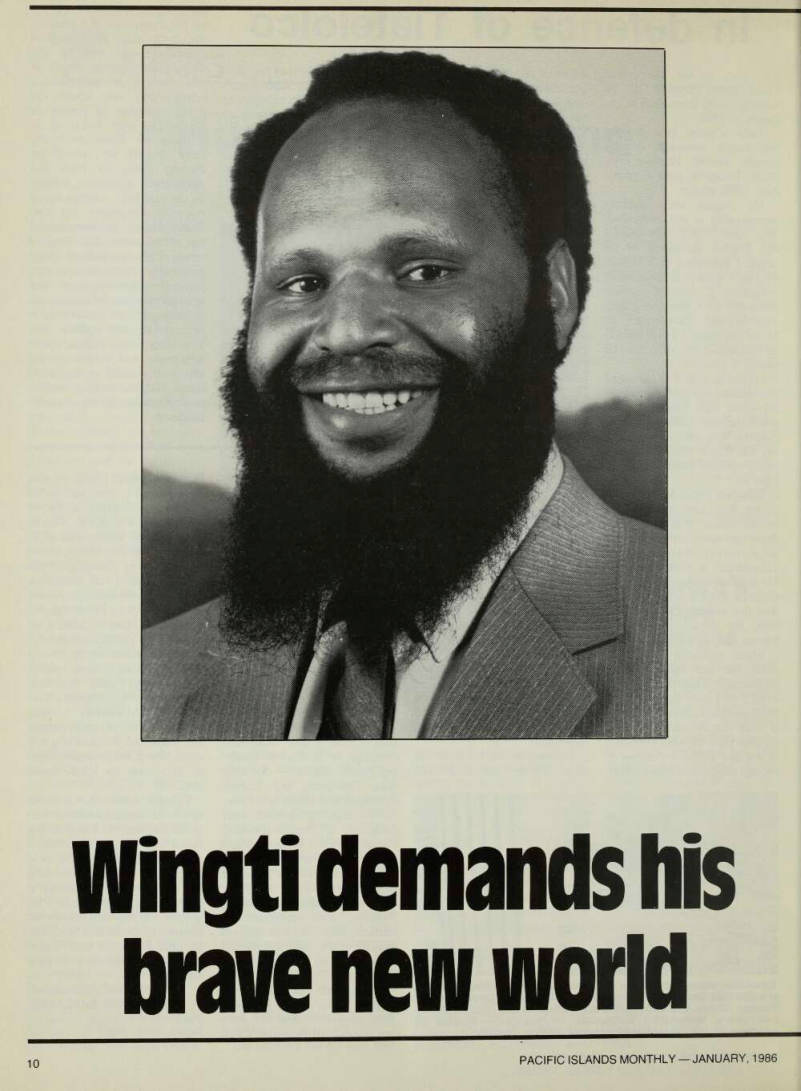
Wingti demands Ms
pp. 10-12 · Read in the full issue
brave new world
Is history repeating itself in Papua New Guinea?
March, 1980: Prime Minister Michael Somare is ousted by a vote of no confidence in parliament and Sir Julius Chan leads a coalition of parties into government.
July, 1982: A general elec tion sweeps Somare back into power.
November, 1985: Somare is ousted by a vote of no-confi dence and Paias Wingti, with Chan as his deputy, leads a coalition of five parties into government.
Some time before July, 1987: Will the next general election see another return of “The Chief,” Somare?
Cynics say it is certainly on the cards that Somare will come back. Wingti says, referring to the 1982 election: “On that occasion our people were sad about Mr Somare being thrown out of office. But I cannot see him getting another sympathy vote this time.”
Somare has certainly left be hind him a daunting burden of economic difficulties and it is the economy which, in the final analysis, which determines the votes. Unless the country is making money there are going to be no riches to share around for people at the grass roots.
The country is certainly not making the money it hoped to.
Government revenue from minerals PNG’s main money-earning export for 1986 is projected to be only 30 million kina, compared to 132 million kina in 1985. Price prospects for most agricultural exports are also dismal.
Australian aid is projected to decline under the new agree ment with Canberra, and be cause of the slide of the Austra lian dollar. Aid in the first half of 1985 at 101 million kina was down 13 million kina on the same period last year.
It would seem that fewer people have been earning and fewer goods have been pro duced, or bought. Latest figures for January - June, 1985, com pared with the same period in 1984, show personal tax collec tion at 53 million kina, down 10 million kina, and company tax receipts at 30 million kina, down 5 million kina. Indirect
tax receipts, usually a good barometer of consumer spen ding, fell by 6 million kina to 73 million kina.
Total government revenue for that period was 254 million kina, down 82 million kina.
Revenue for the full year is expected to fall far short of budget estimates.
On top of that the govern ment deficit for 1985, estimated at 92 million kina, is expected to be far higher. Overseas borrowing stands at 1 billion kina.
One reason for the tax short fall may be the steady decline in employment of expatriates with fat salary cheques. Many com panies are cutting back.
It is not that Somare’s gov ernment was not doing any thing about this state of affairs.
His finance minister, Philip Bouraga, brought down a budget which slashed govern ment spending by 30 million kina and set out to raise an
extra 15 million kina in indirect taxes. This included a 1 per cent rise in the general import levy, widening the net to in clude such basics as rice, tinned fish and meat, flour and sugar; a change in tax valuation on company-provided houses to cost employees up to 17 kina a week more in tax; a 50 per cent rise in the international depar ture tax to 15 kina.
And in the month just before they were ousted Somare’s ministers had announced a whole range of measures aimed at removing what was de scribed as “bureaucratic im pediments to business initia tive,” in a bid to get the economy moving and to win foreign investment.
The law which established the National Investment and Development Authority, the body charged with regulating and monitoring foreign invest ment, was to be repealed. The new law was going to be much
shorter and simpler, setting out standard terms and conditions for those wishing to carry out business in PNG.
Registration would have been much more automatic and far less complex.
And the equity rules which demand a majority control of companies by Papua New Gui neans was to be relaxed and the list of reserved activities not open to foreign enterprise made subject to periodic re view.
The then Lands Minister, John Nilkare, had announced far-reaching changes. His de partment had committed itself to the mammoth task of re gistering the 96 per cent of the country’s land for which there is no written record of ownership.
This would have eventually cut out the long and complicated ownership disputes and even tribal warfare which usually re sults when proposals are put forward for projects on land
belonging to local clansmen, The administrative delays stemming from cumbersome procedures, excessively detailed regulations and a generally overworked Lands Department were also to be tackled. The department’s staffing was to be overhauled and a grossly overloaded manual registry system computerised and the 28 relevant Acts of Parliament consolidated.
The Industrial Relations Act, too, was to be amended.
Strikes in essential services, such as water, electricity and hospitals, were to be outlawed.
Other workers would have been required to give seven days’ notice of an intended strike and fined if they refused to go back if the strike was vetoed by Cabinet.
Somare’s government was not to be fair lurching from one crisis to another, as the Opposition maintained. So
why did Somare lose the confi dence of the country’s elected representatives? It was a com bination of factors, one being public relations. All these posi tive measures did not receive much publicity: many of them were announced at a business seminar but did not get full coverage by the local media, Meanwhile, the problems were getting a thorough public airing as Wingti took the helm of the Opposition in March, 1985.
Another factor was that the batten down the hatches Bouraga budget displeased man V ran k and file MPs. And man V of them had seen the three years of the current term of P ad i a ™ent whizz by without Setting a portfolio or a commit *ee chairmanship, They aJI knew the high casualty rate at past elections for first-termers and many must have reasoned they could not fail to improve their own posi
tions by casting their lots in with the Opposition. And then there was the disenchantment caused by government ministers’ deal ings with Pelair executives and persistent rumors of “get-rich quick” deals for some of those in powerful positions.
So when Sir Julius broke the unwritten convention of allow ing the budget through and threw down the challenge just 48 hours later, he won over 58 MPs to vote for the no-confi dence motion. Somare could only muster 51.
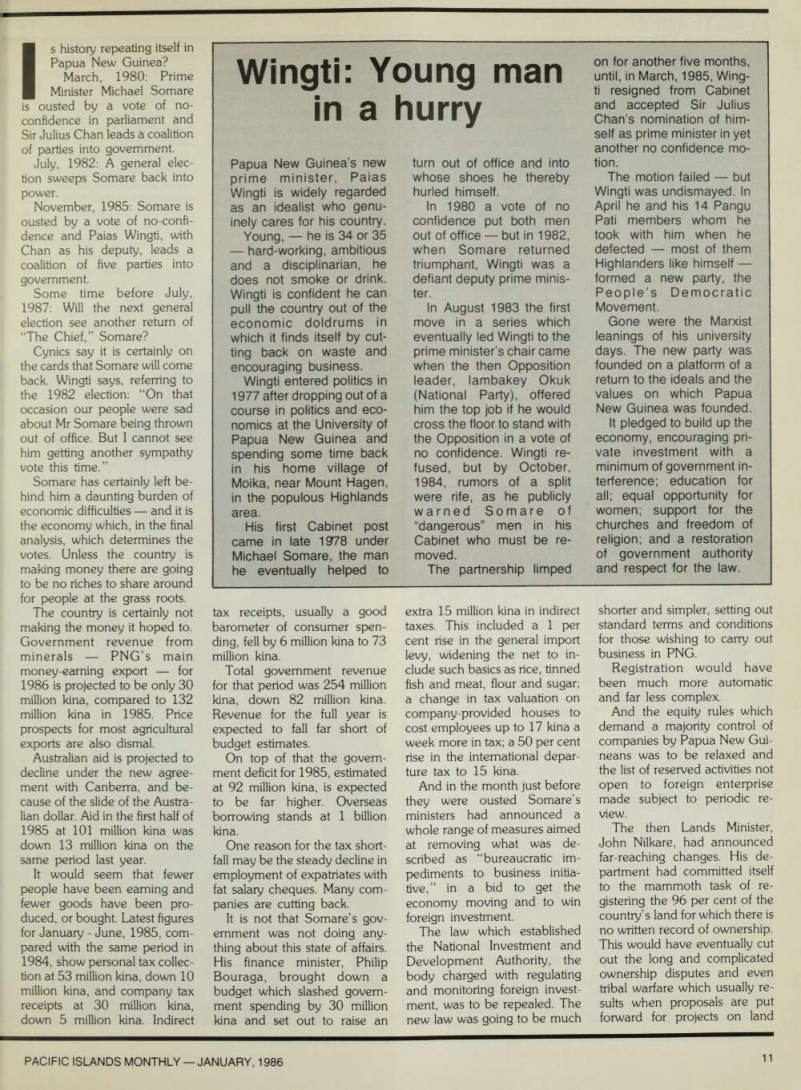
Wingti strode into power with pledges to cut public spending, streamline the public service, encourage business and foreign investment, and promote min ing and agriculture — in fact to do much the same as Somare had been j^B trying to do. JB The question B.; everyone is now o asking is what have B ■ Wingti and his part- B ners got that could make them succeed in 18 months on a prog ram So mare has B been to do JB
for years. One attribute Wingti has displayed is the ability to take decisive action: in his first three days in power he cut the number of government depart ments from 28 to 25 — which Somare failed to do in three years,despite election promises.
In fact Wingti is beginning to reveal an iron will of a style very reminiscent of the Iron Lady of the United Kingdom, Mrs Thatcher. He straight away found over-spending and in ordering an immediate review of government departments said: “Only incompetents need fear change.”
He warned MPs that their “cargo cult mentality of hand outs has to stop” and ordered all his Cabinet to reveal their business interests in a bid to put an
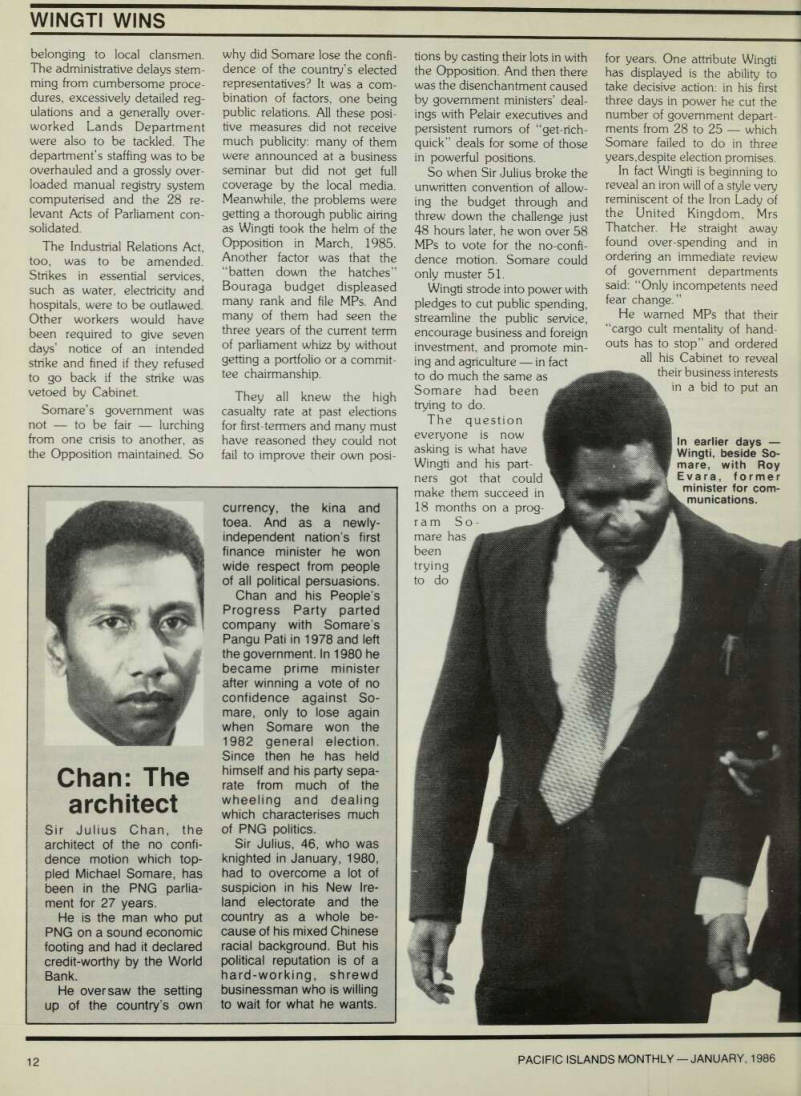
In earlier days Wingti, beside So mare, with Roy Evara, former minister for com kmunications.