In defence of Tlatelolco
I’m sorry to see ill-informed depreciation palmed off as worldly, witty journalism in the pages of PIM.
Take a good look at Roy Vaughan’s coverage of the South Pacific Nuclear-Free Zone Treaty in your Septem ber, 1985 edition.
My disgust with ignorant stereotyping is not one-sided.
The April, 1984, PIM carried my English translation of an article I published in TIEMPO, Mexico’s leading weekly news magazine. It showed up the absurdity of a Mexican comic strip fantasy, “Rarotonga”, so far as anything in Cook Islands or Polynesian history, culture or reality is concerned.
I suppose that, if all I knew of Australian journalism was what someone had told me after speed-reading Wild Men of Sydney, this sort of reporting on the South Pacific Forum’s treaty-making efforts would fit right in.
Vaughan’s put-downs begin in his first paragraph; “Many would argue that the Latin American treaty with the almost unpronounceable name (Tlatelolco) is pretty useless.”
He goes on to say, “. . .at this distance there is an impression that the average South Amer ican, let alone anyone else, knows little about it.”
What possible relevance does the fact that he can’t pronounce “Tlatelolco” have to anything? I have heard Austra lians and New Zealanders make a hash out of their own indi genous place names. Tlatelolco is the site of the secretariat of foreign relations in Mexico City,
a part of that now earthquake wounded metropolis that is steeped in the history of the nation.
How “useless” has the Trea ty of Tlatelolco been? Not only have there been no recorded violations in its zone, but its influence on the South Pacific Nuclear-Free Zone Treaty is clear. I have no doubt that its influence will be found in all future such treaties.
It represents a remarkable achievement, considering that it was born in 1967. That that was a time, when some people thought nuclear explosions could be used peacefully for such things as massive earth moving projects (e.g. canal building), seems regrettable . . . on hindsight. But this is why it made provision for “peaceful” nuclear explosions ... of which there have been none in its zone.
Politics is the art of the possible. With that in mind, the Treaty of Tlatelolco is ex traordinary. Its protocols have been signed by the parties concerned. In the case of the one calling for respect of its zone by the world’s nuclear powers, it represents one of the only if not the only such accord accepted by h\\ five: China, France, U.K., U.S. and U.S.S.R. It is true that not all Latin American nations have signed the Treaty of Tlatelolco, but it also seems apparent that it has served as a restraint on some of those widely believed to have nuclear capability (e.g.
Argentina).
I frankly doubt that there are many literate, educated Latin
Americans ignorant of the gen eral nature of this treaty. I note its mention, again and again, in speeches by Latin American national leaders, especially the president of Mexico. Also, why reference to the “South Amer icans”? It is a long way from the U.S.-Mexico border (where the zone starts) to South America. It is a Latin American Treaty.
Galal J. Kernahan
Newport Beach, Calif.
Usa
Our most sincere gratitude to the respected U.S. and Oceania correspondent of TIEMPO.
While we willingly fling ourselves to the battlements to defend his right to express his disgust and outrage we are forced to wonder if he is being entirely fair to Roy Vaughan by
damning his excellent coverage of the Forum on the basis of one throw-away line. Vaughan points out, too, that he was being quite accurate. In fact he still cannot pronounce the name, and nor could the limited number of people at Rarotonga who knew of it.
Perhaps Mr Kemahan could have helped by telling us, thereby lifting us from our Antipodean ignorance, where in we regularly mispronounce not only Aboriginal, but also Maori, Malay, Indonesian and just about every other kind of name. It is a sad state of affairs which the introduction of com pulsory schooling has not seemed to adjust. More serious ly, however, we wonder if, in fact, rather than opinion, the Tlatelolco Treaty has achieved very much, and just how gener ally it is known and under stood. But, our thanks, indeed, to Mr Kemahan for his views.
Editor.
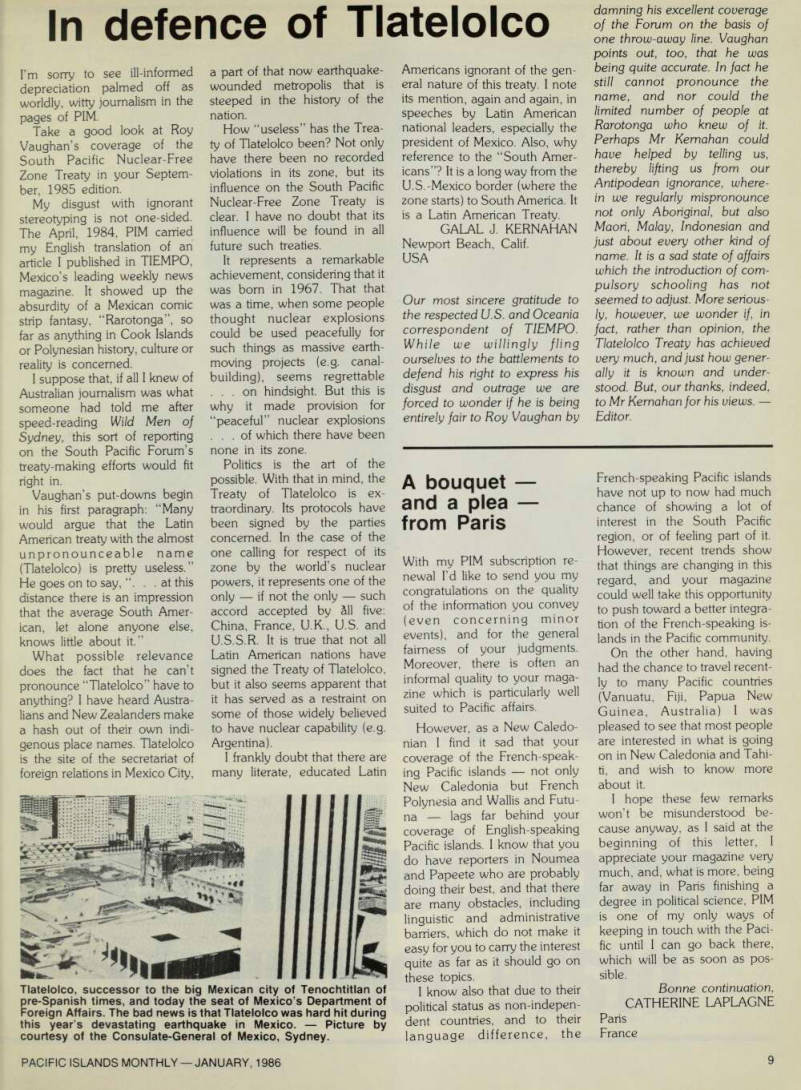
Tlatelolco, successor to the big Mexican city of Tenochtitlan of pre-Spanish times, and today the seat of Mexico’s Department of Foreign Affairs. The bad news is that Tlatelolco was hard hit during this year’s devastating earthquake in Mexico. Picture by courtesy of the Consulate-General of Mexico, Sydney.