the bomb
letters
Human rights and the bomb
In their attempt to negotiate their political destiny, and con scious particularly of the press ing need to attain economic self-sufficiency, the Microne sians have not completely sold out but are hesitantly trading their fundamental freedom of choice and liberty for economic gain, and for the potentially devastating promise of security and protection. What would they choose if they were given the option true sovereignty (independence), or a necessary security shield for their own protection and for the protec tion of their neighboring na tionalities? This is a critical question, and is directly related to the controversies surroun ding the permanent denial clause in the compacts of free association.
True to its name, the denial clause effectively denies full Micronesian sovereignty. In their last best hope of winning the battle against this oppres sive denial of their basic human rights the Belauans have initi ated the most humanistic, fair, and peace-oriented diplomatic action of the 20th century: the nuclear-free zoning principle.
Yet this move is seen as threatening to the world pow ers. Why?
The implications of this issue are far and wide, and rightly controversial in world politics.
At issue are two incompatible political stances taken by the U.S. States and the Belauans.
The U.S. position is explicitly clear in the written form of the denial clause. In a dip lomatically ingenious move, de finitely in opposition to the U.S. position on this issue, the Be lauans are shielding themselves by drafting into their constitu tion nuclear-free zone provi sions. These provisions are in tended to protect the sovereign territory of Belau from trans port, storage, and deployment,
or in general, utilisation of any war-related devices (nuclear weapons and poisonous chemi cals).
Given the likelihood that a third world war will be fought exclusively with nuclear weapons, the Belauans are essentially declaring themselves a war-free nation. Through the exercise of their fundamental freedom of choice, the Belauan people have chosen to be free of any direct or indirect war related activity in their territory by all countries in the world, including the United States.
They have suffered enough from wars that they never initi ated, and preparations for wars that they do not want.
Recognising the adverse and
potentially disadvantageous effects of the Belauans’ action, particularly its potential for up setting the balance of military dominance in the western Paci fic, the U.S. has vigorously opposed this humanistic, origi nal, and fair declaration of human rights.
Against the U.S. or the Soviet Union, or any other nation in the world, the Belauans will continue to protect themselves with the nuclear-free zone pro visions.
Wedged between these two opposing world powers and antagonistically threatened by them, the last best hope of survival for the Belauans cri tically depends on world-wide recognition, acceptance, and
support of their desperate cry for world peace. If they are destined to be completely eliminated from the face of this earth either by direct nuclear war action of simply by “acci dents” of nuclear testing Micronesia is a high-risk area as far as these two matters are concerned, history will testify to this Belauans should be remembered and credited in history as the first group of people in the world to initiate, take action, and fight to the end for the humanistic declaration of a nuclear war-free world.
This is the only way they can effectively combat a world super-power.
Rufino Mauricio
Eugene, Oregon
Usa
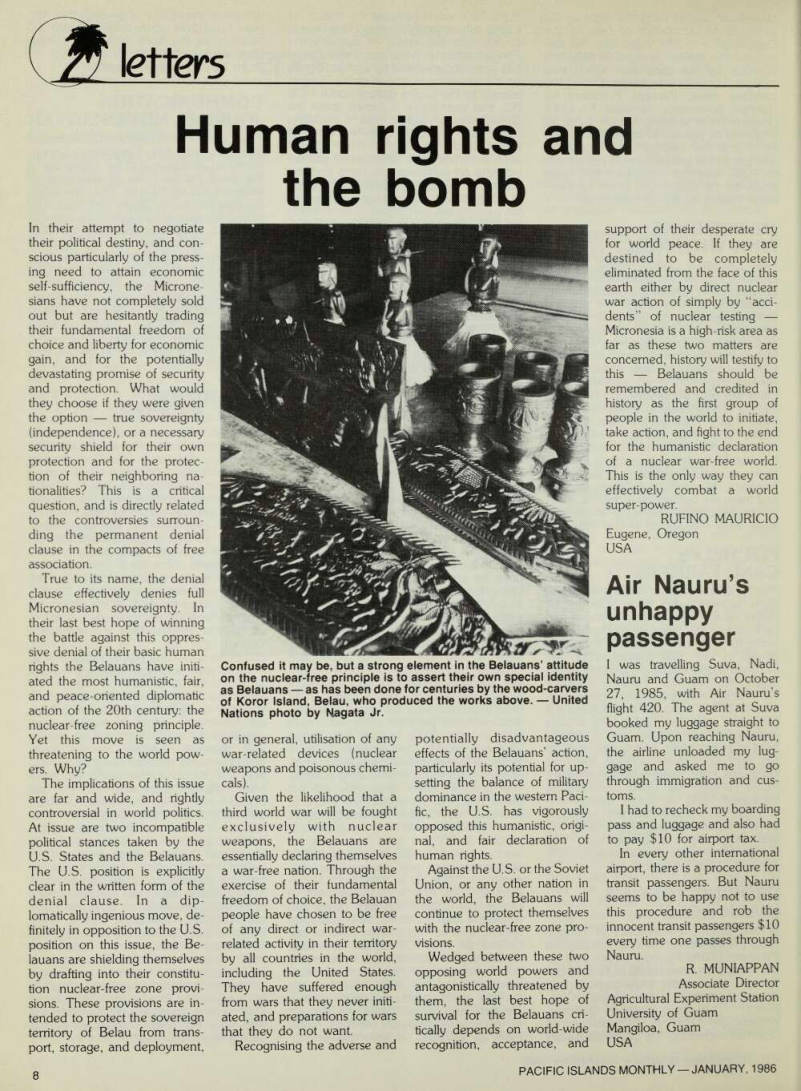
Confused it may be, but a strong element in the Belauans’ attitude on the nuclear-free principle is to assert their own special identity as Belauans as has been done for centuries by the wood-carvers of Koror Island, Belau, who produced the works above. United Nations photo by Nagata Jr.