Fiji Labor Party
pp. 17-21 · Read in the full issue
"Win or bust” bid by Fiji Labor Party
Whichever party wins the two by-elections held in Fiji in Novem ber, the results will be of immense political consequ ence to the country. They pose a test on which either the two established racially-aligned par ties, or the newly-formed, and professedly multi-racial, Labor Party could falter, or even founder.
One by-election is for a Fijian communal seat, and the other is for a national Indian seat, which means that voters of other races, Fijian and the general electors (non-Indians or Fijians) will also cast their votes.
The trade union-supported Labor Party which came on the political scene in Fiji only in July of this year is contesting both seats. The Indian-dominated National Federation Party, which forms the Opposition in parliament, is not fielding a candidate in the Lau-Rotuma Fijian seat.
The by-elections came about because of the death earlier this year of the member for Lau- Rotuma, Mr Jonati Mavoa, at the time the minister of foreign affairs, and the resignation from the House of Sir Vijay R.Singh, formerly member for the Indian national seat of Lautoka. Sir Vijay was appointed chief ex ecutive of the newly-formed Sugar Cane Growers’ Council earlier this year.
Lau-Rotuma is a blue-ribbon seat of the Alliance party. In the 1982 general election, the only occasion on which Mr Mavoa was opposed, there were 7345 registered voters, of whom 83.34 per cent, or 6330 cast votes, 6121 in favor of Mr Mavoa. The only other candi date, Mr Desmond Faigaitu, of the National Federation Party, polled 209.
The Alliance has chosen as its candidate Mr Felipe Bole, 49, an experienced civil servant,
who has served as a depart mental permanent secretary and as a diplomat (Fiji’s perma nent representative to the Un ited Nations in New York). Mr Bole’s last job was at the East-West Center in Honolulu as director of the Pacific Islands Development Program. He comes from a chiefly clan and graduated with a master’s de gree from Victoria University in New Zealand.
Mr Bole was challenged by one of the Fiji Labor Party’s vice-presidents, Mrs Jokabeci Koroi, 54, a former nursing sister who has been a unionist for 14 years. Mother of six children, she is the national secretary of the Fiji Nurses’
Association.
The Lau-Rotuma seat is a straight two-Way contest be tween the time-tested Alliance Party, and the brand-new Labor Party, unknown and un tried.
In the contest for the north central Indian national seat pre viously held by Sir Vijay Singh, it is a three-cornered fight be tween two brothers and one of the founders and guiding lights of the Labor Party, Mr Mahen dra Chaudry.
When the Labor Party was launched in July its leaders said they were not planning to make a big impact in the 1987 gen eral elections. They said they were charting a 10-year course and aimed to ’’form the govern ment in 1991.” However, initial support and enthusiasm from the public, and the two by election chances have tempted them to try themselves at the hustings.
Mr Chaudry, 43, was bom and raised in the Ba-Tavua area and is one of the best-known, and most ambitious, of Fiji’s labor leaders. Since 1960, when he joined the Auditor- General’s office, until his res ignation in 1975 to become the
general secretary of the 7000strong Public Service Associa tion, Mr Chaudry has lived in Suva. He has built up a reputa tion as a firm union organiser but in recent years has made little secret of his political ambi tions both within and outside the union movement.
Chaudry has considerable following among public ser vants who see him as their champion. He is an aggressive negotiator and has given the government some bad times.
Mr Charles Walker, then the finance minister, resigned from the Cabinet about two years ago in protest after the govern ment bowed to public service pressure for a pay rise regarded as damaging to the national economy.
Chaudry also formed a far mers’ organisation in Vanua Levu and although his power base is the public service, he can except some support from this sector of the community, which may give pause to the National Federation Party which has its power base among the sugar farmers of the Western Division.
Chaudry has put his future, and possibly that of Labor, on the line by taking part in the by-election. A defeat could be political suicide for them both.
He and his officials went into the vote confident that they were offering the electorate the best choice, and hoped to capitalise on the open split between the two factions of the
Nfp.
Given this split, and the poor support the Alliance has in this electorate, Chaudry probably has a good chance of victory.
The Alliance has fielded Mr Uday Singh, 45, younger brother of the National Federa tion’s candidate, Mr James Shankar Singh, 61, a former president of the Indian Alliance and once a member of Ratu
Mara’s Cabinet.
Mr Uday Singh was bom in Ba, a member of one of the richest cane-farming families in the area. He has been a staunch supporter of the Alliance, despite his brother’s upset and eventual defection to the NFP.
Uday Singh unsuccessfuly contested the same seat in 1977 and in the last election, 1982, he lost by five and a half votes against Sir Vijay.
James Shankar Singh, the NFP candidate, is one of Fiji’s most experienced politicians.
He was for many years presi dent of the Indian Alliance, one of the three constituent parties of the Grand Alliance, more commonly called the Alliance Party, which has formed Fiji’s government since indepe dence.
Previously James Singh was running mate with Ratu Mara, but had differences with him and resigned from cabinet. He resigned from the Indian Alliance in 1981 and had since kept a low profile until his election earlier this year as the NFP’s organising secretary.
Voter apathy is generally pro nounced in by-elections in Fiji and a low poll was expected.
The Labor party appeared to be the most vigorous on the hustings and with good reason.
Their votes depended upon a change of mind in the public.
The Alliance was depending upon the split in the NFP to bring Indian voters over to their side to add to their traditional block support from Fijians and such as the Gujerati merchants who normally support the establishment.
The NFP rates its chances as good. It concedes it may lose some of its traditional support to the new party, but says this drift will not be enough to bother its chances of success.
Like the Alliance the NFP di misses the Labor Party as sim ply an aberration of nuisance value only.
But inside its committees, the NFP does seem to be afraid of their own factionalism. The Koya group, supporting James Shankar Singh, is clearly at odds with the former NFP lead er, Jai Ram Reddy, and his supporters. They appeared to be working for James Singh and for the Labor Party’s Mahendra Chaudry.
Seen on television with the clarity which mod ern satellite communica tions provides even to the furthest corners of the globe, Caspar Weinberger comes across as a steady, mod erate, clean-shaven, collegiate sort of man. He is soberly suited, calm of voice, measured of tone, determined, and obviously aware of the awe some power he wields as mas ter of one of the world’s great est military machines.
And yet he also gives the impression of being thoughtful and patient; ready to listen to those who differ with his coun try’s view.
Whether he is prepared to do more than listen might also be doubted, at least if you happen to be David Lange, prime minister of New Zealand with whom Weinberger, and the rest of the American administration, are at odds over whether or not an ally should sink his own principles (and political liabili ties), in order to honor a long standing fraternal agreement.
The question is of immense importance to the Pacific, not only because of the effect it has had upon the credibility of the ANZUS agreement, but also because of the pressure it has put upon the other countries of the region.
Australia is particularly and vitally involved. The Americans have given some the appear ance of demanding that Austra lia choose between their close family friendship with New Zea land and their need of the power of the United States.
And that presents Canberra with a terrible dilemma, for it is a fair guess that if such a choice had to be made, particularly with Australia under a Labor government, the nod would not go towards Washington, de spite the obvious and powerful need of the trans-Pacific con nection with the superpower.
That may be too coarse a way of expressing a most com plicated problem. But, the fact that the situation is now in its current fragile state may also be a sign that the Americans do not quite appreciate the delica cy of the matter, nor the depth of the life-long relationship be tween the ANZAC countries.
All of this was the major topic
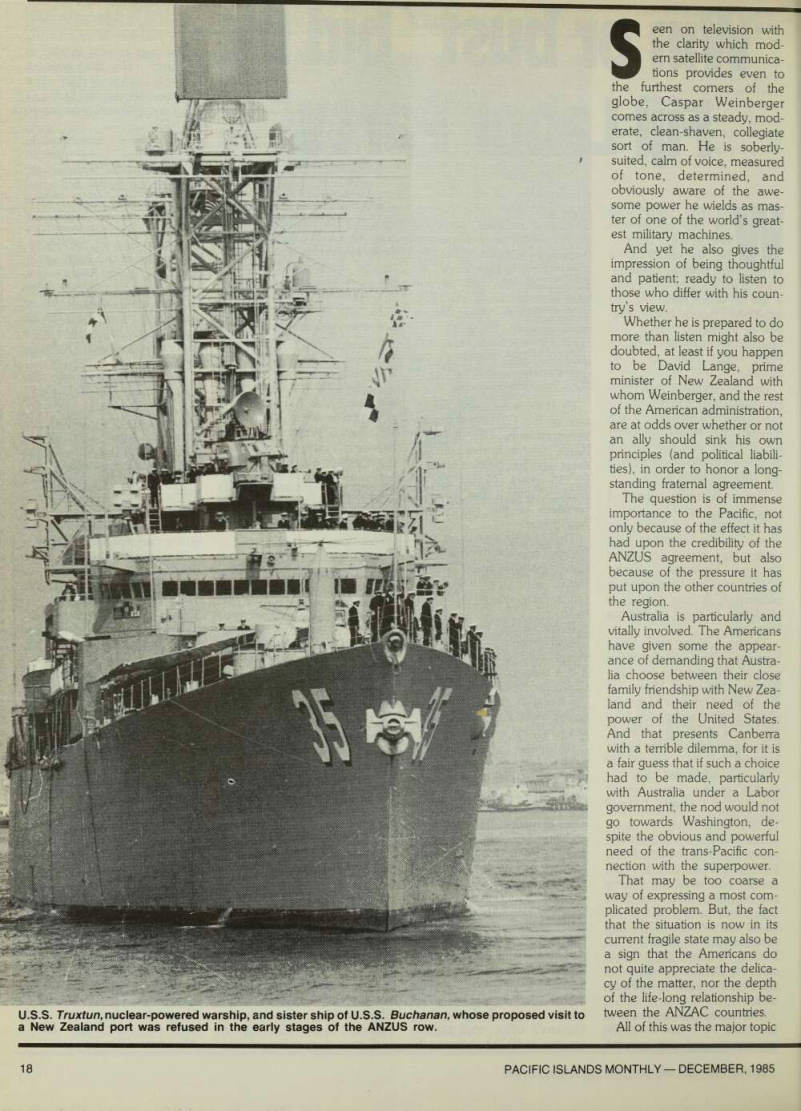
U.S.S. Truxtun, nuclear-powered warship, and sister ship of U.S.S. Buchanan, whose proposed visit to a New Zealand port was refused in the early stages of the ANZUS row.
Of all the vexatious topics currently disturbing the political waters of the Pacific, few rival the argument between the United States and New Zealand over the harboring of nuclear ships and weapons. The stubborn postures of both countries have eaten out the roots of ANZUS, one of the oldest and most important mutual defence agreements in the region.
There are signs, as we report elsewhere in this issue, that New Zealand’s David Lange no longer has the fullest support of his countrymen, but, borne along also by the huge international furore over the Greenpeace bombing, he is maintaining his stand.
Against him, equally adamant, Lange faces a U.S.
Secretary of State, George Shultz, not known for his patience with those who confront him, and the milder-mannered, but equally firm, US Secretary of Defence, Caspar Weinberger.
Weinberger recently was the subject of an international, satellite-linked interview with senior journalists in Australia, New Zealand, and Asia.
Pacific Islands Monthly’s publisher, GARRY BAR KER, was there.
Weinberger’S Anzus Doctrine
"we would welcome NTs return, anytime...”
in an international press confer ence conducted recently with Weinberger, using the Intelsat satellite and ground facilities in Australia, New Zealand, Japan, Korea, the Philippines and Singapore.
Following is a transcript of some of the questions and answers relating to that, and other Pacific matters: Q: Various U.S. spokesmen have said you want to review your involvement in ANZUS if New Zealand passes nuclear
free legislation. What do you want to review? What are your options?
A; If New Zealand takes a final legislative stand that would prevent our being able to carry out our responsibilities under the ANZUS Treaty and also prevent New Zealand from carrying out theirs. Obviously we would have to think about establishing security arrange ments for the area that divided the burdens as best we could without, apparently, the par ticipation of New Zealand.
This would be a source of great regret to us, not only because of our long personal friendships and historic associa tions and alliances that we have had over many years, but be cause of the very bad effect that it would have on the security of the whole region.
So we very much hope that we won’t have to reach this point. We would very much hope that presently New Zea land will understand how vital it is for their interests, for ours, for Australia, that we continue to work together, as we have for so many years.
Q: That would seem to fore shadow a total pullout by the U.S. from ANZUS, and perhaps development of an arrangement with Australia. Is this so?
A: We never like to deal in hypothetical types of questions.
We just hope that it will be realised that the arrangement we had where the three of us work together, share burdens, share benefits and maintain the security of the whole region, could be continued.
It should be recognised, how ever, that if New Zealand de cides that they simply don’t want to do that, or that they have a policy which they feel precludes their doing that, then we would have to look at what methods we have of protecting our own interests in Australia and other nations in the region; how that could best be carried out.
Q; What action do you want New Zealand to take that would mean you did not reach that point where you had to negoti ate separate agreements?
A; We do not understand why we cannot simply continue as we have been for so many years, until about a year to a year and a half ago. We have never fully understood, and do not understand to this day, what benefits New Zealand thinks can come to itself or to the region by this kind of action.
It is an attempt to force us to change a world-wide policy, a world-wide commitment, that we have to fulfil with our Navy in ports in all the continents, and that we simply cannot change. That is the policy of neither confirming nor denying the presence of nuclear
weapons.
It would give a great deal of valuable information and aid and comfort to the enemy if we would be forced to disclose that. So we cannot do that. And a country that tries to force us to change that policy - simply, that can’t happen.
So that is why we would have to think about major changes, should that become the permanent policy of New Zealand. We very much hope it won’t.
Q: But do you accept, though, that in the proposals that were presented to you recently by New Zealand's de puty prime minister, Mr Geof frey Palmer, New Zealand accepts that the United States will not confirm nor deny whe ther the weapons are on board the vessel?
A; Yes, but that policy was basically, I’m sorry to say, total ly unworkable. It was a propo sal that we would allow, as we understood it, some official in New Zealand to decide whether there were or were not nuclear weapons on board. If he let a ship in, why then, presumably, there would be the announce ment to the world that that ship did not have nuclear weapons.
He was, presumably, going to make some sort of inspection offshore and make a unilateral decision as to whether an American ship could come in and help fulfil its joint security mission with New Zealand.
It was patently unworkable and I think that is the very kindest way to phrase it.
We were sorry. We were hoping it would be something useful, but clearly it was not.
Q; Well, to get to the bottom line, then, are you saying New Zealand either accepts, without questioning them, all United States naval vessels into its ports, or they lose ANZUS?
A; No, what we are saying is that we should have a continua tion of the policy that we have had for all of the years since the ANZUS Treaty was signed that has worked so very well, and that is, that when American ships are proposed for port visits to New Zealand, which, in the past, have always been not only very popular, but very vital for our naval exercises, that those visits be accepted, provid
ing other conditions are right at the time.
We have never said that an American ship or any ship had to be accepted by New Zealand at any time or at any place, but we did have to insist and we do have to insist that we can never confirm or deny the presence of nuclear weapons on any ship.
Q: From your own know ledge of New Zealand politics, do you think it is realistic to ask Prime Minister Lange to over turn this quite fundamental policy that his government and his party have endorsed time and time again, which is to bar nuclear weapons from New Zealand?
A: It has been a fundamental policy for only a few months and I would not dream of advising New Zealand what they should do about their own policy. That is eminently the business of New Zealand. But, on the other hand, it is proper for me, since you have in quired, and since we have done so many times, to point out the consequences of this very dras tic change in the fundamental policy of New Zealand.
Q: Will America pull out of ANZUS if the New Zealanders go ahead with their decision to pass that denial of ship visits into law?
A; To a very considerable extent, New Zealand has pulled out of the alliance by the action that it has taken thus far. That is why we say that we hope very much that they will rethink that position and agree to the value of the continuation of the alliance and recognise the benefits and the burdens that we all share and we all bear in helping to keep the peace in this major and vital region of the world.
Q: But will America pull out of the ANZUS alliance if this happens?
A; You keep asking that as if it is some sort of unilateral decision that we would take.
We are not able to perform the duties and the responsibilities that we have under the ANZUS alliance if one of the partners simply says, “you can’t come in under any circumstances unless you break your world-wide policy.”
It isn’t a question of our pulling out. We have responsi bilities and the only way they can be fulfilled is by an active presence of the fleet and of various other security assets in the region. Australia recognises that. Every other country in the region recognises that.
Q: So if ANZUS does be come inoperative, would America seek a new bilateral arrangement with Australia? A: I think we have a bilateral arrangement with Australia that is working extremely well, and I think the Australian govern ment has recognised the vital nature of continuing that kind of relationship and that, in effect, and in essence, we have already established a very good bilateral relationship and hope very much to continue that.
Q: Would you keep the framework of ANZUS open and welcome New Zealand back at any time?
A: Oh, yes, there’s no desire to punish anybody or anything of that kind. The conditions that gave rise to the ANZUS Treaty are still there. Nothing has changed. The only thing that has changed is the policy of New Zealand, which I hope is temporary, and which, in effect, prevents our carrying out our obligations and prevents the ANZUS organisation from doing the very vital task that it has performed so very well of keeping the peace in that whole region.
There’s some theory that if you don’t have nuclear weapons you somehow are no longer a target and are there fore perfectly safe. And, very sadly, Belgium and a number of other countries are around to testify that that just isn’t so. You get trampled on, and smashed, just as quickly whether you have weapons or whether you have a treaty, if you happen to be in the way of an aggressor.
The way you keep the peace is to be strong enough through mutual action to deter war.
Q: Could you see any form of new arrangement being set up in the Pacific to include Japan?
A: We have a very good, close, working rleationship with Japan and I think it is vital that
we do. It is vital that we recognise that conditions have totally changed, and reversed themselves in the past 40 years, and it is vital to have the help of Japan in helping us all preserve peace.
There’s a growing threat from the Soviets in that whole region. They are increasing their naval and their air assets very rapidly. They are making vey major use of Cam Ranh Bay in Vietnam and other areas, so it is important to have the help of everyone.
Japan is a very strong coun try, and we think can contri bute, and is contributing, in a major way, to the security and safety of all of us in that very important part of the world.
Q: That Soviet threat on Cam Ranh Bay is now serious ly threatening our sea lanes of communication in the Western Pacific, certainly for America to respond to any situation in the Middle East. How do you see this in relation to the problems of the Philippines and the con tinued existence of the Amer ican bases at Clark and Subic Bay?
A: We think the security arrangements that are in place are vital, are necessary, and should continue. We think that it is essential that we maintain this kind of capability of dealing with what is clearly a growing Soviet threat. If it is not there, if we are not able to do that, you add not only credibility to the threat, but ym encourage it. It is only when you have the ability to make a strong and immediate response that a country like the Soviet Union will understand that an attack by them will gain them nothing.
If you encourage them, if you tempt tyrants, so to speak, then you are in a situation in which you are apt to have aggression start.
Q; How do you see New Zealand’s new plan for taking a wider, but lesser, military role within the Southern Pacific?
A; I really have not seen sufficient detail of what additio nal burdens would be carried as a result of that. We don’t really have any clear idea, any good idea, of what is intended. But nothing can be substituted for
the arrangements that we have had in effect and urgently need in the future. Certainly nothing that New Zealand could do, if they are not going to reverse their present policy, would re store for them the kind of security they had during the period when the ANZUS Treaty was fully in effect.
The hour-long conference then diverted to discussion of Asian defence questions, in cluding the continuing build-up of military strength in North Korea, and the still developing Soviet involvement with it.
Mr Weinberger was also questioned about the Strategic Defence Initiative (5.D.1.) or “Star Wars” program, and asked if he thought it would jeopardise the Geneva talks (“I don’t think so.”) or whether President Reagan was likely to modify his position on it.
“The S.D.I. does not jeopar dise anybody or anything,” he said. “It offers a very much greater hope to the world that nuclear weapons will be re ndered obsolete and impotent.
The president is fully deter mined to continue with the research necessary to see if we can deploy such a system...it offers too much hope to the world to give up.”
The conversation continued through US-China relations on which Mr Weinberger said: “...what we are talking about are ways to modernise and strengthen the defensive nature of China’s military capabilities. I think most people agree that that’s a good and necessary thing to do, particularly in view of the size and strength of the Soviet threat on their borders. ”
He conceded that the US public and the Congress now sought reforms in the Philip pines, but fended off hypotheti cal questions about what the US might do if their bases in that country came under attack as part of a break-down of the current regime.
However, he said, “we re gard the bases as important to us, the Philippines and the region. We have contingency plans to do what is necessary to
preserve and protect those bases and enable them to be used, to continue to maintain the freedom of the Philippine islands and the Pacific region.”
He was asked whether secur ity conditions .had changed in the Pacific, especially since Soviet naval strength in the ocean had grown considerably.
“Without any question,” he said. “When I said the condi tions which led to ANZUS were unchanged I meant that the need to band together to deter attacks by the Soviets had not changed. But the actual strength of the Soviet Union has increased, and is increasing on a very alarmingly rapid basis, and so the threat has increased, but the factors which led us to associate have not changed. ”
Did he see any role for the ASEAN countries taking a greater share of the defence burden in the Pacific - perhaps through some kind of regional grouping?
“It is not important whether strength is maintained through an organisation,” he replied.
“What is vital is that the job be done.”
Again he was asked what would happen when, or if, New Zealand passed its nuclear-free legislation.
“We would hope,” he said, “that further, calmer, con sideration of the whole problem and its consequences would lead to some change of thinking and some recognition of the fact that we cannot change the no-confirm-or-deny policy, be cause of our world-wide com mitments and our responsibility to preserve and protect our ships and their ability, in turn, to preserve and protect freedom in the region.
“We hope that this re-ex amination will lead to the con clusion that the conditions that we have had in the past have worked extraordinarily well for all three countries.
“There is not only no reason to change and to weaken those.
There is every reason in the world, in view of the growing Soviet threat, not to do so.”
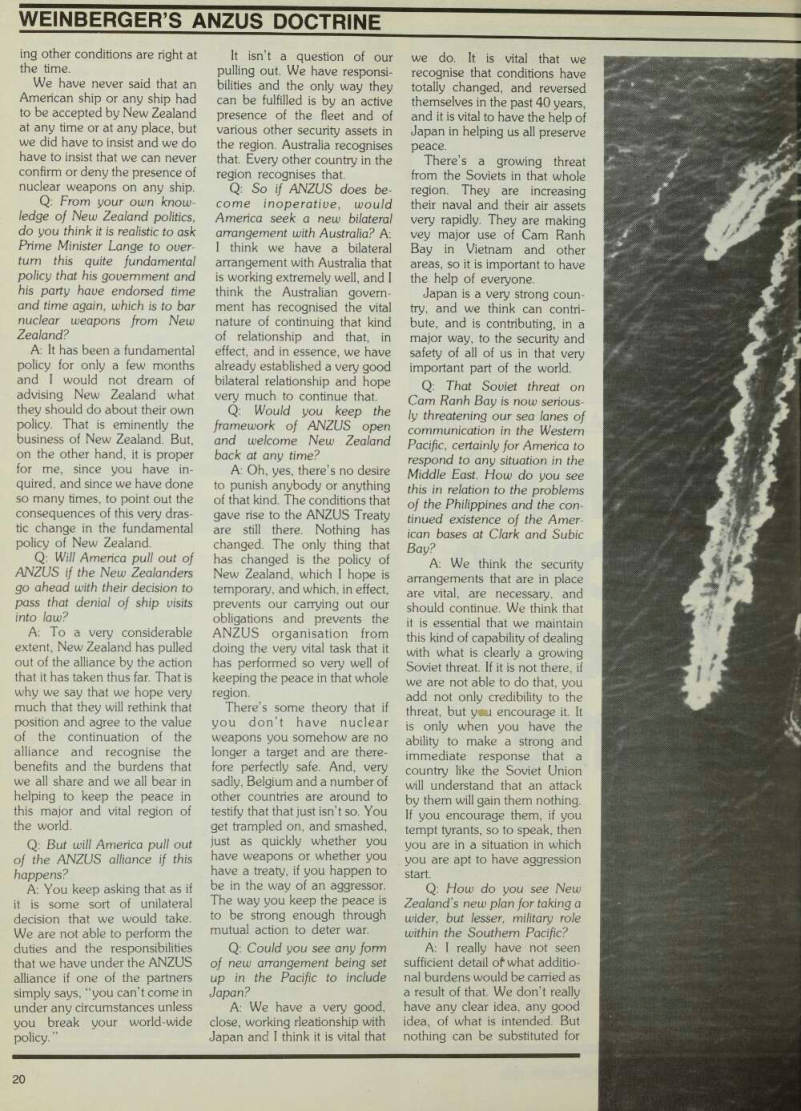
The giant nuclear-powered aircraft carrier, U.S.S. Enterprise ...
“the U.S. cannot and will not change its neither-confirm-nor-deny policy on nuclear propulsion or nuclear arms.”