constant factor”
pp. 11-16 · Read in the full issue
Irene Narayan Interview
"in Fiji race is the constant factor”
The Iron Lady of Fiji.. the “Mrs Indira Gandhi of Fiji”., the ’’only real man among the 52 members of Fiji’s House of
Representatives...”
These and other terms have been used to describe the sari clad, 53-year old, Mrs Irene Jai Narayan, who has been con stantly returned to parliament with huge majorities for the past 19 years in an Indian commu nal seat for the capital city, Suva.
Mrs Narayan came to Fiji from India, her birthplace, in 1955, at the age of 23 when she married a Fiji citizen, Mr Jai Narayan. Both had met at Benares University. She was born, and had her early educa tion at Lucknow, the youngest of nine children, of whom only three survive, a brother and a sister.
While she has emerged as a very powerful, fearless, and outspoken politician in Fiji, poli tics does not run in her blood.
Her father and brother both had Army careers.
At college she dabbled a little in student affairs, but she was not fond of politics. When she came to Fiji and joined the teaching service as a higher school teacher there was still no thought in her mind of a politi cal career.
Then the late A. D. Patel, founder of the National Federa tion Party and the first Leader of the Opposition in the parlia ment, approached her to con-
Politics make a heady brew in Fiji. Cabinet shuffles ... speculation about new prime ministers ... yet new splits in the National Federation Party .. the formation of the Fiji Labor Party, seeking to cut across the traditional, racially-arranged, voting sys tem. All these and much else fill the minds of the gossips.
Through it all the name of Irene Jai Narayan, former deputy leader of the NFP, the only woman in the parliament, constantly is heard, especially now in the wake of her virtual sacking by the party leader.
What will she do? Will she join the Labor Party? Will she soldier on against the autocratic leader, Siddiq Koya?
Our Suva Correspondent interviews this lady of strong personality and great determination; admired by many, particularly among the nation’s intel ligentsia, and avoided by others who accuse her of nagging too much. But, as our correspondent reports, not a soul can ignore her.
test a communal seat against the well-known lawyer, the late A.l.M.Deoki.
Mr Patel had heard Mrs Narayan speak at some rallies and was convinced she had the makings of a fine politician.
While she felt unsure of herself, Patel and others urged her on and she went to the hustings, defeating Mr Deoki in resound ing fashion. Ever since then she has been returned with a thum ping majority on the NFP ticket.
But 19 years later things are quite different. Mrs Narayan is now highly unlikely to contest the next election as an NFP candidate.
Now the situation is quite different. Mr Patel is long dead.
The former leader of the opposition, Jai Ram Reddy is no longer in office. The leader of the party is now S.M.Koya whom she once challenged for the leadership and lost by one vote.
Mrs Narayan and Mr Koya have never seen eye to eye politically, and the animosity goes back to the great NFP leadership crisis in the wake of the April, 1977 general election which the NFP won, but after which they could not form a government. Mr Koya was party leader at the time, having taken over from A. D. Patel.
From the political shambles Koya was turned out and the party leadership was given to Jai Ram Reddy, a Lautoka lawyer. Mrs Narayan was large ly responsible for the second general election that year, and the campaign which led to the ousting of Mr Koya.
While Mrs Narayan still main-
Continued on page 14
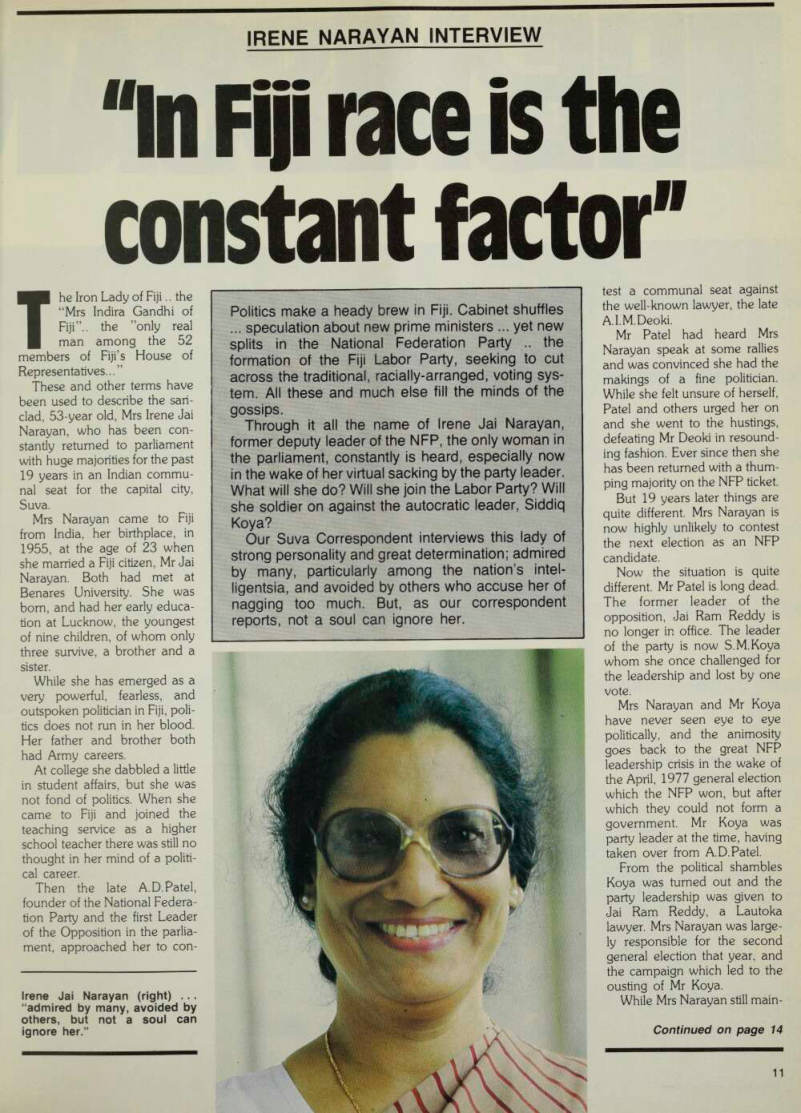
Irene Jai Narayan (right) . . .
“admired by many, avoided by others, but not a soul can ignore her.”
tains she is a member of the Opposition, she has withdrawn her support from the leadership of Mr Koya and has vowed not to work with him. In her 19 years she has become experi enced, mature, and a very shrewd, knowledgeable and fearless politician. She was elected the president of the party in 1977 and Opposition Whip in 1978.
In 1977 she was made depu ty leader but in 1979 when there were moves for the reunification of the two NFP factions, the Flower Group, under Mr Reddy, and the Dove Group under Mr Koya, in pre paration for the 1982 elections, a compromise was worked out in which she gave up the presidency to a Koya man, Mr Ram Sami Gounder. She re mained deputy leader and sha dowed the finance minister.
In a reshuffle of the NFP shadow cabinet in July this year Mr Koya dumped her as deputy leader and appointed Mr Koresi Matatolu. She was offered the education portfolio, but re jected it.
Today she says she cannot support Mr Koya’s style of leadership which, she says, ’’depends upon bluff and blus ter.”
The days when politicians could thrive on this sort of thing are gone, she says, but Mr Koya has not changed. He is fond of forming his own cliques, and now the NFP is the victim of that habit. She makes no secret of the difficulty she has in working with Koya and, while she says her relations continue to be good with other NFP parliamentarians, she no longer attends the NFP parliamentary board meetings. She claims that she is muzzled and, despite her rank as the most senior NFP member of parliament, is no longer permitted to express her views.
She is NFP, but she is not prepared to follow what Mr Koya or his cohorts dictate, she says.
But how long is she prepared to continue in this way?
“This is a big question,” she replied. “Perhaps for the next
two days, two weeks, two months or perhaps for two years. I really cannot say.”
She said there was no leader ship and the party was di sintegrating. It was important to save the party, she said, be cause the NFP is an Indian party, which can speak up for the rights of the Indians.
But, as long as Mr Koya was the leader, the NFP could not be saved. He was not interested in the party, but consumed with maintaining his position. He was not working to make the party strong, as Mr Reddy had done, she said. Mr Reddy had gone out of his way to befriend even his political enemies in the drive for party unity. Without this the party could not be taken seriously as a viable alternative government in Fiji, she said.
Today, however, the NFP was a kind of joke, she said. It was the Koya group or the Dove group. It was no longer
one party. This was not the sort of party to which she wished to subscribe. If it continued in such fashion it would disintegrate, she said, and would not be a force in the 1987 elections.
Mrs Narayan has a very large following in Suva, and was a notable constituent politician.
Until Mr Koya barred her from the party offices as a result of their dispute earlier this year she was constantly available to her constituents, and devoted full time to defending their rights wherever she felt they were being damaged. Her supporters seem to be loyal and could well follow her whichever way she decides to go.
Inside and outside parlia ment, her voice was constantly heard, taking the government to task on a wide variety of bread and butter issues, invol ving basic public welfare.
In the Suva City Council elections she has always played a key role, especially in selec
tion of candidates. This year, however, she has had no say at all in the process. At one stage there were indications that the Labor Party was likely to get her backing and field candi dates who would have the support of the NFP’s Flower faction.
Mrs Narayan acted as a mediator for a possible merger of the NFP’s Youth Wing and the Labor Party. However, Labor Party officials turned down the proposal, saying the party was not prepared to form a coalition with any group.
Political analysts in Suva say the merger would have been only cosmetic. The Labor Party, they say, would have totally absorbed the Youth Wing, giving the Labor Party a member in the House of Repre sentatives, in the form of the Youth Wing man, Davendra Singh who defeated the Koya, official NFP candidate, Dr Bal want Singh Rakha in a by election earlier this year.
The merger would have also cleared the way for the dissi dents, Irene Jai Narayan, Dr Satendra Nandan, and Mr H.M.Lodhia, to join the Labor Party. It is understood that the Labor Party leader, Dr Timoci Bavadra, and others, saw the danger of being overwhelmed by the experience of the NFP members and also by giving the impression that the Labor Party was merely the NFP in another form.
But is Mrs Narayan con templating joining the Labor Party? ”1 have not yet decided to join that party. What will happen over the next few months I cannot say. But, sure ly, if and when, I do join I shall not aspire to any leadership role. If anyone believes I might bf leading the Labor Party, that is not true.”
What would make you join the Labor Party? “I want to see how the party conducts itself. I would like to see what kind of following it has, and what stand it takes on some important issues. It is a very good thing for the Labor Party to say that the two established parties have divided the coun try on racial lines, but we want
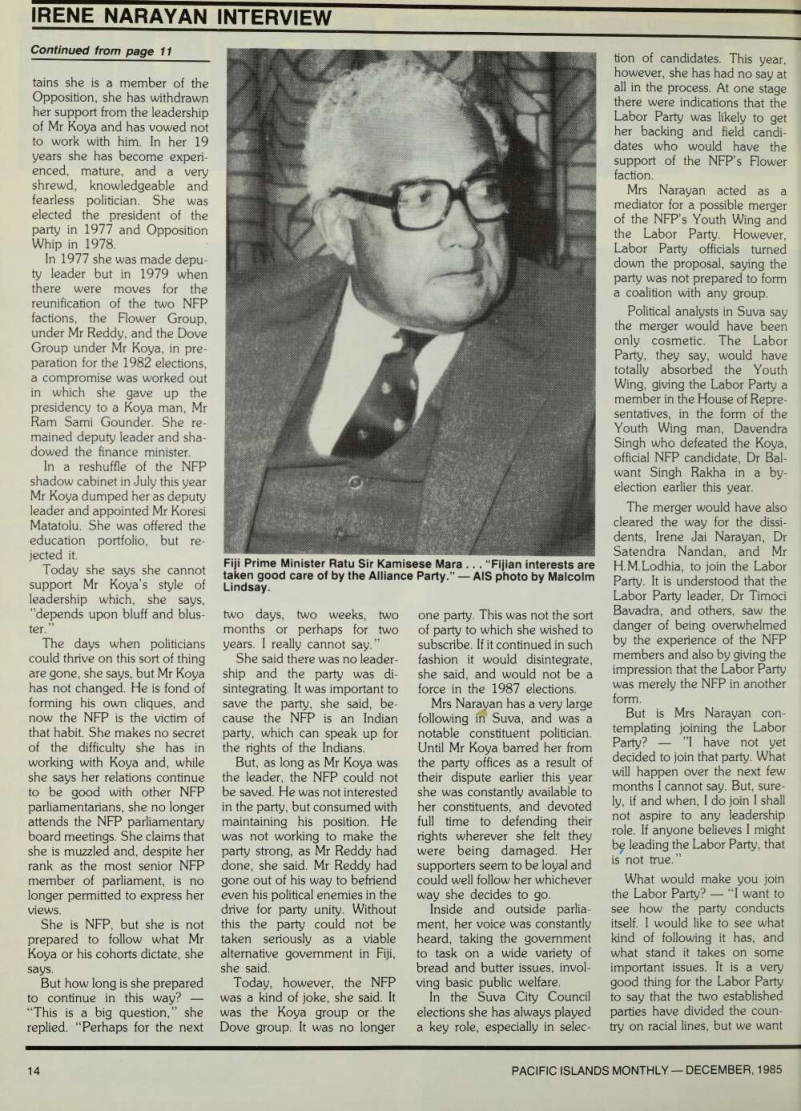
Fiji Prime Minister Ratu Sir Kamisese Mara ... “Fijian interests are taken good care of by the Alliance Party.” - AIS photo by Malcolm Lindsay.
to bring the races together.
“It is very nice of them to say they want a common name and a common identity for all people. Those are very nice, idealistic things to say. But in Fiji race is very important. The Alliance Party, which is predominantly Fijian, takes every care to protect the rights of the Fijian people. The National Federation Party is predominantly an Indian party and it is one which could speak up for the rights of the Indian people.
“The Labor Party is hopeful of drawing support from both Fijians and Indians and would not be prepared to speak for any particular race. But from my experience 1 know that in this country in the final analysis everything boils down to race.
So what will be the position of the Indians in the Labor Party?
It is unknown.
“If there is an issue affecting the welfare of the Indians in this country, will the Labor Party be
prepared to speak on behalf of them?
“By the same token, if there is an issue affecting the Fijians, will the Labor Party stand up and speak for them?
“In fact, let me be frank, I will not be very worried what the Labor Party chooses to say or not to say regarding the Fijian people, because I think the Fijian interests are taken good care of by the Alliance Party, But as far as Indian interests are concerned, these days the Federation Party does not seem to be worried about what is the future of the Indians in this country or what is affecting the Indians or their welfare here even at the present time, “As a communal Indian member I have always thought in terms of my community, and let me be very frank; I will not be apologetic for being commu nal in my approach, because we have a constitution which is very communal. It is a racial
constitution. The electoral sys tem is racial and the prime minister of the country has often enough said that race is a fact of life. I accept that.
“So far we have been fortun ate enough that so many years after independence the two ma jor races have been living side by side in peace.
“In fact we have been very fortunate that there has been no racial strife, or religious or communal intolerance. On the whole we are living very happi ly in the country.
“But the racial factor is very much there and the different races, particularly the two major races, must be satisfied. They must have confidence in their leaders that they will take care of them, and will always do things which are in the best interest.
“The Fijian community is very fortunate that they have good leaders, but today if you asked the same question about
Irene Narayan and Siddiq Koya in happier times ... Mr Koya “is not interested in the party, but consumed with maintaining his position” - “if the party continues in this fashion it will disintegrate, and will not be a force in the 1987 elections”. - Fiji Times photo.
the Indians you would get a different answer.
“It really saddens me to say that the Indians do not have leaders who are really dedi cated and committed to the cause. ”
Q: Will the Labor Party fill this gap? “These are the things I want to see before I make a decision. I am in no great hurry.”
Q; So you don’t see Fiji politics moving away from ra cial divisions? - ”No. Anyone who thinks we can push the racial divisions into the back ground and talk about our people, their fears, worries and needs, and have politics on bread and butter issues no, it is not going to be that way.”
Q: What effect do you see the Labor Party having on Fiji politics? - ”It is too early to say what the Labor Party is likely to achieve, but I must say I do welcome the advent of the party. Right now there is one big question about it and that is how many Fijians will they have in it? From the reports I am getting I can see that it is mostly Indians, and mostly the disgruntled supporters of the National Federation Party who have gone over.
“Dr Bavadra and others are campaigning in the villages, but what kind of support they are getting from the Fijian com munity cannot really be accur ately assessed at this stage. That is one question. And if the Labor Party is not able to get sufficient support from the Fi jian community I don’t think they will be able to achieve very much.
“What will happen is that only the Indians will be frag mented, some with the NFP and some with the Labor Party.
In such a situation the Alliance will have a field day.
“If the Alliance holds on to its traditional support and also that of the Indians who have always supported the Alliance then the Alliance will have a bigger majority. The by-election about to occur, and the Suva City Council elections will throw some light on the situation.
“There is one area of the city where the majority of Fijians live and have previously block-
voted for the Alliance Party. If the Labor Party can make inroads here, or even in one of the five seats, that will show their strength and support.
“In the by-election for the Ba-Lautoka Indian National Communal seat there has been no active campaigning. It is a big constituency with about 30,000 voters, of whom 8000 or so are Fijians. In 1982 the Indian Alliance was wiped out there. But now we have reports that whole villages are changing to Labor.
“Even if the National Federa tion Party got 6000 to 7000 traditional votes, I have my guess that the Labor Party, which will be supported by the young and educated crowd, is likely to win. The Labor Party is definitely a force to reckon with. ”
In the last session of parlia ment both the prime minister, Ratu Sir Kamisese Mara, and the Leader of the Opposition, Mr Koya, defended the House business committee’s decision to limit debate on the governor general’s speech to 15 minutes per member. Mrs Narayan
complained that the move was designed to gag her, and ran into strong criticism from the two leaders.
Mrs Narayan said their tone and words were uncalled for.
Mr Koya was widely seen as referring to Mrs Narayan when he said that people who wished to “use democracy to prop ound their views both in news papers the House are without discipline. The day is coming very soon for those people to know that if they have love for this country - and I have because I was born here - they would not behave in this fashion for the last 12 years.”
Mr Koya said the committee decided on the time limit for good reasons which were known to the public.
In also defending the limit, the prime minister referred to a statement by Mrs Narayan that those who negotiated for Fiji should become a little more demanding and aggressive in getting a quota. He said he was surprised Mrs Narayan had taken him to task on the ques tion of negotiating for Fiji under
Sparteca.
He said Mrs Narayan had condemned him for not doing what he should have been doing. On the other hand Aus tralian and New Zealand media had accused him of twisting the arms of their prime ministers.
His credibility was at stake, he said.
The prime minister went on to describe Mrs Narayan as ’’beautiful, moves nicely and dresses well, and has all the attributes of a beautiful lady.”
“It is only when she speaks that all these attributes fall away and we see vicious vindictive ness, and all the attributes we do not usually associate with a beautiful lady. I hope she real ises her talents and exploits them to the full,” the prime minister said.
Mrs Narayan said she was hurt by the comments. “All I can say is that parliament is the place where we argue out the issues. But when someone runs short of argument they can resort to abuse. So if I have been abused in the House I would say that the honorable gentlemen had run short of ideas. ”
She said it was a pity that the prime minister had chosen to attack her in this fashion.
“Would he have attacked me in the same fashion if I had been a Fijian lady of chiefly class?”
On the reference to her In dian birth Mrs Narayan said the slur was very hurtful. Other MPs were born in India, but they were not reminded of it.
She had served Fiji unstintingly for 30 years, and to be con stantly reminded of her Indian birth was “a sad thing,” she said.
Mrs Narayan, 53, is married to a Fiji-born school teacher, Jai Narayan, who is a member of the Boundaries Commission and the Electoral Commission.
She was a school teacher, but entered politics in 1966 and is a full-time politician. They have four children, three boys and a girl. The eldest son is a doctor, married with one child and lives in New Delhi. The second son is studying in Canberra. The daughter is studying in India and the youngest son is in Suva at the University of the South Pacific.
Former National Federation Party leader Jai Ram Reddy ... “he went out of his way to befriend even political enemies in the drive for party unity”. - Fiji Times photo.