letters
Local lore and the Earhart case
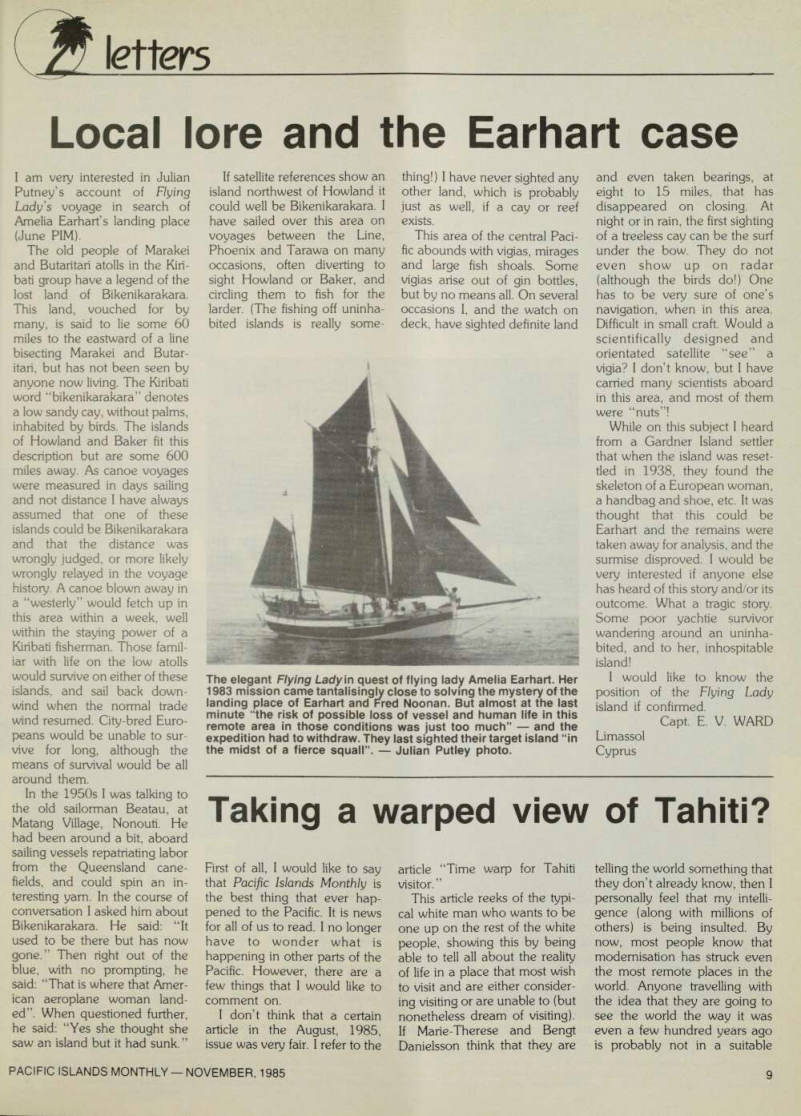
I am very interested in Julian Putney’s account of Flying Lady’s voyage in search of Amelia Earhart’s landing place (June PIM).
The old people of Marakei and Butaritari atolls in the Kiri bati group have a legend of the lost land of Bikenikarakara.
This land, vouched for by many, is said to lie some 60 miles to the eastward of a line bisecting Marakei and Butar itari, but has not been seen by anyone now living. The Kiribati word “bikenikarakara” denotes a low sandy cay, without palms, inhabited by birds. The islands of Howland and Baker fit this description but are some 600 miles away. As canoe voyages were measured in days sailing and not distance I have always assumed that one of these islands could be Bikenikarakara and that the distance was wrongly judged, or more likely wrongly relayed in the voyage history. A canoe blown away in a “westerly” would fetch up in this area within a week, well within the staying power of a Kiribati fisherman. Those famil iar with life on the low atolls would survive on either of these islands, and sail back down wind when the normal trade wind resumed. City-bred Euro peans would be unable to sur vive for long, although the means of survival would be all around them.
In the 1950 s I was talking to the old sailorman Beatau, at Matang Village, Nonouti. He had been around a bit, aboard sailing vessels repatriating labor from the Queensland cane fields, and could spin an in teresting yam. In the course of conversation I asked him about Bikenikarakara. He said: “It used to be there but has now gone.” Then right out of the blue, with no prompting, he said; “That is where that Amer ican aeroplane woman land ed”. When questioned further, he said: “Yes she thought she saw an island but it had sunk. ”
If satellite references show an island northwest of Howland it could well be Bikenikarakara. I have sailed over this area on voyages between the Line, Phoenix and Tarawa on many occasions, often diverting to sight Howland or Baker, and circling them to fish for the larder. (The fishing off uninha bited islands is really some
thing!) I have never sighted any other land, which is probably just as well, if a cay or reef exists.
This area of the central Paci fic abounds with vigias, mirages and large fish shoals. Some vigias arise out of gin bottles, but by no means all. On several occasions I, and the watch on deck, have sighted definite land
and even taken bearings, at eight to 15 miles, that has disappeared on closing. At night or in rain, the first sighting of a treeless cay can be the surf under the bow. They do not even show up on radar (although the birds do!) One has to be very sure of one’s navigation, when in this area.
Difficult in small craft. Would a scientifically designed and orientated satellite “see” a vigia? I don’t know, but I have carried many scientists aboard in this area, and most of them were “nuts”!
While on this subject I heard from a Gardner Island settler that when the island was reset tled in 1938, they found the skeleton of a European woman, a handbag and shoe, etc. It was thought that this could be Earhart and the remains were taken away for analysis, and the surmise disproved. I would be very interested if anyone else has heard of this story and/or its outcome. What a tragic story.
Some poor yachtie survivor wandering around an uninha bited, and to her, inhospitable island!
I would like to know the position of the Flying Lady island if confirmed.
Capt.
E. V. Ward
Limassol Cyprus
The elegant Flying Lady in quest of flying lady Amelia Earhart. Her 1983 mission came tantalisingly close to solving the mystery of the landing place of Earhart and Fred Noonan. But almost at the last minute “the risk of possible loss of vessel and human life in this remote area in those conditions was just too much” - and the expedition had to withdraw. They last sighted their target island “in the midst of a fierce squall”. - Julian Putley photo.