befits
pp. 59-60 · Read in the full issue
Don Travers Re
ports from Tubuai,
Austral Islands ,
French Polynesia:
• SAUVAGE. A 15-m staysail schooner built of aluminium in France, 1975, Sauuage arrived from Tahiti with Jack (USA) and Francoise (Fr.) Rocchio. Sauuage is British-registered at Jersey, Chan nel Islands. Jack and Francoise cruised from France to French Polynesia the first time through the Caribbean and Panama Canal.
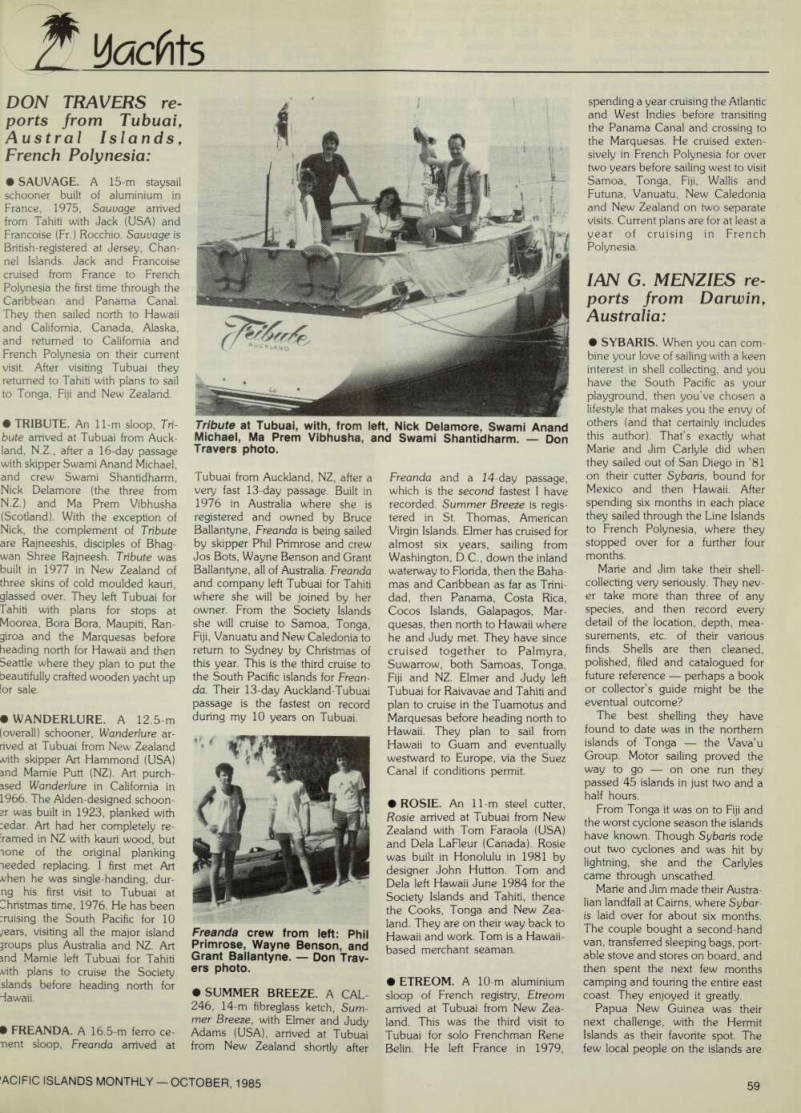
They then sailed north to Hawaii and California, Canada, Alaska, and returned to California and French Polynesia on their current visit. After visiting Tubuai they returned to Tahiti with plans to sail to Tonga, Fiji and New Zealand. • TRIBUTE. An 11-m sloop, Tri bute arrived at Tubuai from Auck land, N.Z., after a 16-day passage with skipper Swami Anand Michael, and crew Swami Shantidharm, Nick Delamore (the three from N.Z.) and Ma Prem Vibhusha (Scotland). With the exception of Nick, the complement of Tribute are Rajneeshis, disciples of Bhag wan Shree Rajneesh. Tribute was built in 1977 in New Zealand of three skins of cold moulded kauri, glassed over. They left Tubuai for Tahiti with plans for stops at Moorea, Bora Bora, Maupiti, Ran giroa and the Marquesas before heading north for Hawaii and then Seattle where they plan to put the beautifully crafted wooden yacht up for sale.
• Wanderlure. A 12.5-M
(overall) schooner, Wanderlure ar rived at Tubuai from New Zealand A/ith skipper Art Hammond (USA) and Mamie Putt (NZ). Art purch ased Wanderlure in California in 1966. The Alden-designed schoon er was built in 1923, planked with :edar. Art had her completely re named in NZ with kauri wood, but aone of the original planking aeeded replacing. I first met Art A/hen he was single-handing, dur ng his first visit to Tubuai at Christmas time, 1976. He has been :ruising the South Pacific for 10 /ears, visiting all the major island groups plus Australia and NZ. Art and Mamie left Tubuai for Tahiti vith plans to cruise the Society slands before heading north for dawaii. • FREANDA. A 16.5-m ferro ce nent sloop, Freanda arrived at
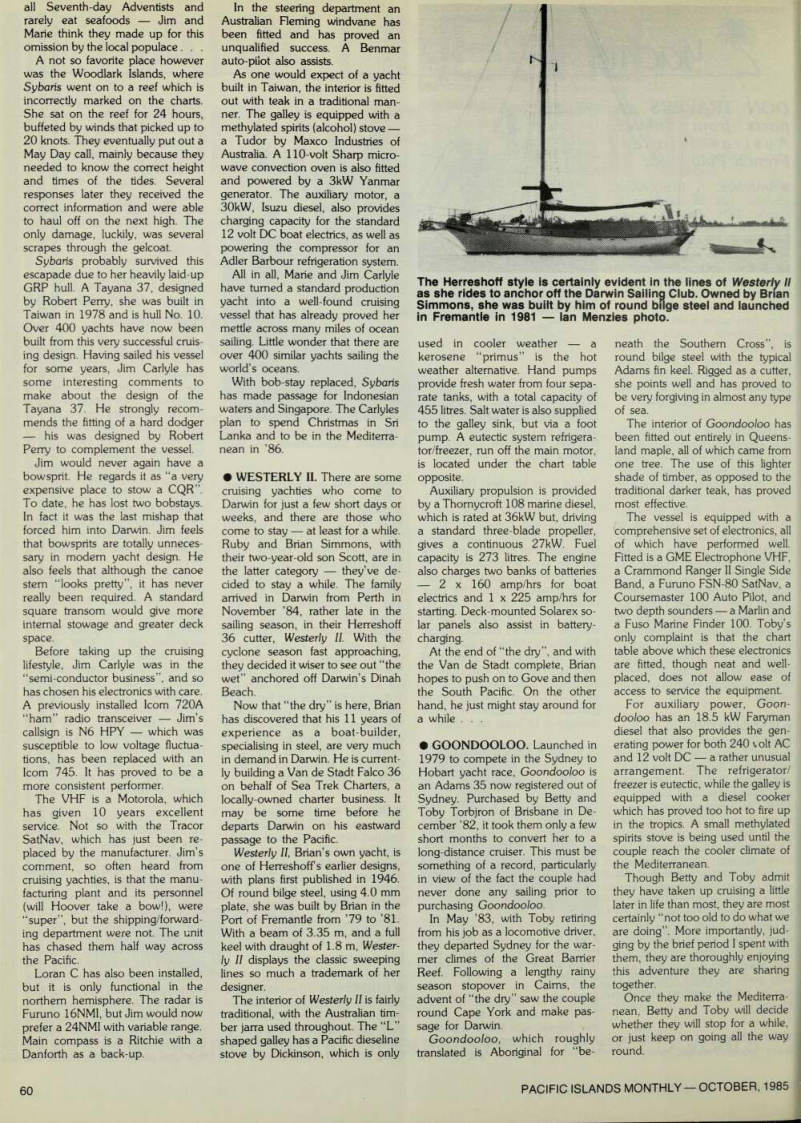
Tubuai from Auckland, NZ, after a very fast 13-day passage. Built in 1976 in Australia where she is registered and owned by Bruce Ballantyne, Freanda is being sailed by skipper Phil Primrose and crew Jos Bots, Wayne Benson and Grant Ballantyne, all of Australia. Freanda and company left Tubuai for Tahiti where she will be joined by her owner. From the Society Islands she will cruise to Samoa, Tonga, Fiji, Vanuatu and New Caledonia to return to Sydney by Christmas of this year. This is the third cruise to the South Pacific islands for Frean da. Their 13-day Auckland-Tubuai passage is the fastest on record during my 10 years on Tubuai.
• Summer Breeze. A Cal
246, 14-m fibreglass ketch, Sum mer Breeze, with Elmer and Judy Adams (USA), arrived at Tubuai from New Zealand shortly after
Freanda and a 14- day passage, which is the second fastest 1 have recorded. Summer Breeze is regis tered in St. Thomas, American Virgin Islands. Elmer has cruised for almost six years, sailing from Washington, D.C., down the inland waterway to Florida, then the Baha mas and Caribbean as far as Trini dad, then Panama, Costa Rica, Cocos Islands, Galapagos, Mar quesas, then north to Hawaii where he and Judy met. They have since cruised together to Palmyra, Suwarrow, both Samoas, Tonga, Fiji and NZ. Elmer and Judy left Tubuai for Raivavae and Tahiti and plan to cruise in the Tuamotus and Marquesas before heading north to Hawaii. They plan to sail from Hawaii to Guam and eventually westward to Europe, via the Suez Canal if conditions permit. • ROSIE. An 11-m steel cutter, Rosie arrived at Tubuai from New Zealand with Tom Faraola (USA) and Dela LaFleur (Canada). Rosie was built in Honolulu in 1981 by designer John Hutton. Tom and Dela left Hawaii June 1984 for the Society Islands and Tahiti, thence the Cooks, Tonga and New Zea land. They are on their way back to Hawaii and work. Tom is a Hawaii based merchant seaman. • ETREOM. A 10-m aluminium sloop of French registry, Etreom arrived at Tubuai from New Zea land. This was the third visit to Tubuai for solo Frenchman Rene Belin. He left France in 1979,
spending a year cruising the Atlantic and West Indies before transiting the Panama Canal and crossing to the Marquesas. He cruised exten sively in French Polynesia for over two years before sailing west to visit Samoa, Tonga, Fiji, Wallis and Futuna, Vanuatu, New Caledonia and New Zealand on two separate visits. Current plans are for at least a year of cruising in French Polynesia.
Lan G. Menzies Re
ports from Darwin,
Australia:
• SYBARIS. When you can com bine your love of sailing with a keen interest in shell collecting, and you have the South Pacific as your playground, then you’ve chosen a lifestyle that makes you the envy of others (and that certainly includes this author). That’s exactly what Marie and Jim Carlyle did when they sailed out of San Diego in ’Bl on their cutter Sybaris, bound for Mexico and then Hawaii. After spending six months in each place they sailed through the Line Islands to French Polynesia, where they stopped over for a further four months.
Marie and Jim take their shell collecting very seriously. They nev er take more than three of any species, and then record every detail of the location, depth, mea surements, etc. of their various finds. Shells are then cleaned, polished, filed and catalogued for future reference perhaps a book or collector’s guide might be the eventual outcome?
The best shelling they have found to date was in the northern islands of Tonga the Vava’u Group. Motor sailing proved the way to go on one run they passed 45 islands in just two and a half hours.
From Tonga it was on to Fiji and the worst cyclone season the islands have known. Though Sybaris rode out two cyclones and was hit by lightning, she and the Carlyles came through unscathed.
Marie and Jim made their Austra lian landfall at Cairns, where Sybar is laid over for about six months.
The couple bought a second-hand van, transferred sleeping bags, port able stove and stores on board, and then spent the next few months camping and touring the entire east coast. They enjoyed it greatly.
Papua New Guinea was their next challenge, with the Hermit Islands as their favorite spot. The few local people on the islands are
Tribute at Tubuai, with, from left, Nick Delamore, Swami Anand Michael, Ma Prem Vibhusha, and Swami Shantidharm. - Don Travers photo.
Freanda crew from left: Phil Primrose, Wayne Benson, and Grant Ballantyne. Don Trav ers photo.
all Seventh-day Adventists and rarely eat seafoods Jim and Marie think they made up for this omission by the local populace . . .
A not so favorite place however was the Woodlark Islands, where Sybaris went on to a reef which is incorrectly marked on the charts.
She sat on the reef for 24 hours, buffeted by winds that picked up to 20 knots. They eventually put out a May Day call, mainly because they needed to know the correct height and times of the tides. Several responses later they received the correct information and were able to haul off on the next high. The only damage, luckily, was several scrapes through the gelcoat.
Sybaris probably survived this escapade due to her heavily laid-up GRP hull. A Tayana 37, designed by Robert Perry, she was built in Taiwan in 1978 and is hull No. 10.
Over 400 yachts have now been built from this very successful cruis ing design. Having sailed his vessel for some years, Jim Carlyle has some interesting comments to make about the design of the Tayana 37. He strongly recom mends the fitting of a hard dodger his was designed by Robert Perry to complement the vessel.
Jim would never again have a bowsprit. He regards it as “a very expensive place to stow a CQR”.
To date, he has lost two bobstays.
In fact it was the last mishap that forced him into Darwin. Jim feels that bowsprits are totally unneces sary in modem yacht design. He also feels that although the canoe stem “looks pretty”, it has never really been required. A standard square transom would give more internal stowage and greater deck space.
Before taking up the cruising lifestyle, Jim Carlyle was in the “semi-conductor business”, and so has chosen his electronics with care.
A previously installed Icom 720 A “ham” radio transceiver Jim’s callsign is N 6 HPY which was susceptible to low voltage fluctua tions, has been replaced with an Icom 745. It has proved to be a more consistent performer.
The VHF is a Motorola, which has given 10 years excellent service. Not so with the Tracer SatNav, which has just been re placed by the manufacturer. Jim’s comment, so often heard from cruising yachties, is that the manu facturing plant and its personnel (will Hoover take a bow!), were “super”, but the shipping/forward ing department were not. The unit has chased them half way across the Pacific.
Loran C has also been installed, but it is only functional in the northern hemisphere. The radar is Furuno 16NMI, but Jim would now prefer a 24NMI with variable range.
Main compass is a Ritchie with a Danforth as a back-up.
In the steering department an Australian Fleming windvane has been fitted and has proved an unqualified success. A Benmar auto-pilot also assists.
As one would expect of a yacht built in Taiwan, the interior is fitted out with teak in a traditional man ner. The galley is equipped with a methylated spirits (alcohol) stove a Tudor by Maxco Industries of Australia. A 110-volt Sharp micro wave convection oven is also fitted and powered by a 3kW Yanmar generator. The auxiliary motor, a 30kW, Isuzu diesel, also provides charging capacity for the standard 12 volt DC boat electrics, as well as powering the compressor for an Adler Barbour refrigeration system.
All in all, Marie and Jim Carlyle have turned a standard production yacht into a well-found cruising vessel that has already proved her mettle across many miles of ocean sailing. Little wonder that there are over 400 similar yachts sailing the world’s oceans.
With bob-stay replaced, Sybaris has made passage for Indonesian waters and Singapore. The Carlyles plan to spend Christmas in Sri Lanka and to be in the Mediterra nean in ’B6. • WESTERLY 11. There are some cruising yachties who come to Darwin for just a few short days or weeks, and there are those who come to stay at least for a while.
Ruby and Brian Simmons, with their two-year-old son Scott, are in the latter category they’ve de cided to stay a while. The family arrived in Darwin from Perth in November ’B4, rather late in the sailing season, in their Herreshoff 36 cutter, Westerly 11. With the cyclone season fast approaching, they decided it wiser to see out “the wet” anchored off Darwin’s Dinah Beach.
Now that “the dry” is here, Brian has discovered that his 11 years of experience as a boat-builder, specialising in steel, are very much in demand in Darwin. He is current ly building a Van de Stadt Falco 36 on behalf of Sea Trek Charters, a locally-owned charter business. It may be some time before he departs Darwin on his eastward passage to the Pacific.
Westerly 11, Brian’s own yacht, is one of Herreshoff s earlier designs, with plans first published in 1946.
Of round bilge steel, using 4.0 mm plate, she was built by Brian in the Port of Fremantle from ’79 to ’Bl.
With a beam of 3.35 m, and a full keel with draught of 1.8 m, Wester ly II displays the classic sweeping lines so much a trademark of her designer.
The interior of Westerly II is fairly traditional, with the Australian tim ber jarra used throughout. The “L” shaped galley has a Pacific dieseline stove by Dickinson, which is only
used in cooler weather a kerosene “primus” is the hot weather alternative. Hand pumps provide fresh water from four sepa rate tanks, with a total capacity of 455 litres. Salt water is also supplied to the galley sink, but via a foot pump. A eutectic system refrigera tor/freezer, run off the main motor, is located under the chart table opposite.
Auxiliary propulsion is provided by a Thomycroft 108 marine diesel, which is rated at 36kW but, driving a standard three-blade propeller, gives a continuous 27kW. Fuel capacity is 273 litres. The engine also charges two banks of batteries 2 x 160 amp/hrs for boat electrics and 1 x 225 amp/hrs for starting. Deck-mounted Solarex so lar panels also assist in battery charging.
At the end of “the dry”, and with the Van de Stadt complete, Brian hopes to push on to Gove and then the South Pacific. On the other hand, he just might stay around for a while . . . • GOONDOOLOO. Launched in 1979 to compete in the Sydney to Hobart yacht race, Goondooloo is an Adams 35 now registered out of Sydney. Purchased by Betty and Toby Torbjron of Brisbane in De cember ’B2, it took them only a few short months to convert her to a long-distance cruiser. This must be something of a record, particularly in view of the fact the couple had never done any sailing prior to purchasing Goondooloo.
In May ’B3, with Toby retiring from his job as a locomotive driver, they departed Sydney for the war mer climes of the Great Barrier Reef. Following a lengthy rainy season stopover in Cairns, the advent of “the dry” saw the couple round Cape York and make pas sage for Darwin.
Goondooloo, which roughly translated is Aboriginal for “be
neath the Southern Cross”, is round bilge steel with the typical Adams fin keel. Rigged as a cutter, she points well and has proved to be very forgiving in almost any type of sea.
The interior of Goondooloo has been fitted out entirely in Queens land maple, all of which came from one tree. The use of this lighter shade of timber, as opposed to the traditional darker teak, has proved most effective.
The vessel is equipped with a comprehensive set of electronics, all of which have performed well.
Fitted is a GME Electrophone VHF, a Crammond Ranger II Single Side Band, a Furuno FSN-80 SatNav, a Coursemaster 100 Auto Pilot, and two depth sounders a Marlin and a Fuso Marine Finder 100. Toby’s only complaint is that the chart table above which these electronics are fitted, though neat and well placed, does not allow ease of access to service the equipment.
For auxiliary power, Goon dooloo has an 18.5 kW Faryman diesel that also provides the gen erating power for both 240 volt AC and 12 volt DC a rather unusual arrangement. The refrigerator/ freezer is eutectic, while the galley is equipped with a diesel cooker which has proved too hot to fire up in the tropics. A small methylated spirits stove is being used until the couple reach the cooler climate of the Mediterranean.
Though Betty and Toby admit they have taken up cruising a little later in life than most, they are most certainly “not too old to do what we are doing”. More importantly, jud ging by the brief period 1 spent with them, they are thoroughly enjoying this adventure they are sharing together.
Once they make the Mediterra nean, Betty and Toby will decide whether they will stop for a while, or just keep on going all the way round.
The Herreshoff style is certainly evident in the lines of Westerly // as she rides to anchor off the Darwin Sailing Club. Owned by Brian Simmons, she was built by him of round bilge steel and launched in Fremantle in 1981 - lan Menzies photo.