Independence born
pp. 27-29 · Read in the full issue
the month
Independence born naturally-or aborted?
The first step towards independence, or the start of a transitional period of six months at the end of which a new govern ment in France will throw the whole question of sovereignty out the window?
This is one of the main questions being asked in New Caledonia about the territory’s second round of elections in less than 12 months. The poll, due to be held on September 29, was based on the division of New Caledonia into four re gions, each governed by its own council. As the French Government would have it, the election was to be seen as the first stage in its plans to take the territory to independence.
However, many thousands of New Caledonians, banking on the promises of the Opposi tion in France, were convinced that this whole game would come to an end after the parliamentary elections in France early next year, which by all indications will see the socialists tossed out.
Despite this possibility, which seemed to be enhanced during August with the visit of French Right-wing politicians Francois Leotard, Jacques Medecin and Roger Chinaud, the Kanak Socialist National Liberation Front (FLNKS) reaffirmed that it would participate in the poll.
The more moderate independ ence party, the LKS, also indi cated it was satisfied with the course of events and would field candidates.
Preparations for the elections started in earnest during the last week in August when the new law was declared after much haggling in the French parlia ment, and two challenges to its legality which were fought out
SUE WILLIAMS reports from Noumea on the lead-up to the elections due in New Caledonia on September 29. As she wrote, the question was: would the poll represent the start of a serious process of moving the territory to independence, or would any such process be aborted in a few months by a new conservative majority in the National Assembly in Paris.
in the Constitutional Court in Paris.
However, the campaigning has been in no way, shape or form like that of a normal election lead-up. The lines were very clearly drawn many months ago, with people voting for the party which best repre sented their views on the inde pendence question.
On figures put up well before the vote it seemed certain the FLNKS would win the regions of the north and the islands, with the anti-independence RPCR holding Noumea. The centre region was the only one which seemed to be in any doubt.
While the results seemed something of a foregone con clusion, there was much trepidation over the security aspect of the elections, and whether they could be held in a fair and equal manner without fears of reprisals, or a return to
the violence witnessed during the elections of last November which were boycotted by the
Flnks.
The tensions were height ened during August by re newed clashes between the FLNKS and authorities at the east coast mining centre of Thio.
The first incident occurred early in the month when gen darmes moved into the San Philippo tribe to arrest a man wanted for the murder of 17year-old Yves Tual, killed on January 11 near Boulouparis.
The FLNKS supporters set up barricades at one point and even attacked the gendarmes’ headquarters in Thio village.
The wanted man escaped.
Trouble again erupted in the San Philippo tribe some two weeks later when Messrs Leotard, Medecin and Chinaud attempted a stopover there to meet and talk to FLNKS mem-
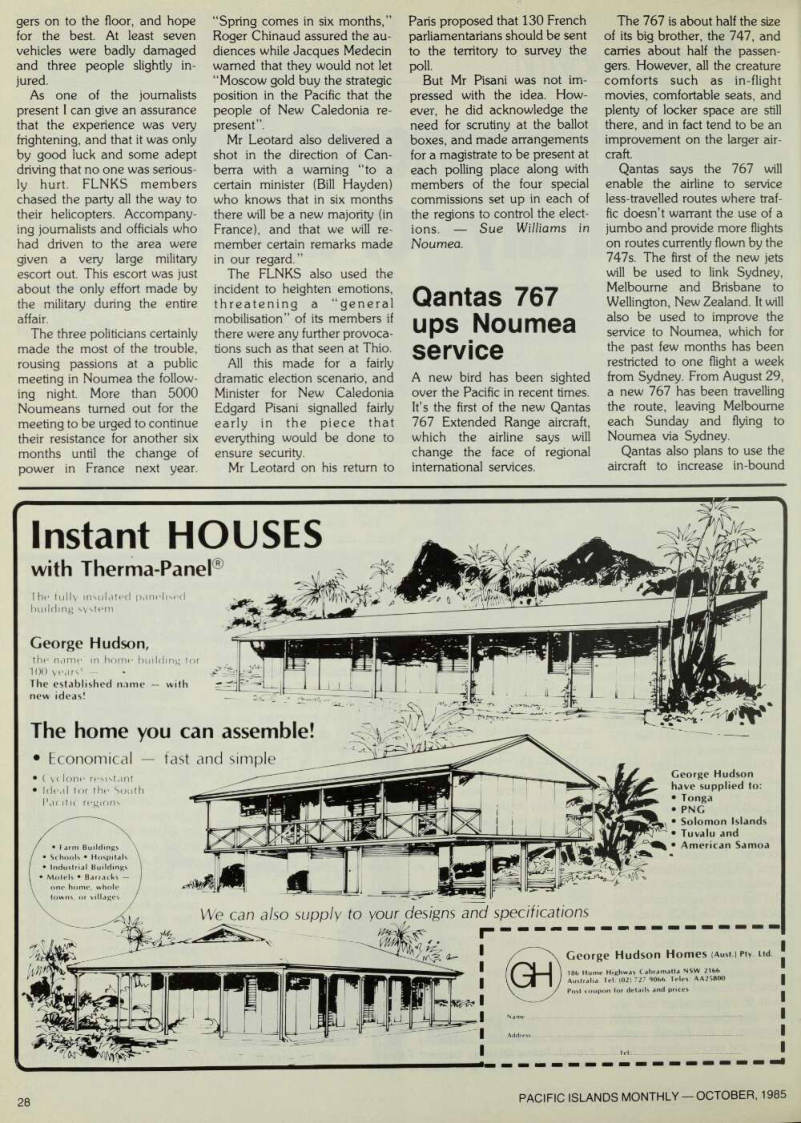
Noumea Notebook
bers. The trio were met at the entrance to the tribe by about a dozen Kanaks, many wielding machetes and iron bars and told in no uncertain terms to get out. “This is Kanaky”, they said, “not France”.
And the politicians had no right to be there.
After some minutes of heated argument which threatened to deteriorate into a brawl, Mr Leotard, who is secretary-gen eral of the French Republican Party, decided to retreat.
However, this was prevented by several large trucks carrying nickel ore to the ship-loading facilities and which had moved in behind the cavalcade carrying the visitors and accom panying journalists and officials.
This further infuriated the Kanaks. The party eventually got clear, but on the way back to Thio village was virtually ambushed by several Kanaks on the roadside hurling large rocks at the 20-odd cars.
There was no way the motor cade could reverse, and drivers could only step on their accelerators, get their passen
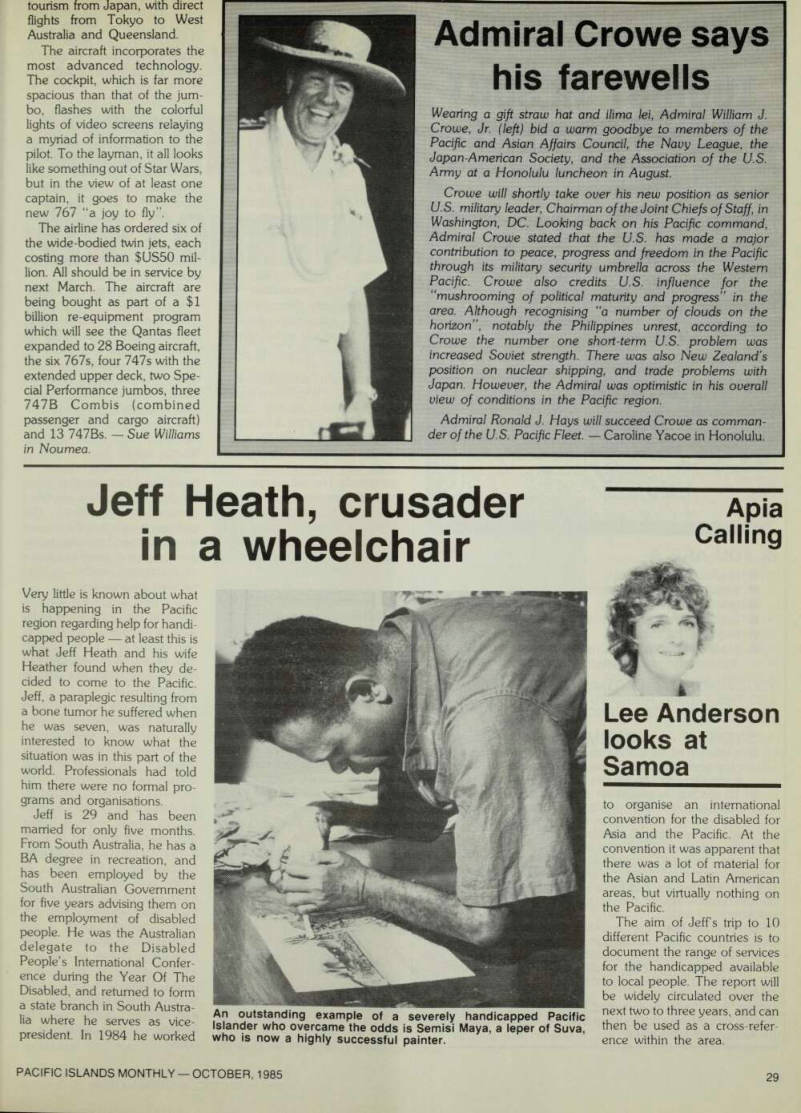
French Prime Minister Laurent Fabius . . . will his plan for New Caledonia be given a chance to work?
Sue Williams
gers on to the floor, and hope for the best. At least seven vehicles were badly damaged and three people slightly in jured.
As one of the journalists present I can give an assurance that the experience was very frightening, and that it was only by good luck and some adept driving that no one was serious ly hurt. FLNKS members chased the party all the way to their helicopters. Accompany ing journalists and officials who had driven to the area were given a very large military escort out. This escort was just about the only effort made by the military during the entire affair.
The three politicians certainly made the most of the trouble, rousing passions at a public meeting in Noumea the follow ing night. More than 5000 Noumeans turned out for the meeting to be urged to continue their resistance for another six months until the change of power in France next year.
“Spring comes in six months,”
Roger Chinaud assured the au diences while Jacques Medecin warned that they would not let “Moscow gold buy the strategic position in the Pacific that the people of New Caledonia re present”.
Mr Leotard also delivered a shot in the direction of Can berra with a warning “to a certain minister (Bill Hayden) who knows that in six months there will be a new majority (in France), and that we will re member certain remarks made in our regard.”
The FLNKS also used the incident to heighten emotions, threatening a “general mobilisation” of its members if there were any further provoca tions such as that seen at Thio.
All this made for a fairly dramatic election scenario, and Minister for New Caledonia Edgard Pisani signalled fairly early in the piece that everything would be done to ensure security.
Mr Leotard on his return to
Paris proposed that 130 French parliamentarians should be sent to the territory to survey the poll.
But Mr Pisani was not im pressed with the idea. How ever, he did acknowledge the need for scrutiny at the ballot boxes, and made arrangements for a magistrate to be present at each polling place along with members of the four special commissions set up in each of the regions to control the elect ions. — Sue Williams in Noumea.
Qantas 767
ups Noumea
service
A new bird has been sighted over the Pacific in recent times.
It’s the first of the new Qantas 767 Extended Range aircraft, which the airline says will change the face of regional international services.
The 767 is about half the size of its big brother, the 747, and carries about half the passen gers. However, all the creature comforts such as in-flight movies, comfortable seats, and plenty of locker space are still there, and in fact tend to be an improvement on the larger air craft.
Qantas says the 767 will enable the airline to service less-travelled routes where traf fic doesn’t warrant the use of a jumbo and provide more flights on routes currently flown by the 7475. The first of the new jets will be used to link Sydney, Melbourne and Brisbane to Wellington, New Zealand. It will also be used to improve the service to Noumea, which for the past few months has been restricted to one flight a week from Sydney. From August 29, a new 767 has been travelling the route, leaving Melbourne each Sunday and flying to Noumea via Sydney.
Qantas also plans to use the aircraft to increase in-bound
tourism from Japan, with direct flights from Tokyo to West Australia and Queensland.
The aircraft incorporates the most advanced technology.
The cockpit, which is far more spacious than that of the jum bo, flashes with the colorful lights of video screens relaying a myriad of information to the pilot. To the layman, it all looks like something out of Star Wars, but in the view of at least one captain, it goes to make the new 767 “a joy to fly”.
The airline has ordered six of the wide-bodied twin jets, each costing more than SUSSO mil lion. All should be in service by next March. The aircraft are being bought as part of a $1 billion re-equipment program which will see the Qantas fleet expanded to 28 Boeing aircraft, the six 7675, four 747 s with the extended upper deck, two Spe cial Performance jumbos, three 7478 Combis (combined passenger and cargo aircraft) and 13 74785. Sue Williams in Noumea.