"Our nation will grow”
p. 23 · Read in the full issue
Somare
Papua New Guinea prime minister, Mr Michael Somare, laun ched two projects in Sydney early in September and both bear his name the Auss3.6s million, seven-storey offices of the Consulate-Gen eral in Clarence Street, Somare Haus, and the Michael Somare Foundation, which will provide funds to promote the principles of service to PNG, “for which Michael Somare stands,” says the official release.
After officially opening the new consulate-general offices, Mr Somare shed responsibility for the foundation and its name, chosen by the founders, the business sector of Papua New Guinea. He told a press conference: “We are very care ful not to link the foundation with party politics. It has nothing to do with my party or with politicians.”
An appeal is being launched internationally to raise funds for the foundation and “ambassa dors” will be appointed in Aus tralia, the United States, Japan, West Germany, New Zealand, Britain and a number of other countries. The target is three million kina out of which will be funded a building to be known as the Centre, educational scholarships “for young citizens of Papua New Guinea to pre pare them for service to the community and the nation” and other projects “which will further the cause of democracy in Papua New Guinea.”
Sir Barry Holloway, ex- Speaker of the National Parlia ment, and former finance minister, is chairman of the foundation’s board of directors, and other members include Mr Tony Siaguru, MP, and five businessmen.
A section of Clarence Street was roped off for the opening ceremony in front of Somare Haus which was ceremoniously blessed by the Roman Catholic Archbishop of Port Moresby, the Most Rev. Peter Kurunko. It
was almost completely a Papua New Guinean function, the federal minister for sport, cul ture and tourism, Mr John Brown, being the only Austra lian government representative, substituting for prime minister, Bob Hawke, who, in spite of his name being on the com memorative bronze plaque un veiled, sent an apology.
In the space of 10 years, said Mr Somare, linking PNG’s tenth anniversary on Septem ber 16 with the opening of the building, Papua New Guinea had taken its rightful place in the community of nations. Part of the credit for that must go, he said, to those enlightened Aus tralians who assisted them in the period leading up to inde pendence.
“Thousands of Australians have assisted us and we recog nise their contributions and appreciate them greatly,” Mr Somare said.
“Similarly, we appreciate the continued Australian budgetary aid, still vital for our continued stable growth and deve lopment. We understand the strain it places on the Australian foreign aid vote, especially dur ing these difficult times,and we appreciate this continued com mitment from Australia.
“In the last 10 years Papua
New Guinea has achieved much that some sceptics said we could not achieve, and we take great pride in those achievements. We don’t claim, and never have claimed, that we have overcome all prob lems.
“Most Australians will already be aware of the significant crime problems which have vexed my government for some years. Australian media cover age of them has been extensive and colorful. Crime, lack of respect and lack of understan ding of the rights and freedoms of others, is a major problem.
But, it is one that I am confident we can handle.”
On PNG politics Mr Somare said: “Today, Papua New Guinea is a politically united and stable parliamentary demo cracy which is willing and able to meet any challenge.
“During our first 10 years we have overcome strong seces sion movements and, signifi cantly, we have done this with out the use of force. Unlike so many other newly-independent countries we have not careless ly shrugged off our democratic institutions in the search for short-term gains.
“It is my opinion that most of those countries which have taken that path have found the
gains to be illusory and the long-term costs severe. Papua New Guinea has not taken, and will not take, that course.
“We are a democratic people, our instincts are demo cratic and our way of conduc ting our daily business is demo cratic. The institutions which existed in our traditional societies were, almost invari ably, based on democratic con sensus decision-making.
“Democracy in Papua New Guinea is not a new flower rooted in shallow soil. Its antecedents in village life are lost in the period before written history. Today, ours is a vital and lively democracy, often very lively indeed. We have moulded our own distinctive democracy from the Melane sian traditions of our forefathers and the western institutions be queathed to us by Australia.”
Mr Somare described So mare Haus as another concrete expression of his country’s close ties with Australia and their special relationship. Papua New Guinea has three dip lomatic posts in Australia Sydney, Brisbane and, of course, Canberra. It was by far their largest diplomatic effort anywhere in the world and it was appropriate that it should be so, he said. For, despite the inevitable changes that had come about through independ ence, their people still had many aspirations and beliefs in common, he said.
Later, at a press conference, Mr Somare was asked about his hopes for the next 10 years.
“We have learned from our mistakes; from the difficulties and problems, and we look to the next 10 years being as successful as the past decade.
Our feeling of being a nation will grow. We started from nothing; we have had our frustrations, difficulties and problems, but we have made democracy survive and taken great strides.” John Carter in Sydney.
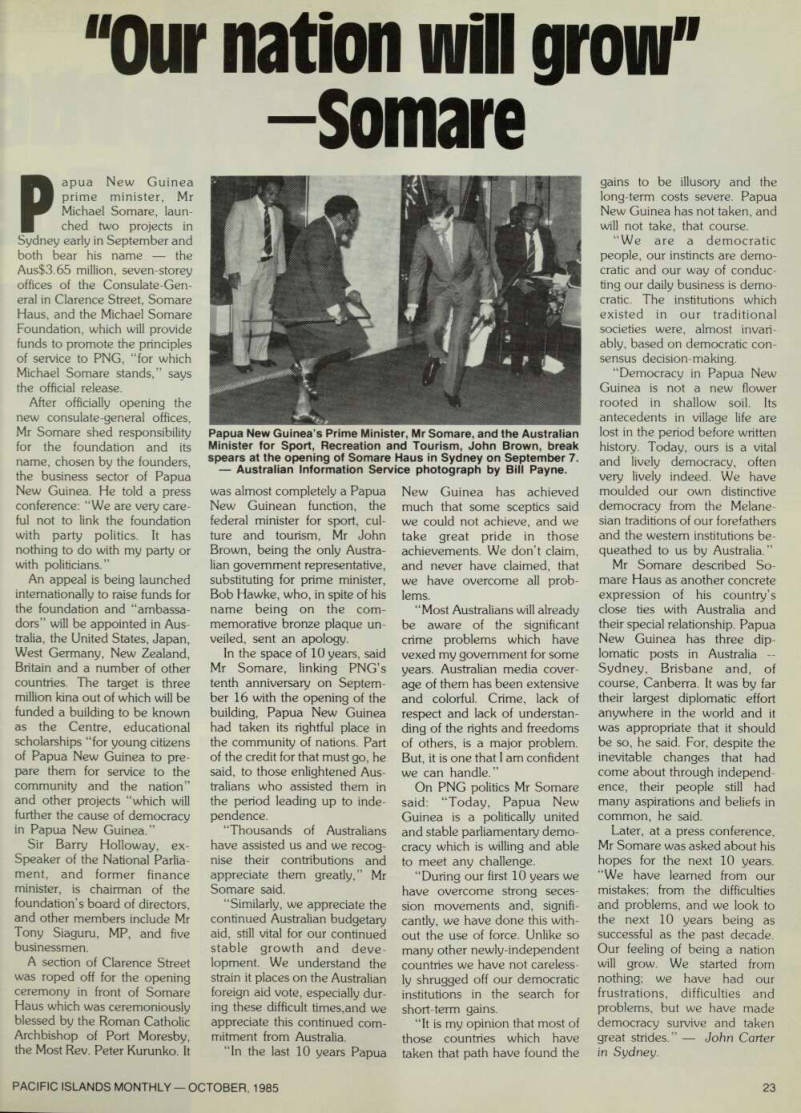
Papua New Guinea’s Prime Minister, Mr Somare, and the Australian Minister for Sport, Recreation and Tourism, John Brown, break spears at the opening of Somare Haus in Sydney on September 7.
Australian Information Service photograph by Bill Payne.