deaths
p. 65 · Read in the full issue
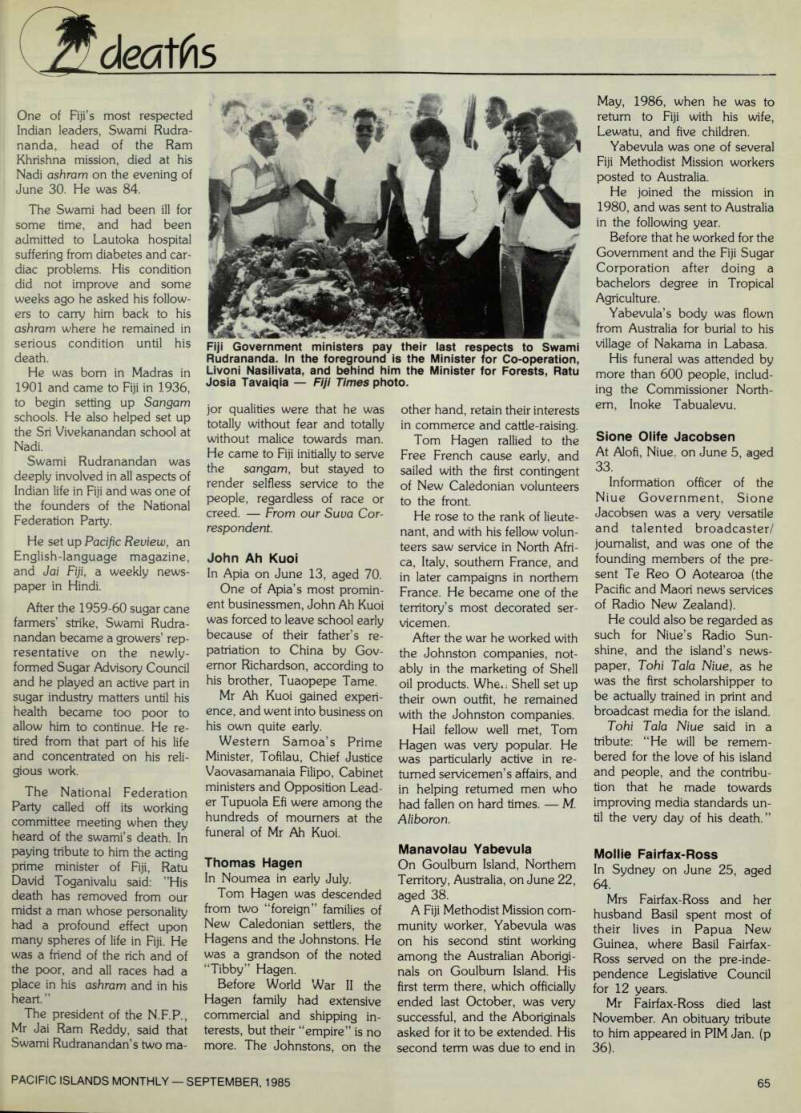
One of Fiji’s most respected Indian leaders, Swami Rudra nanda, head of the Ram Khrishna mission, died at his Nadi ashram on the evening of June 30. He was 84.
The Swami had been ill for some time, and had been admitted to Lautoka hospital suffering from diabetes and car diac problems. His condition did not improve and some weeks ago he asked his follow ers to carry him back to his ashram where he remained in serious condition until his death.
He was bom in Madras in 1901 and came to Fiji in 1936, to begin setting up Sangam schools. He also helped set up the Sri Vivekanandan school at Nadi.
Swami Rudranandan was deeply involved in all aspects of Indian life in Fiji and was one of the founders of the National Federation Party.
He set up Pacific Review , an English-language magazine, and Jai Fiji, a weekly news paper in Hindi.
After the 1959-60 sugar cane farmers’ strike, Swami Rudra nandan became a growers’ rep resentative on the newly formed Sugar Advisory Council and he played an active part in sugar industry matters until his health became too poor to allow him to continue. He re tired from that part of his life and concentrated on his reli gious work.
The National Federation Party called off its working committee meeting when they heard of the swami’s death. In paying tribute to him the acting prime minister of Fiji, Ratu David Toganivalu said: ”His death has removed from our midst a man whose personality had a profound effect upon many spheres of life in Fiji. He was a friend of the rich and of the poor, and all races had a place in his ashram and in his heart.”
The president of the N.F.P., Mr Jai Ram Reddy, said that Swami Rudranandan’s two ma-
jor qualities were that he was totally without fear and totally without malice towards man.
He came to Fiji initially to serve the sangam, but stayed to render selfless service to the people, regardless of race or creed. From our Suva Cor respondent.
John Ah Kuoi In Apia on June 13, aged 70.
One of Apia’s most promin ent businessmen, John Ah Kuoi was forced to leave school early because of their father’s re patriation to China by Gov ernor Richardson, according to his brother, Tuaopepe Tame.
Mr Ah Kuoi gained experi ence, and went into business on his own quite early.
Western Samoa’s Prime Minister, Tofilau, Chief Justice Vaovasamanaia Filipo, Cabinet ministers and Opposition Lead er Tupuola Efi were among the hundreds of mourners at the funeral of Mr Ah Kuoi.
Thomas Hagen In Noumea in early July.
Tom Hagen was descended from two “foreign” families of New Caledonian settlers, the Hagens and the Johnstons. He was a grandson of the noted “Tibby” Hagen.
Before World War II the Hagen family had extensive commercial and shipping in terests, but their “empire” is no more. The Johnstons, on the
other hand, retain their interests in commerce and cattle-raising.
Tom Hagen rallied to the Free French cause early, and sailed with the first contingent of New Caledonian volunteers to the front.
He rose to the rank of lieute nant, and with his fellow volun teers saw service in North Afri ca, Italy, southern France, and in later campaigns in northern France. He became one of the territory’s most decorated ser vicemen.
After the war he worked with the Johnston companies, not ably in the marketing of Shell oil products. Whe.; Shell set up their own outfit, he remained with the Johnston companies.
Hail fellow well met, Tom Hagen was very popular. He was particularly active in re turned servicemen’s affairs, and in helping returned men who had fallen on hard times. M.
Aliboron.
Manavolau Yabevula On Goulbum Island, Northern Territory, Australia, on June 22, aged 38.
A Fiji Methodist Mission com munity worker, Yabevula was on his second stint working among the Australian Aborigi nals on Goulbum Island. His first term there, which officially ended last October, was very successful, and the Aboriginals asked for it to be extended. His second term was due to end in
May, 1986, when he was to return to Fiji with his wife, Lewatu, and five children.
Yabevula was one of several Fiji Methodist Mission workers posted to Australia.
He joined the mission in 1980, and was sent to Australia in the following year.
Before that he worked for the Government and the Fiji Sugar Corporation after doing a bachelors degree in Tropical Agriculture.
Yabevula’s body was flown from Australia for burial to his village of Nakama in Labasa.
His funeral was attended by more than 600 people, includ ing the Commissioner North ern, Inoke Tabualevu.
Sione Olife Jacobsen At Alofi, Niue, on June 5, aged 33.
Information officer of the Niue Government, Sione Jacobsen was a very versatile and talented broadcaster/ journalist, and was one of the founding members of the pre sent Te Reo O Aotearoa (the Pacific and Maori news services of Radio New Zealand).
He could also be regarded as such for Niue’s Radio Sun shine, and the island’s news paper, Tohi Tala Niue, as he was the first scholarshipper to be actually trained in print and broadcast media for the island.
Tohi Tala Niue said in a tribute: “He will be remem bered for the love of his island and people, and the contribu tion that he made towards improving media standards un til the very day of his death.”
Mollie Fairfax-Ross In Sydney on June 25, aged 64.
Mrs Fairfax-Ross and her husband Basil spent most of their lives in Papua New Guinea, where Basil Fairfax- Ross served on the pre-inde pendence Legislative Council for 12 years.
Mr Fairfax-Ross died last November. An obituary tribute to him appeared in PIM Jan. (p 36).
Fiji Government ministers pay their last respects to Swami Rudrananda. In the foreground is the Minister for Co-operation, Livoni Nasilivata, and behind him the Minister for Forests, Ratu Josia Tavaiqia Fiji Times photo.