yachts
pp. 59-60 · Read in the full issue
Lan G. Menzies Re
ports from Darwin,
Australia:
• SAUNTER. Alan Steadman, from Barry on the South Glamor gan coast of Wales, is not one to make a circumnavigation in a hurry.
He is now in his ninth year at sea, with many miles still ahead of him.
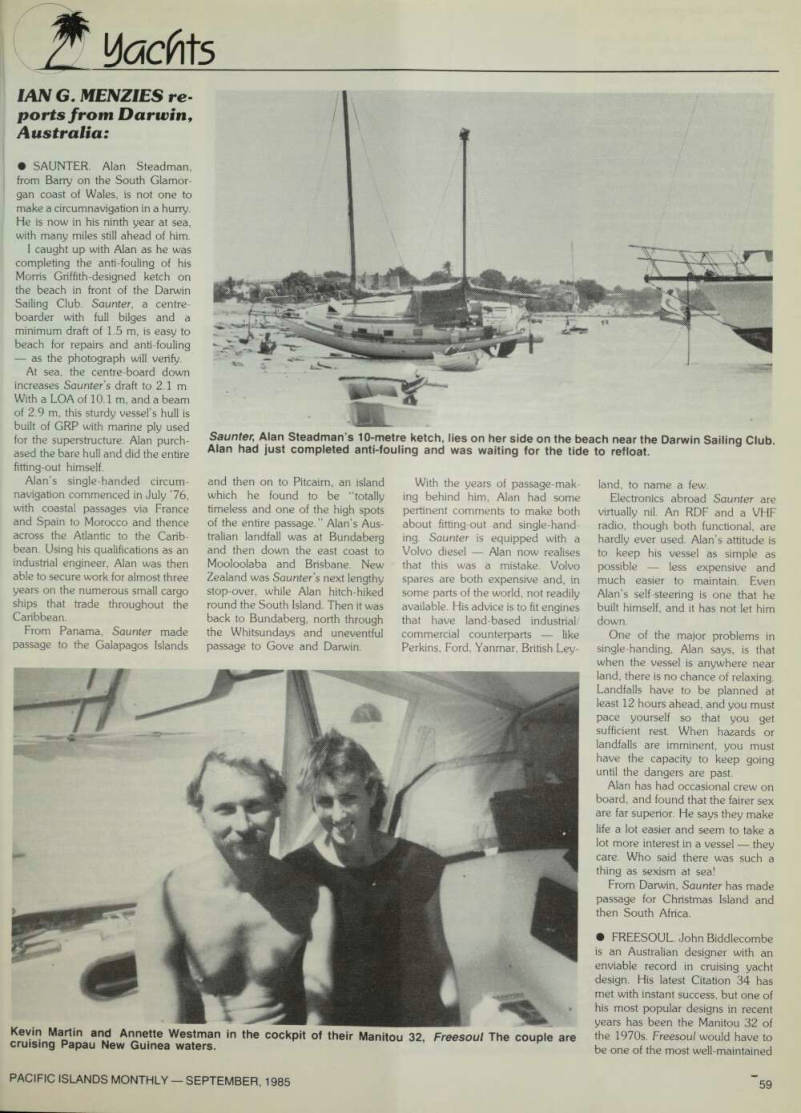
I caught up with Alan as he was completing the anti-fouling of his Morris Griffith-designed ketch on the beach in front of the Darwin Sailing Club. Saunter , a centre boarder with full bilges and a minimum draft of 1.5 m, is easy to beach for repairs and anti-fouling as the photograph will verify.
At sea, the centre-board down increases Saunter’s draft to 2.1 m With a LOA of 10.1 m, and a beam of 2.9 m, this sturdy vessel’s hull is built of GRP with marine ply used for the superstructure. Alan purch ased the bare hull and did the entire
fitting-out himself.
Alan’s single-handed circum navigation commenced in July ’76, with coastal passages via France and Spain to Morocco and thence across the Atlantic to the Carib bean. Using his qualifications as an industrial engineer, Alan was then able to secure work for almost three years on the numerous small cargo ships that trade throughout the Caribbean.
From Panama, Saunter made passage to the Galapagos Islands
and then on to Pitcairn, an island which he found to be “totally timeless and one of the high spots of the entire passage. ” Alan’s Aus tralian landfall was at Bundaberg and then down the east coast to Mooloolaba and Brisbane. New Zealand was Saunter’s next lengthy stop-over, while Alan hitch-hiked round the South Island. Then it was back to Bundaberg, north through the Whitsundays and uneventful passage to Gove and Darwin.
With the years of passage-mak ing behind him, Alan had some pertinent comments to make both about fitting-out and single-hand ing. Saunter is equipped with a Volvo diesel Alan now realises that this was a mistake. Volvo spares are both expensive and, in some parts of the world, not readily available. His advice is to fit engines that have land-based industrial/ commercial counterparts like Perkins, Ford, Yanmar, British Ley
land, to name a few.
Electronics abroad Saunter are virtually nil. An RDF and a VHF radio, though both functional, are hardly ever used. Alan’s attitude is to keep his vessel as simple as possible less expensive and much easier to maintain. Even Alan’s self-steering is one that he built himself, and it has not let him down.
One of the major problems in single-handing, Alan says, is that when the vessel is anywhere near land, there is no chance of relaxing.
Landfalls have to be planned at least 12 hours ahead, and you must pace yourself so that you get sufficient rest. When hazards or landfalls are imminent, you must have the capacity to keep going until the dangers are past.
Alan has had occasional crew on board, and found that the fairer sex are far superior. He says they make life a lot easier and seem to take a lot more interest in a vessel they care. Who said there was such a thing as sexism at sea!
From Darwin, Saunter has made passage for Christmas Island and then South Africa. • FREESOUL. John Biddlecombe is an Australian designer with an enviable record in cruising yacht design. His latest Citation 34 has met with instant success, but one of his most popular designs in recent years has been the Manitou 32 of the 19705. Freesoul would have to be one of the most well-maintained
Kevin Martin and Annette Westman in the cockpit of their Manitou 32, Freesoul The couple are cruising Papau New Guinea waters.
Saunter, Alan Steadman’s 10-metre ketch, lies on her side on the beach near the Darwin Sailing Club.
Alan had just completed anti-fouling and was waiting for the tide to refloat.
and fitted out examples of this breed.
Purchased as a GRP hull and deck by Kevin Martin in May ’79, she was eventualy launched at Geelong (Victoria, Australia), about three years later. Freesoul is hull No. 60 of about 70 vessels that were built. Her vital statistics are LOA of 9.7 m, draught of 1.7 m, with 2136 kg of lead in her keel, giving her an unburdened weight of approximately 4.5 t.
Kevin undertook all the fitting out himself, using King Billy Pine and Merbau (sometimes known as “poor man’s teak”), to achieve an interior that has all the charm and traditionalism usually found in much older vessels. He can be justly proud of his efforts, not only because of the quality of his work manship, but also because of some innovative design features that he has incorporated. One of the best is his collapsible chart table, so conve nient in a vessel that has limited interior volume.
Perhaps the most interesting aspect of Kevin’s fitting-out of Freesoul has been his careful selec tion of electronic and mechanical aids. All of it was done with an eye for space constraints imposed by a 9.7 m vessel, and bugetary limita tions. He has chosen well.
The Volvo MD 7 A diesel auxiliary
of 9.8 kW, with offset prop, is fed from the 136-litre fuel tank. This unit also generates charging power for the four batteries, which are
wired to two separate banks. The top-opening refrigerator can be po wered either from this 12-volt sys tem, or from propane gas or 240volt AC power, if required.
The galley, though small, is ex tremely efficient with a two-burner methylated spirit/alcohol stove fit ted, and a portable single burner kerosine “primus” as a back-up.
Fresh water is pumped to the sink from the 227 litres carried on board.
Communications are catered for by a 27 MHZ Handic transceiver and a Fujion multi-band receiver.
So accurate and powerful is the Fujion that Kevin also used it as an RDF. A Euromarine digital depth sounder, and a VDO Sumlog 11, backed up by a Walker trailing log, complete the electronics. An Auto helm 1000 has also been installed, but its performance in rough weath er has not been satisfactory. Kevin admits that his navigational equip ment and communications, is basically for coastal work he plans to upgrade before he attempts long-distance offshore passages.
Freesoul, like most other Manitou 32, is ketch-rigged. Kevin has altered the sail plan to a cutter ketch with a self-tacking wishbone staysail. Winches are by Barlow with mast steps being made out of aluminium strips, pop riveted to the mast.
Beneath the waterline, Kevin has added a skeg aft of the rudder, to give the vessel better directional stability. If there is one criticism that
Kevin has of the double-ender Manitou design, it is that the aft cabin gives the yacht too much buoyancy aft. The skeg helps to overcome this problem. To im prove water flow over the fully stainless steel rudder, Kevin has also fastened rubber flaps to cover the gap between rudder post and keel. All in all, some intersting and practical innovations.
For ground tackle, Freesoul has two 12.2 kg Plough anchors with the first warp of 30 m of 8 mm chain and 50 m of “Silver” rope, and the second with 6 m of 8 mm chain and a similar length of “Sil ver” rope.
I caught up with Kevin Martin, and his first mate Annette West man, in Coffs Harbour on the New South Wales mid-north coast. With its very proteced yacht harbour and equable climate, Coffs Harbour is fast becoming popular with cruising yachtsmen as a layover for the northern cyclone season, or just to “rest a while”. As the couple had been cruising since August, Kevin was not resting, but putting his skills to work as an automotive mechanic to build up funds for the next leg of their voyage via the Great Barrier Reef to Papua New Guinea. • CHUKLYN. A couple who have been meandering their leisurely way across the South Pacific over the last five years are Lynne and Carl Turnau of Vancouver, Can ada. Along the way they produced offspring in the shape of a daughter, Amber, now two-and-a-half.
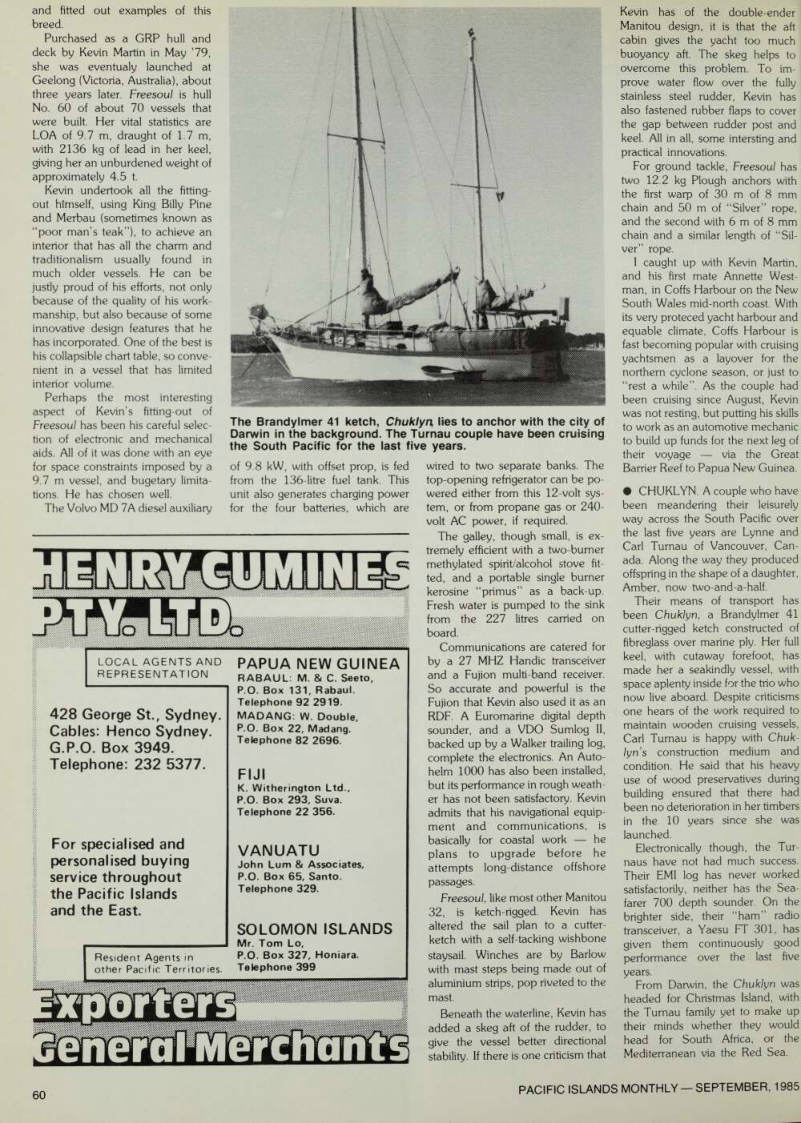
Their means of transport has been Chuklyn, a Brandylmer 41 cutter-rigged ketch constructed of fibreglass over marine ply. Her full keel, with cutaway forefoot, has made her a seakindly vessel, with space aplenty inside for the trio who now live aboard. Despite criticisms one hears of the work required to maintain wooden cruising vessels, Carl Turnau is happy with Chuk lyn’s construction medium and condition. He said that his heavy use of wood preservatives during building ensured that there had been no deterioration in her timbers in the 10 years since she was launched.
Electronically though, the Tur naus have not had much success.
Their EMI log has never worked satisfactorily, neither has the Sea farer 700 depth sounder. On the brighter side, their “ham” radio transceiver, a Yaesu FT 301, has given them continuously good performance over the last five years.
From Darwin, the Chuklyn was headed for Christmas Island, with the Turnau family yet to make up their minds whether they would head for South Africa, or the Mediterranean via the Red Sea.
The Brandylmer 41 ketch, Chuklyn, lies to anchor with the city of Darwin in the background. The Turnau couple have been cruising the South Pacific for the last five years.