New trade concessions
p. 15 · Read in the full issue
spur SPARTECA
Australia’s prime minis ter, Bob Hawke, went much further, perhaps beyond his own advis ers’ recommendation, in announcing at the Forum meet ing in Rarotonga liberalisation of Pacific regional trade under
Sparteca.
New Zealand, which had operated a somewhat more generous system previously, also announced improvements to its SPARTECA conditions by lowering duty on Fiji vodka and gin and reducing liquor matura tion requirements. Mr Lange also said New Zealand would liberalise investment incentive schemes to make launching of joint ventures easier.
Australia’s new terms will come into effect on January 1, 1987, a date determined mostly by the time required by bureaucrats to make their changes.
Officials concede that the concessions from Australia are the result of pressure from Fiji, supported by recommenda tions from the Australian de partments of Foreign Affairs and Trade. The minister of Industry and Commerce, Sena tor Button, who has a different set of fish to fry, is said to be less pleased.
Nor is there any secret that the concessions had a good deal to do with the signing of the South Pacific Nuclear-Free Zone Treaty, sponsored by Australia and supported by New Zealand. Eight nations have signed and the treaty is a fact, needing only ratification in Suva next year before its pro tocols set off on the rounds of the metropolitan and nuclear powers.
Predictably, Vanuatu did not sign, and nor did either Papua New Guinea or the Solomons.
Some say PNG delayed to demonstrate their displeasure over the recent three per cent cut in Australian aid. The
Federated States of Micronesia, now a full member of the Forum, offered to sign but, apparently, was advised to tarry until things were clearer on the status of the Compact of Free Association with the U.S.
Although the nuclear-free zone treaty, nuclear testing and the independence of New Cale donia looked to be the items of chief concern at the Forum, it was the liberalisation of SPAR TECA which was the main achievement of the meeting.
Under the new rules Australia will lift all duty and quotas on Forum Island products, except for five. These are garments, steel, footwear, sugar and cars.
Nobody cares very much about steel and cars. Sugar is the subject of a very sensible bilate ral understanding between Fiji and Australia. But textiles, clo thing and footwear are impor tant.
Fiji has great hopes of deve loping its current garment trade into a major industry, sup plying, principally, Australia and New Zealand. For a variety of reasons Australia has de clined to remove the present quota system and, indeed, may never do so officially. However, Mr Hawke did announce in Rarotonga extension of the pre sent Fiji quota and its mainten ance at a minimum 66,000 units a year, with annual negotiations on greater quanti ties until 1988 when Fiji’s re quest for a quota of at least 500,000 garments a year will be considered.
In effect the changes mean that Australia has all but totally adopted the New Zealand ’’negative listing” system of de ciding what items should be duty-free under the agreement and has thus made trade very much more free.
Beyond these changes Aus tralia and New Zealand have agreed to examine the possibil-
ity of including the Pacific countries in the Closer Economic Relationship (CER) which operates across the Tasman. But, say some trade experts, what the islands now have under the liberalised SPARTECA may well prove to be better for them
than membership of CER which demands two-way con cessions, However, Ratu Mara sug gested, and the Forum agreed, that a committee be set up to examine the CER idea. Staff Writer.
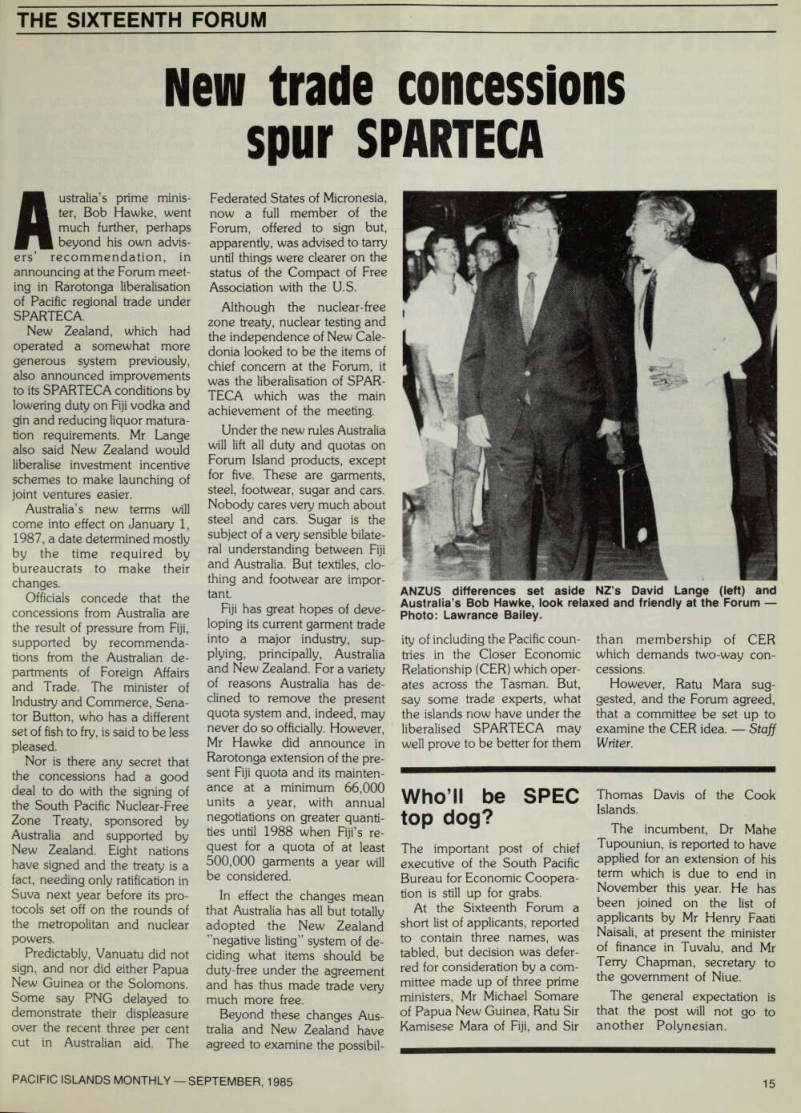
ANZUS differences set aside NZ’s David Lange (left) and Australia’s Bob Hawke, look relaxed and friendly at the Forum - Photo: Lawrance Bailey.