Yachts
pp. 58-60 · Read in the full issue
Ian G. Menzies Re
ports from Darwin, Australia:
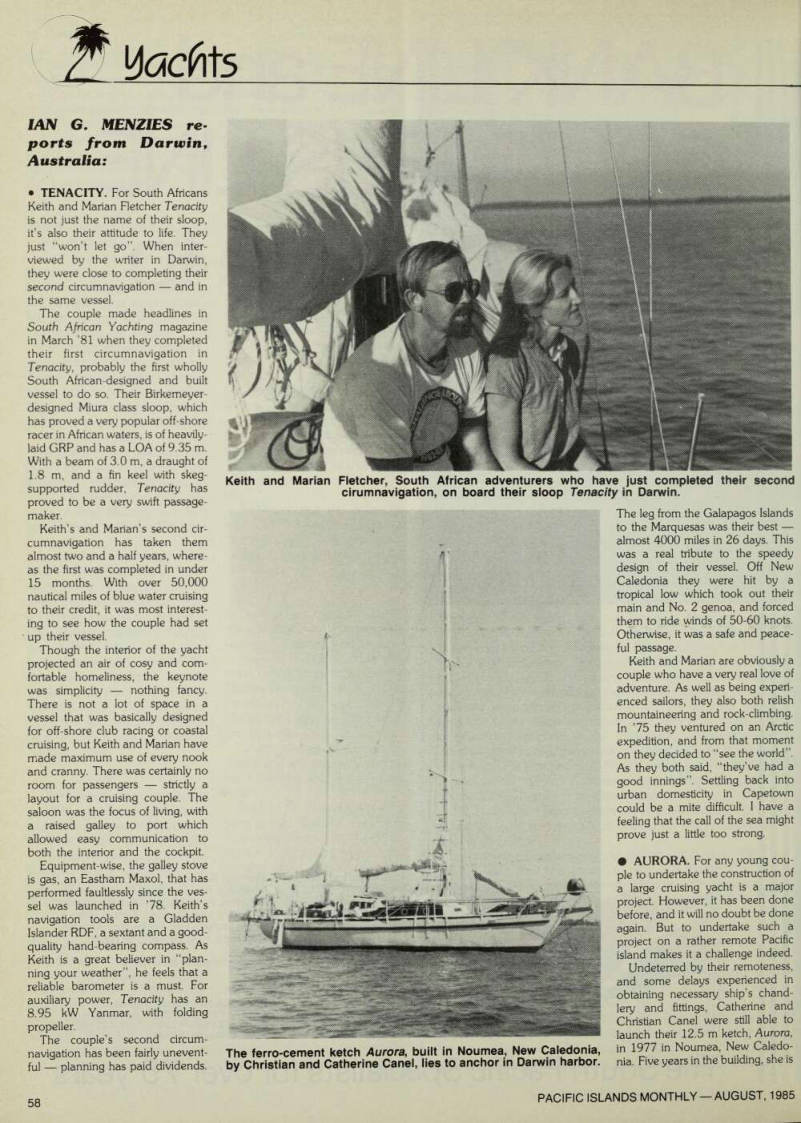
• TENACITY. For South Africans Keith and Marian Fletcher Tenacity is not just the name of their sloop, it’s also their attitude to life. They just “won’t let go”. When inter viewed by the writer in Darwin, they were close to completing their second circumnavigation and in the same vessel.
The couple made headlines in South African Yachting magazine in March ’Bl when they completed their first circumnavigation in Tenacity, probably the first wholly South African-designed and built vessel to do so. Their Birkemeyer designed Miura class sloop, which has proved a very popular off-shore racer in African waters, is of heavily laid GRP and has a LOA of 9.35 m.
With a beam of 3.0 m, a draught of 1.8 m, and a fin keel with skeg supported rudder, Tenacity has proved to be a very swift passage maker.
Keith’s and Marian’s second cir cumnavigation has taken them almost two and a half years, where as the first was completed in under 15 months. With over 50,000 nautical miles of blue water cruising to their credit, it was most interest ing to sec how the couple had set ' up their vessel.
Though the interior of the yacht projected an air of cosy and com fortable homeliness, the keynote was simplicity nothing fancy.
There is not a lot of space in a vessel that was basically designed for off-shore club racing or coastal cruising, but Keith and Marian have made maximum use of every nook and cranny. There was certainly no room for passengers strictly a layout for a cruising couple. The saloon was the focus of living, with a raised galley to port which allowed easy communication to both the interior and the cockpit.
Equipment-wise, the galley stove is gas, an Eastham Maxol, that has performed faultlessly since the ves sel was launched in ’7B. Keith’s navigation tools are a Gladden Islander RDF, a sextant and a good quality hand-bearing compass. As Keith is a great believer in “plan ning your weather”, he feels that a reliable barometer is a must. For auxiliary power, Tenacity has an 8.95 kW Yanmar, with folding
propeller.
The couple’s second circum navigation has been fairly unevent ful planning has paid dividends.
The leg from the Galapagos Islands to the Marquesas was their best almost 4000 miles in 26 days. This was a real tribute to the speedy design of their vessel. Off New Caledonia they were hit by a tropical low which took out their main and No. 2 genoa, and forced them to ride winds of 50-60 knots.
Otherwise, it was a safe and peace ful passage.
Keith and Marian are obviously a couple who have a very real love of adventure. As well as being experi enced sailors, they also both relish mountaineering and rock-climbing.
In ’75 they ventured on an Arctic expedition, and from that moment on they decided to “see the world”.
As they both said, “they’ve had a good innings”. Settling back into urban domesticity in Capetown could be a mite difficult. I have a feeling that the call of the sea might prove just a little too strong. • AURORA. For any young cou ple to undertake the construction of a large cruising yacht is a major project. However, it has been done before, and it will no doubt be done again. But to undertake such a project on a rather remote Pacific island makes it a challenge indeed.
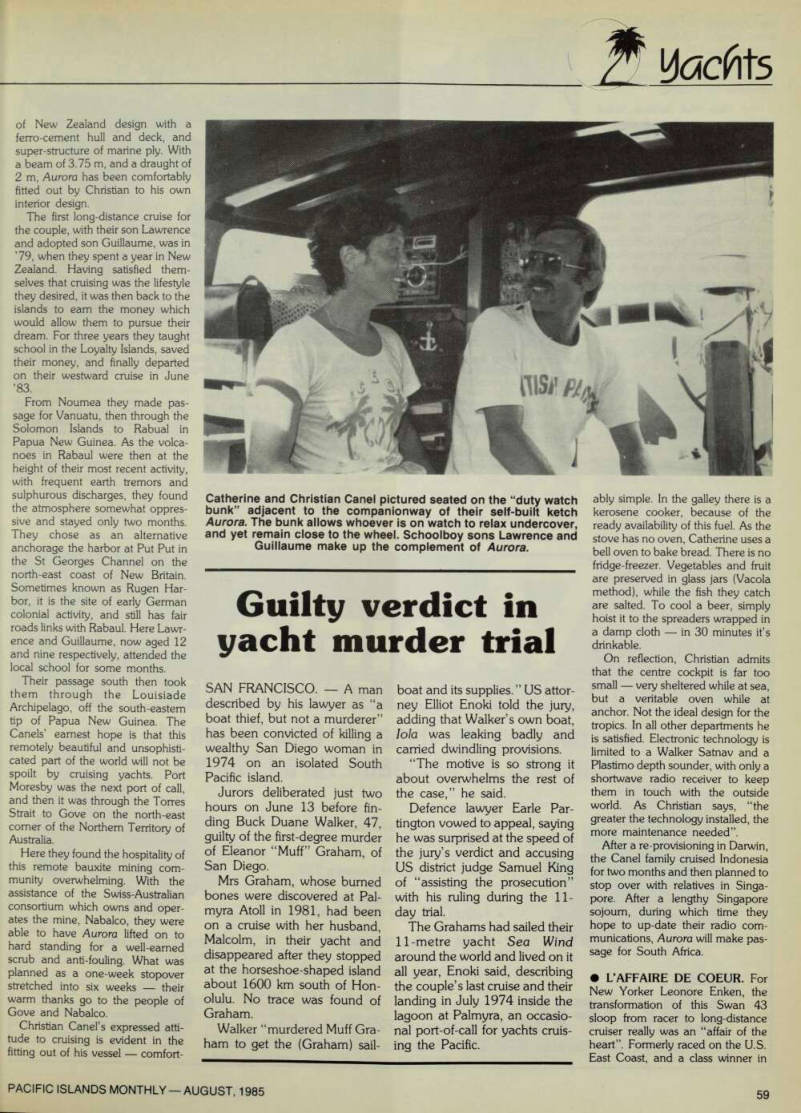
Undeterred by their remoteness, and some delays experienced in obtaining necessary ship’s chand lery and fittings, Catherine and Christian Canel were still able to launch their 12.5 m ketch, Aurora, in 1977 in Noumea, New Caledo nia. Five years in the building, she is
The ferro-cement ketch Aurora, built in Noumea, New Caledonia, by Christian and Catherine Canel, lies to anchor in Darwin harbor.
Keith and Marian Fletcher, South African adventurers who have just completed their second cirumnavigation, on board their sloop Tenacity in Darwin.
of New Zealand design with a ferro-cement hull and deck, and super-structure of marine ply. With a beam of 3.75 m, and a draught of 2 m, Aurora has been comfortably fitted out by Christian to his own interior design.
The first long-distance cruise for the couple, with their son Lawrence and adopted son Guillaume, was in ’79, when they spent a year in New Zealand. Having satisfied them selves that cruising was the lifestyle they desired, it was then back to the islands to earn the money which would allow them to pursue their dream. For three years they taught school in the Loyalty Islands, saved their money, and finally departed on their westward cruise in June ’B3.
From Noumea they made pas sage for Vanuatu, then through the Solomon Islands to Rabual in Papua New Guinea. As the volca noes in Rabaul were then at the height of their most recent activity, with frequent earth tremors and sulphurous discharges, they found the atmosphere somewhat oppres sive and stayed only two months.
They chose as an alternative anchorage the harbor at Put Put in the St Georges Channel on the north-east coast of New Britain.
Sometimes known as Rugen Har bor, it is the site of early German colonial activity, and still has fair roads links with Rabaul. Here Lawr ence and Guillaume, now aged 12 and nine respectively, attended the local school for some months.
Their passage south then took them through the Louisiade Archipelago, off the south-eastern tip of Papua New Guinea. The Canels’ earnest hope is that this remotely beautiful and unsophisti cated part of the world will not be spoilt by cruising yachts. Port Moresby was the next port of call, and then it was through the Torres Strait to Gove on the north-east comer of the Northern Territory of Australia.
Here they found the hospitality of this remote bauxite mining com munity overwhelming. With the assistance of the Swiss-Australian consortium which owns and oper ates the mine, Nabalco, they were able to have Aurora lifted on to hard standing for a well-earned scrub and anti-fouling. What was planned as a one-week stopover stretched into six weeks their warm thanks go to the people of Gove and Nabalco.
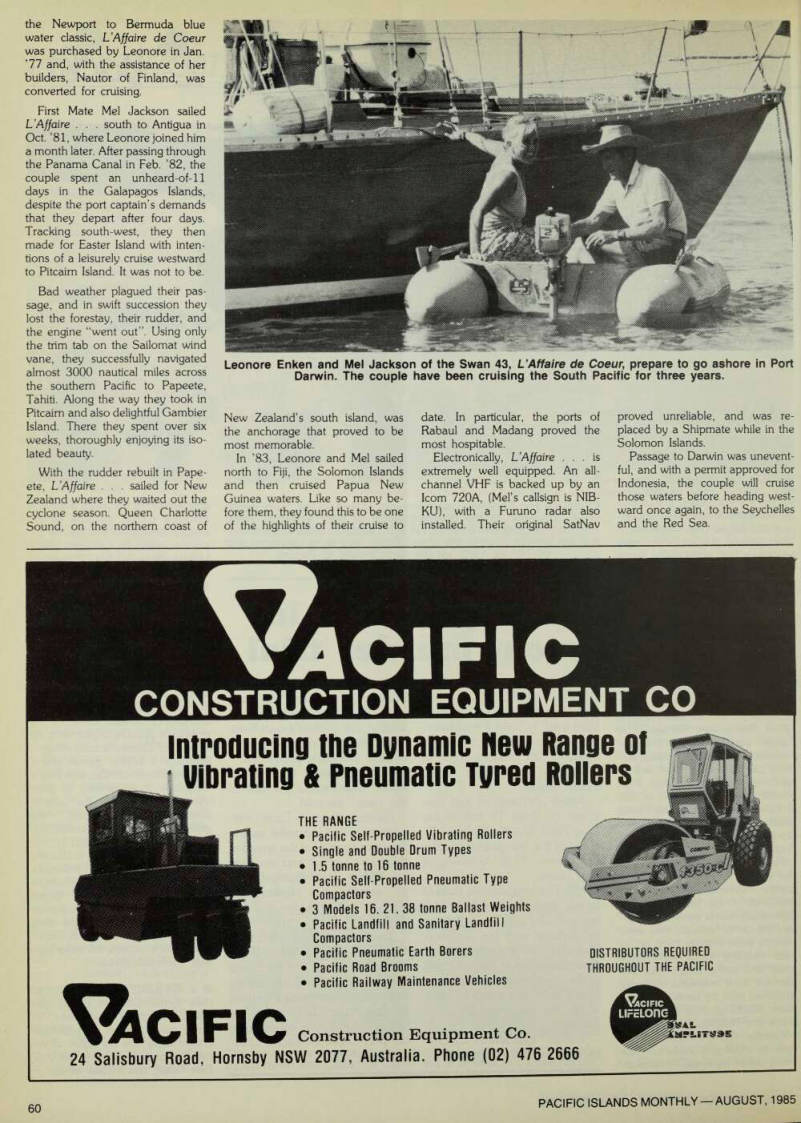
Christian Canel’s expressed atti tude to cruising is evident in the fitting out of his vessel comfort-
ably simple. In the galley there is a kerosene cooker, because of the ready availability of this fuel. As the stove has no oven, Catherine uses a bell oven to bake bread. There is no fridge-freezer. Vegetables and fruit are preserved in glass jars (Vacola method), while the fish they catch are salted. To cool a beer, simply hoist it to the spreaders wrapped in a damp cloth in 30 minutes it’s drinkable.
On reflection, Christian admits that the centre cockpit is far too small very sheltered while at sea, but a veritable oven while at anchor. Not the ideal design for the tropics. In all other departments he is satisfied. Electronic technology is limited to a Walker Satnav and a Plastimo depth sounder, with only a shortwave radio receiver to keep them in touch with the outside world. As Christian says, “the greater the technology installed, the more maintenance needed”.
After a re-provisioning in Darwin, the Canel family cruised Indonesia for two months and then planned to stop over with relatives in Singa pore. After a lengthy Singapore sojourn, during which time they hope to up-date their radio com munications, Aurora will make pas sage for South Africa.
• L’Affaire De Coeur. For
New Yorker Leonore Enken, the transformation of this Swan 43 sloop from racer to long-distance cruiser really was an “affair of the heart”. Formerly raced on the U.S.
East Coast, and a class winner in
Catherine and Christian Canel pictured seated on the “duty watch bunk” adjacent to the companionway of their self-built ketch Aurora. The bunk allows whoever is on watch to relax undercover, and yet remain close to the wheel. Schoolboy sons Lawrence and Guillaume make up the complement of Aurora.
the Newport to Bermuda blue water classic, L’Affaire de Coeur was purchased by Leonore in Jan. ’77 and, with the assistance of her builders, Nautor of Finland, was converted for cruising.
First Mate Mel Jackson sailed L’Affaire . . . south to Antigua in Oct. ’Bl, where Leonore joined him a month later. After passing through the Panama Canal in Feb. ’B2, the couple spent an unheard-of-11 days in the Galapagos Islands, despite the port captain’s demands that they depart after four days.
Tracking south-west, they then made for Easter Island with inten tions of a leisurely cruise westward to Pitcairn Island. It was not to be.
Bad weather plagued their pas sage, and in swift succession they lost the forestay, their rudder, and the engine “went out”. Using only the trim tab on the Sailomat wind vane, they successfully navigated almost 3000 nautical miles across the southern Pacific to Papeete, Tahiti. Along the way they took in Pitcairn and also delightful Gambier Island. There they spent over six weeks, thoroughly enjoying its iso lated beauty.
With the rudder rebuilt in Pape ete, L Affaire . . . sailed for New Zealand where they waited out the cyclone season. Queen Charlotte Sound, on the northern coast of
New Zealand’s south island, was the anchorage that proved to be most memorable.
In ’B3, Leonore and Mel sailed north to Fiji, the Solomon Islands and then cruised Papua New Guinea waters. Like so many be fore them, they found this to be one of the highlights of their cruise to
date. In particular, the ports of Rabaul and Madang proved the most hospitable.
Electronically, L’Affaire ... is extremely well equipped. An all channel VHP is backed up by an Icom 720 A, (Mel’s callsign is NIB KU), with a Furuno radar also installed. Their original SatNav
proved unreliable, and was re placed by a Shipmate while in the Solomon Islands.
Passage to Darwin was unevent ful, and with a permit approved for Indonesia, the couple will cruise those waters before heading west ward once again, to the Seychelles and the Red Sea.
Leonore Enken and Mel Jackson of the Swan 43, L’Affaire de Coeur, prepare to go ashore in Port Darwin. The couple have been cruising the South Pacific for three years.