A question of legitimacy
pp. 50-51 · Read in the full issue
political currents
The Micronesian States
During the May session of the United Nations Trusteeship Council, a petitioner compared the proposed new political sta tus for Micronesia to nothing less than the illegitimate and internationally abhorred status of the oppressive black South African homelands. In rebuttal, Epel lion, the Trukese repre sentative of the Federated States of Micronesia, gave the most eloquent speech of the session when he stated in the strongest terms that his govern ment and his people were appalled by such a comparison.
He said: “We, in fact, are proud peoples with effective control even today over our own lives and islands.”
This confrontation is but a microcosm of the difficult seas at the United Nations which the new Micronesian governments of the Federated States and the Marshalls must navigate in their quest to obtain international recognition for their new politi cal status.
Should the United Nations terminate the Trusteeship of the Pacific Islands it will also be recognising the international legitimacy of Micronesia’s new political status. Such a recogni tion has important long-term ramifications for the govern ments of the Marshall Islands and the Federated States. Both of these governments are over whelmingly dependent on the American treasury for their ex istence. With their particular brand of free association accepted by the international community, these Micronesian governments will be assured the right to conduct foreign affairs and to join in internation al forums. It is through such international contacts that they will be able to continue negotia-
In the first part of a two-part analysis HENRY M.
SCHWALBENBERG, S. J., examines the May meeting of the United Nations Trusteeship Council which had before it the problem of the U.S. Trust Territory of the Pacific Islands. In particular he looks at the problems faced by the new Micronesian governments in establishing international recogni tion of their legitimacy.
tions regardinjg fisheries, foreign aid, and foreign investment.
Without such international legi timacy, the Marshalls and the Federated States would virtual ly be locked into economic dependency on the United States which could only grow and eventually make a mockery of their supposed political autonomy.
The hope of the Marshalls and the Federated States to
have the UN terminate their Trusteeship by October 1 so they can begin self-government in free association with the United States can easily found er on the numerous reefs be fore them. First and foremost, U.S. Congressional approval this northern summer is not assured since several important American Congressmen have serious reservations about the Compacts. If, however, the
U.S. Congress does approve the Compacts this summer, then the Micronesians will have to navigte around three danger ous reefs at the United Nations.
Those three obstacles are the impasse in Palau, the perma nent denial clause in the Com pacts, and the Union of Soviet Socialist Republics.
Twice the Palauans have re jected their Compact of Free Association with the United States. In both cases the Palauan people voted by over 60 per cent in favor of the Compact, but less than the constitutionally required 75 per cent needed to approve an international agreement which would legally allow the transit ing and storage of nuclear weapons. It appears that there are now enough popular and legislative votes in Palau to
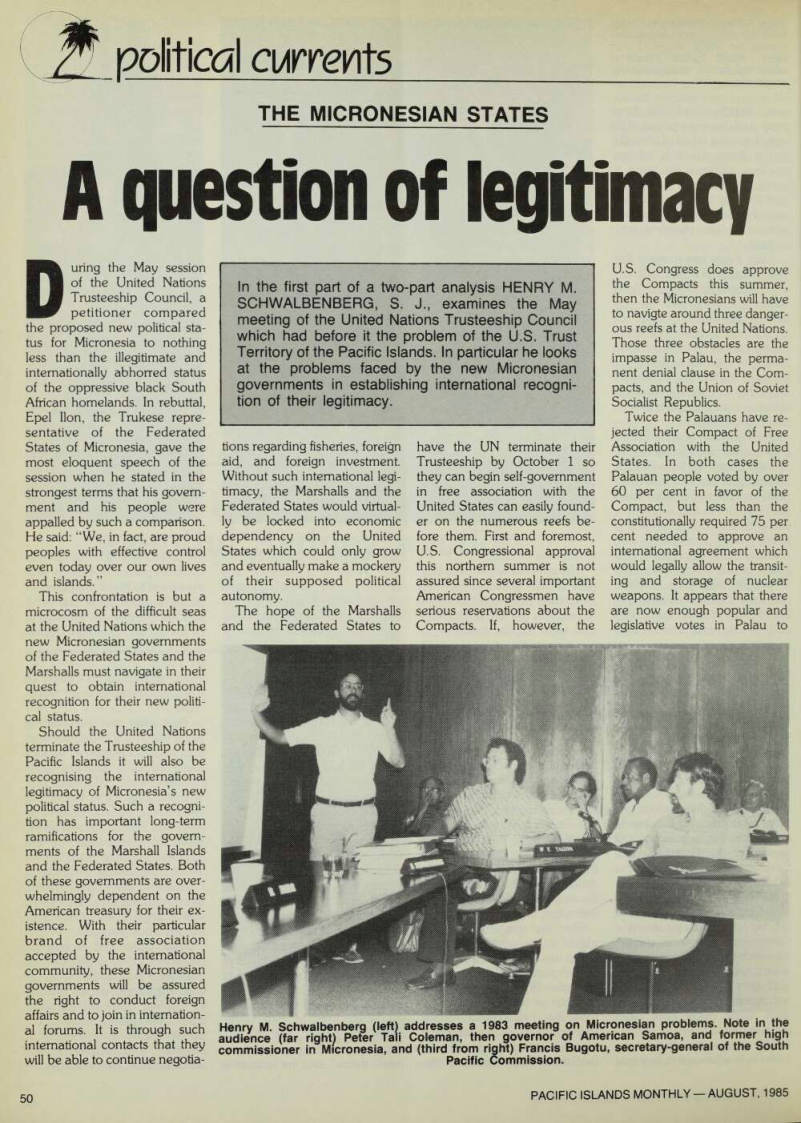
Henry M. Schwalbenberg (left) addresses a 1983 meeting on Micronesian problems. Note in the audience (far right) Peter Tali Coleman, then governor of American Samoa, and former high commissioner in Micronesia, and (third from right) Francis Bugotu, secretary-general of the South Pacific Commission.
approve an amendment to their constitution which could reduce this stringent 75 per cent re quirement to a simple majority.
This option, however, cannot be legally exercised until the next round of national elec tions, approximately three years away. Although it is pos sible, it seems unlikely that the Palauan situation will be re solved in the near future.
This Palauan impasse has given rise to demands for partial termination of the Trusteeship.
At the latest United Nations Trusteeship Council meeting, the representatives of the Mar shalls, the Federated States, and the Northern Marianas all called for termination of the Trusteeship with respect to their own jurisdictions. The Palauan representative for his part stated that termination “should not and must not be held up on account of Palau”.
At this stage in the United Nations it will be the four active member nations of the Trustee ship Council who will decide the issue. Those nations are France, the United Kingdom, the United States, and the Soviet Union. China, while a member of the council, does not participate. Final re sponsibility for Micronesia, however, will rest with the Security Council.
While no nation committed itself on the issue of partial termination, it became clear that the Americans and the British were quite sympathetic to the Micronesian request. The United States at one point even defended the concept of partial termination. The French posi tion is harder to gauge. A former high-ranking French diplomat on the Trusteeship Council once told this reporter of his strong opposition to piecemeal termination. He could not see how it could be justified in international law.
During the council’s meeting, however, the U.S. argued that the Cameroon trusteeship was a legal precedent for partial termination. It is expected that the Soviet delegation will oppose partial termination of the Trusteeship.
The permanent denial clause represents another reef which the Micronesians must circumnavigate on the way to international recognition. Dur ing the council’s debate, the
British delegate quite correctly once characterised a Soviet speech at the council as “undi luted nonsense”. However, during the course of the meet ing the Soviets did raise two substantive objections to the Micronesian free association status. First was a marxist criti que of Western-style elections.
How could the Micronesians, the Soviets ask, choose any other status but free association or commonwealth with the Un ited States when their economy is 90 per cent dependent on U.S. government funding? De spite open and fair elections, the Soviet delegation argued, the Micronesians were in fact denied the option of independ ence because of their economic situation. The plebiscites were, therefore, not free.
It was the representative of the Federated States, Epel lion, who best argued against the Soviet position. Mr lion stated: “One of the primary reasons our people voted for the Com pact of Free Association was because of our economic de pendence on the United States not, and I repeat not, be cause we were forced to accept free association as a result of our economic dependency, but because the Compact puts the means within our grasp to re duce and soon eliminate this dependency.” He asked the council not to use the economic conditions in Micronesia as a pretext to deny the political status and the means for achieving a better life that the Micronesian people have freely chosen. Concerning independ ence the Federated States rep resentative said: “Full inde pendence was an alternative available to us, is an alternative available now, and will be an alternative available to us in the future. ”
Many nations would be will ing to recognise and legitimate a status of less than independ ence, such as free association, if it was clear that in the future a freely associated state could choose independence. How ever, it is at this point that the Soviets make their second sub stantive objective to free association. They argue that the long term mutual security agreements within the Com pacts make it virtually impossi ble for the Micronesians to get free of the cage that the Penta-
gon has woven around them.
The mutual security agree ments form a basic, if not the basic, component of the free association package. These security agreements contain the permanent denial clause which enables the United States to deny military access to Mic ronesia by any other nation, in particular the Soviet Union.
These agreements are written so they will continue no matter what political status Micronc sians may choose in the future.
U.S. strategic denial authority cannot be ended without Amer ican consent. These security agreements would clearly bind Micronesia into the Western alliance and do place an upper limit on their potential political independence.
The only legitimate argument in favor of permanent denial is that the political limitations on self-government are minor compared to the regional secur ity interests it protects. After meeting several Micronesian politicians who expressed opposition to permanent denial on the ground that it would prevent them from playing the Soviets off against the Amer icans for financial gain, this reporter has begun to appreci ate the wisdom of those U.S.
Senators who demanded permanent denial as a condi tion for their approval of the Compacts. Permanent denial removes the risk of upsetting the strategic balance in the Pacific by irresponsible leaders concerned solely with financial gain. But it must be admitted that it is, nonetheless, a denial of full Micronesian sovereignty.
It can be argued that the in ternational community had legitimised such a restriction when in 1947 the United Na tions designated Micronesia as the only “strategic” trust terri
tory subject ultimately not to the UN General Assembly but rather to the UN Security Council.
The third major reef confron ting Micronesian navigators sail ing in search of international acceptance is the Soviet Union.
The Compacts of Free Associa tion are agreements which will continue to foreclose Soviet military access to Micronesian territory and preserve American naval dominance in the central Pacific. The Soviet Union has consistently and will with little doubt continue to oppose any action in the United Nations which might lend legitimacy to these accords. It would be naive to expect the Soviets and the members of the Soviet bloc not to oppose termination of the Trusteeship. The realistic goal of the Micronesians must rather be to diplomatically isolate the Soviet bloc. If it is only the Soviet government and those governments it directly controls who oppose free association, then for all practical purposes the Micronesians will have achieved the international sta tus they need to conduct the foreign affairs necessary to build their economic self-re liance.
Although the French and the British have often, and usually privately, expressed their dis satisfaction on such issues as the fragmentation and partial termination of the Trusteeship, the denial arrangements and the conduct of the latest Palauan referendum on the Compact, it can be expected that they, along with the rest of America’s Western allies, will stand in support of the legitima cy of the Micronesian free association status when the vot ing takes place.
Continued next month
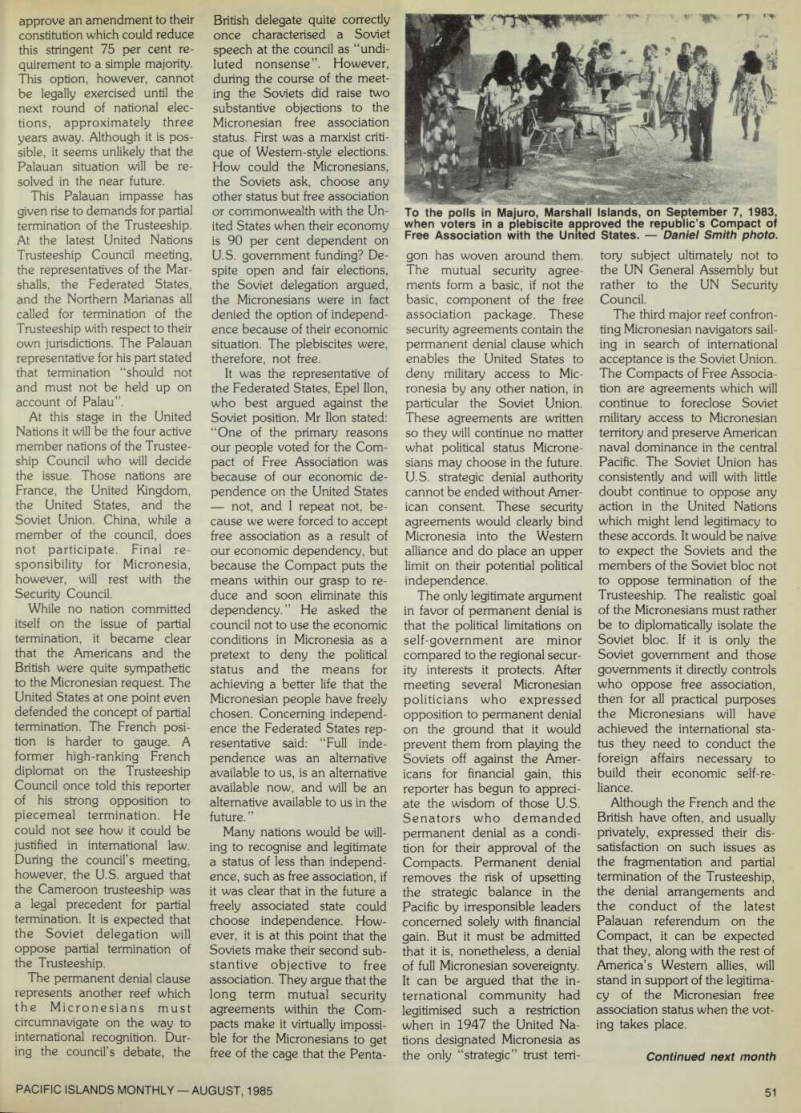
To the polls in Majuro, Marshall Islands, on September 7, 1983, when voters in a plebiscite approved the republic’s Compact of Free Association with the United States. - Daniel Smith photo.