from Canberra
pp. 36-37 · Read in the full issue
New Cal. The view from Canberra
The issue of independ ence for New Caledo nia is threatening to cause a split at the Cook Islands meeting of the South Pacific Forum on August 5 and 6.
Kanak militant, Yann Celene Uregei has spent the past few weeks touring the Pacific seek ing support to have the French territory reinscribed with the United Nations Decolonisation Committee. Uregei has also been lobbying for the Kanak Socialist National Liberation Front to be given observer status at the Forum and for the provisional F.L.N.K.S. govern ment of Kanaky to be officially recognised.
Mr Uregei has had mixed success, but the fact that the response has been so varied ensures that New Caledonia will be one of the major issues that the Forum will have to consider. The problem is that as there are no votes taken at the Forum, the communique usual ly issued at the end of the meeting is likely to represent a lowest common denominator as far as New Caledonia is concerned.
The question is how far the three Melanesian members, Vanuatu, Solomon Islands, and Papua New Guinea are pre pared to push for some action by the Forum on New Caledo nia. Many observers consider it is unlikely that they will be satisfied with the sort of wait and-see approach agreed to at last year’s Forum in Tuvalu.
There, Vanuatu’s prime minister, Father Walter Lini, was keen for the Forum to take a strong line against the French.
But the Forum decided to go along with arguments put by Australia’s Bob Hawke and New Zealand’s David Lange that any move to have New Caledonia brought up before the United Nations could be counter-productive.
It is an argument still being
Calm reigns in New Caledonia and, as is reported elsewhere in this issue, efforts are being made to restore some of the territory’s damaged economy, but the political problems remain large and very complex, as this report from our Canberra cor respondent shows.
pursued by Australia’s foreign minister, Bill Hayden. Uregei had a 45-minute audience with Hayden in Canberra to push the F.L.N.K.S. line. Afterwards Hayden told journalists Austra lia was ’’not without sympathy” for the French government’s predicament in handling the New Caledonia issue.
On the question of the
F.L.N.K.S. request to have New Caledonia considered by the United Nations, Hayden said he saw difficulties in pro ceeding with that course. ”If that initiative were to be set back by French action and France is in a position to call up quite a lot of I.O.U’s at the U.N., including from Third World countries, and most par
ticularly from black Africa then I think the F.L.N.K.S. cause could be severely dam aged,” Hayden said.
On the French attitude to wards New Caledonia, Hayden said the French had enormous problems. ’’First of all, they have to address themselves to a very complex internal situation in New Caledonia which could blow up at any time if it is not sensitively handled. Secondly, they have a domestic political problem in mainland France where there is some sort of opposition, the level of which I am not too sure, to the proposal for independence for New Caledonia. ”
Pushed to be more precise on the Australian government’s position, Hayden said he had sympathy for the claims for independence, but they had to be broadly supported by the people there. The government sympathised with the Fabius Plan which proposes regional assembly elections later this year, an act of self-determina tion before the end of 1987, and some sort of on-going association with France.
While the French govern ment under President Mitter rand is keen to have the Fabius Plan implemented, there are continuing problems. Attempts to amend the legislation estab lishing the statute for the regio nal assembly elections could be made in the senate, where the Socialists don’t have a majority, but the upper chamber has no power to enforce any changes.
It is becoming clear that the French government wants to have the election wrapped up by September at the latest before campaigning gets under way for next March’s national assembly elections in France.
The Gaullist opposition in tends to use New Caledonia as an important election issue be cause it believes there is plenty of domestic mileage to be got from it, although there are
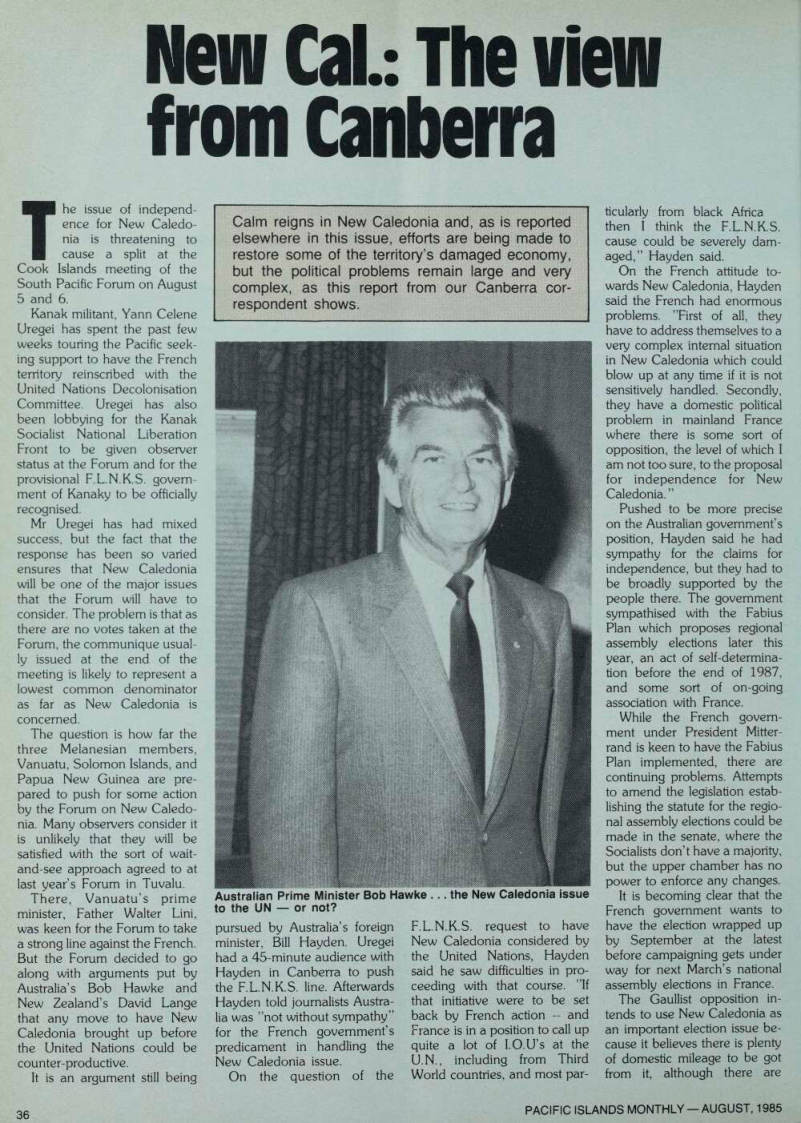
Australian Prime Minister Bob Hawke ... the New Caledonia issue to the UN - or not?
strong suggestions that if the Socialists lost power there would be few changes to the Fabius timetable under a Gaul list administration.
In New Caledonia, the situa tion has been calm since the arrival of the new High Com missioner, Mr Fernand Wibaux, and the departure of Mr Edgard Pisani, so hated by the anti independence movement and little-loved by the F.L.N.K.S.
The F.L.N.K.S. has said it will take part in the election pro vided there are no major changes to the Fabius Plan, and the R.P.C.R. have agreed to participate, provided the elec tions are free and democratic.
The outcome at this early stage is difficult to predict.
While it is fairly easy to forecast an R.P.C.R. majority in the Noumean assembly and an
F.L.N.K.S. majority in both the Loyalty islands, and Northern assemblies. The South looks to be finely balanced.
But with proportional repre sentation and universal suf frage, the more moderate, pro independence L.K.S. party and some anti-independence centre parties could also win important seats. This would mean that neither the R.P.C.R. nor the F.L.N.K.S. would have an overall majority in the 43member territorial congress which will be made up of all the members of the four regional assemblies.
The French government would probably not be unhap py at the prospect of some moderates holding the balance of power between the extreme positions of the F.L.N.K.S. and the R.P.C.R.
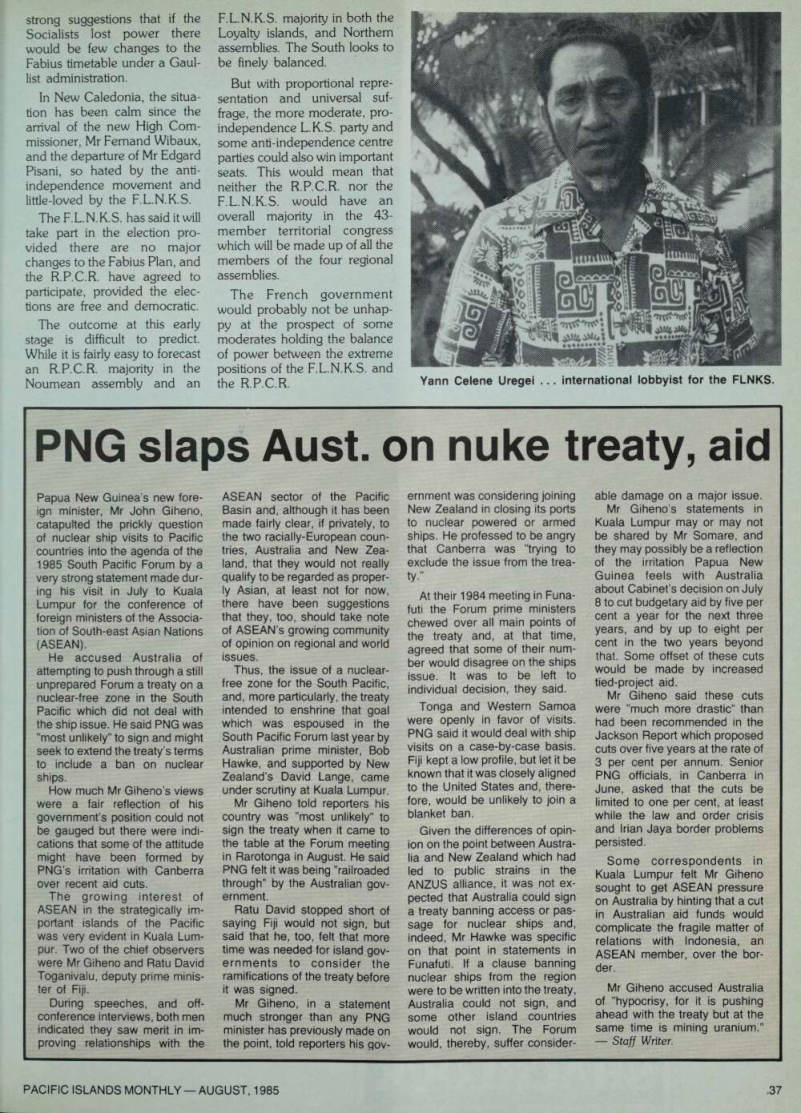
Yann Celene Uregei ... international lobbyist for the FLNKS.