meringue harangue
pp. 27-28 · Read in the full issue
The great Oz-NZ meringue harangue
The normally good relations between the Australian and New Zealand High Commis sioners in Apia survived the ANZUS debate without a ruffle, but they have been upset by a recent dispute over the origins of the pavlova, a much-en joyed, sticky, rich meringue-
based dessert topped with mounds of whipped cream and fresh fruit.
P.I.M.’s resident correspon dent in Apia, Lee Anderson, reports that, in conjunction with Western Samoa’s recent inde pendence celebrations, the Rotoract group asked for a donation of national dishes for a fund-raising evening. Both the Australian and New Zea land High Commissioners offered to provide their most famous national dish, the pride of their nation’s housewives for generations - pavlova.
The Australian High Com missioner was dismayed when he heard his New Zealand counterpart had suggested the same confection. He rushed for pen and paper, quoting from the Australian Encyclopaedia to support his claim that the pavlova was an Australian in vention, as dinky-di as gum leaves and Fosters Lager.
The New Zealand High Commissioner, Mike Mansfield,
Apia Calling
replied with a copy of a letter from a recent edition of The Bulletin , very much an Austra lian magazine, claiming pavlova had its origins in New Zealand.
He added that the pavlova recipe was first published in the Otago Daily; Times in 1935.
“First come, first served,” wrote the Kiwi diplomatic war rior of the sweet tooth. Every man, woman, and child in New Zealand recognised pavlova as the national dish, he main tained.
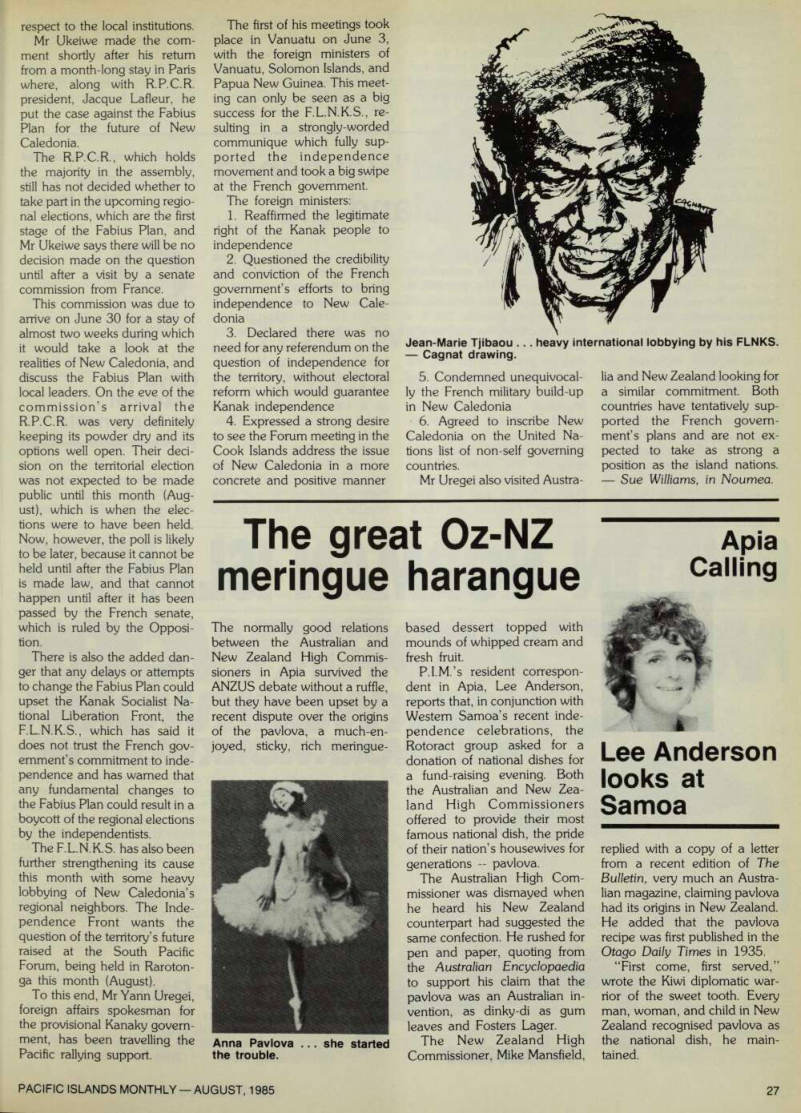
Anna Pavlova ... she started the trouble.
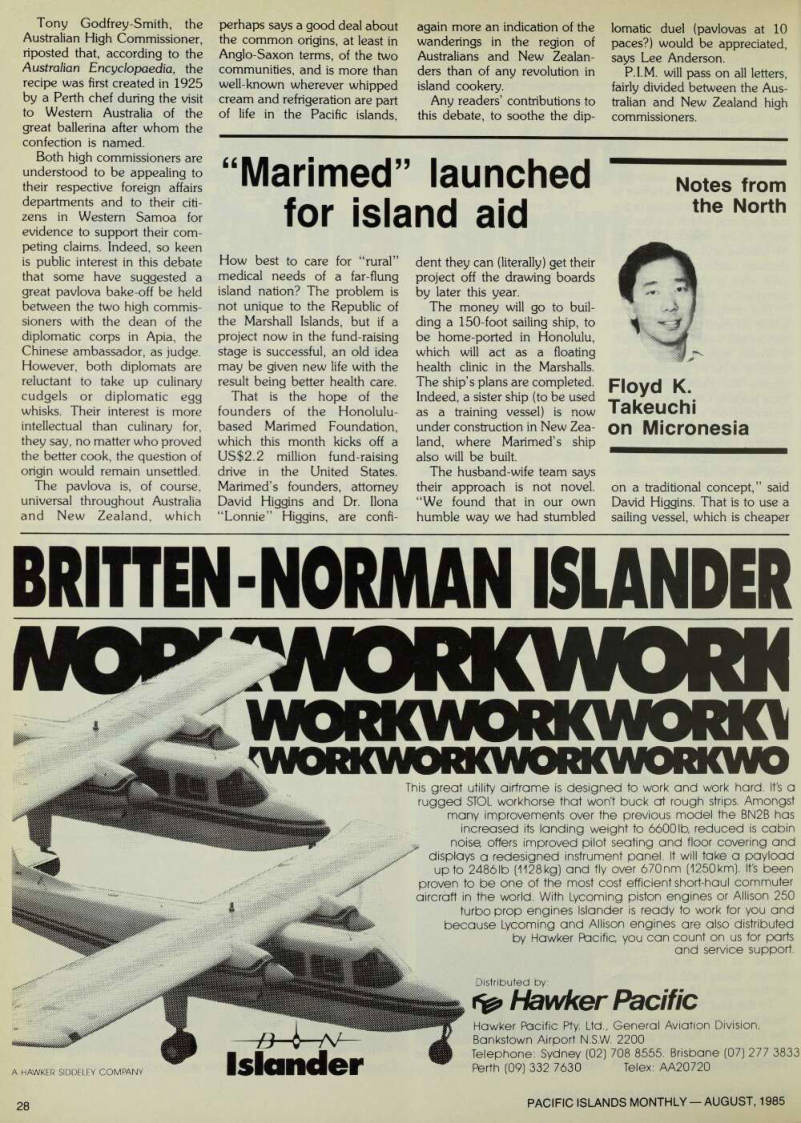
Lee Anderson looks at Samoa
Tony Godfrey-Smith, the Australian High Commissioner, riposted that, according to the Australian Encyclopaedia, the recipe was first created in 1925 by a Perth chef during the visit to Western Australia of the great ballerina after whom the confection is named.
Both high commissioners are understood to be appealing to their respective foreign affairs departments and to their citi zens in Western Samoa for evidence to support their com peting claims. Indeed, so keen is public interest in this debate that some have suggested a great pavlova bake-off be held between the two high commis sioners with the dean of the diplomatic corps in Apia, the Chinese ambassador, as judge.
However, both diplomats are reluctant to take up culinary cudgels or diplomatic egg whisks. Their interest is more intellectual than culinary for, they say, no matter who proved the better cook, the question of origin would remain unsettled.
The pavlova is, of course, universal throughout Australia and New Zealand, which
perhaps says a good deal about the common origins, at least in Anglo-Saxon terms, of the two communities, and is more than well-known wherever whipped cream and refrigeration are part of life in the Pacific islands,
again more an indication of the wanderings in the region of Australians and New Zealan ders than of any revolution in island cookery.
Any readers’ contributions to this debate, to soothe the dip
lomatic duel (pavlovas at 10 paces?) would be appreciated, says Lee Anderson.
P.I.M. will pass on all letters, fairly divided between the Aus tralian and New Zealand high commissioners.