yachts
pp. 73-76 · Read in the full issue
• Fix One Of Hamble. One
would surmise that the owner of a yacht with a name like Fix One of Flamble, would probably have an interest in photography and also be an Englishman . . . from Hamble.
Right on the first assumption, wrong on the second. The owner does indeed have extensive in terests in the photographic industry, but he is a German Jurgen Kliche from West Berlin. Fix One of Hamble sails under a British flag of convenience, is registered out of Southampton, and is commanded by a professional cruising skipper, Frank Schellmann, also from Ger many.
Notwithstanding, Fix One of Hamble’s pedigree is impeccable, for she is a superb Sparkman and Stephen-designed Swan 57 by Nautor of Finland. Frank Schell mann has been with her from the very beginning right through from keel to final commissioning.
Frank put together a video on the whole exercise, which I was able to view while I was on board the vessel. She finally departed Finland in October ’B2, during a winter’s snowstorm, and sailed directly for the sunny warmth of the Carib bean.
Frank, who had about 10 years of charter experience in the Mediterranean and Caribbean be fore taking command of Fix One. . . was given a completely free hand in the fitting-out of the functional aspects of the vessel, particularly the electronics. His advice is worth recording.
One way of making sure that you are buying the right electronics, Frank says, is to visit a number of marine electronics repair shops.
Take a look at the models and makes that are most in evidence, and cross them off your buying list More to the point, however, are Frank’s comments on Satnavs. In his years of cruising, he has heard countless criticisms on a variety of different brands of Satnavs they are forever breaking down when you need them most. When you switch them on they don’t work.
Frank says that they should never be switched off. By keeping them on all the time, the low heat generated keeps out the humidity and dampness both sudden death to delicate electronics. Frank practises what he preaches his Satnav and main radio transceiver are wired directly to a dedicated battery, even by-passing the main switch. They are never “off”.
The layout of the main naviga-
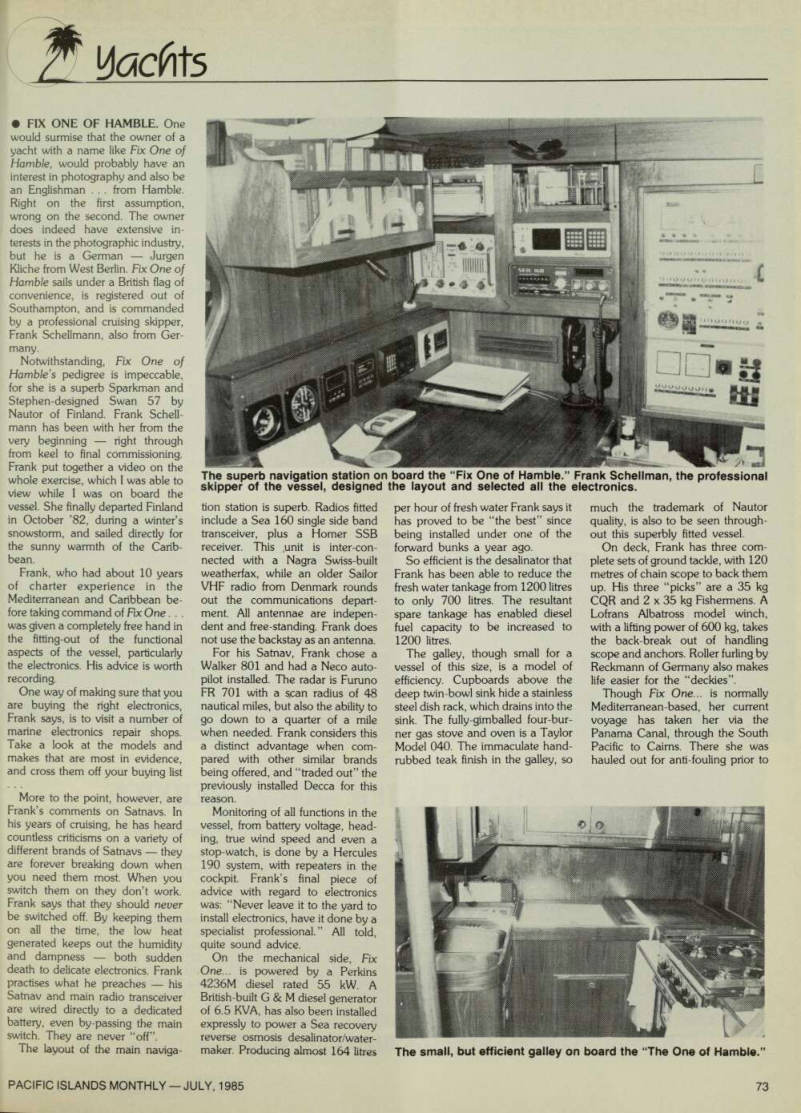
tion station is superb. Radios fitted include a Sea 160 single side band transceiver, plus a Homer SSB receiver. This .unit is inter-con nected with a Nagra Swiss-built weatherfax, while an older Sailor VHF radio from Denmark rounds out the communications depart ment. All antennae are indepen dent and free-standing. Frank does not use the backstay as an antenna.
For his Satnav, Frank chose a Walker 801 and had a Neco auto pilot installed. The radar is Furuno FR 701 with a sican radius of 48 nautical miles, but also the ability to go down to a quarter of a mile when needed. Frank considers this a distinct advantage when com pared with other similar brands being offered, and “traded out” the previously installed Decca for this reason.
Monitoring of all functions in the vessel, from battery voltage, head ing, true wind speed and even a stop-watch, is done by a Hercules 190 system, with repeaters in the cockpit. Frank’s final piece of advice with regard to electronics was: “Never leave it to the yard to install electronics, have it done by a specialist professional. ” All told, quite sound advice.
On the mechanical side, Fix One... is powered by a Perkins 4236 M diesel rated 55 kW. A British-built G & M diesel generator of 6.5 KVA, has also been installed expressly to power a Sea recovery reverse osmosis desalinator/water maker. Producing almost 164 litres
per hour of fresh water Frank says it has proved to be “the best” since being installed under one of the forward bunks a year ago.
So efficient is the desalinator that Frank has been able to reduce the fresh water tankage from 1200 litres to only 700 litres. The resultant spare tankage has enabled diesel fuel capacity to be increased to 1200 litres.
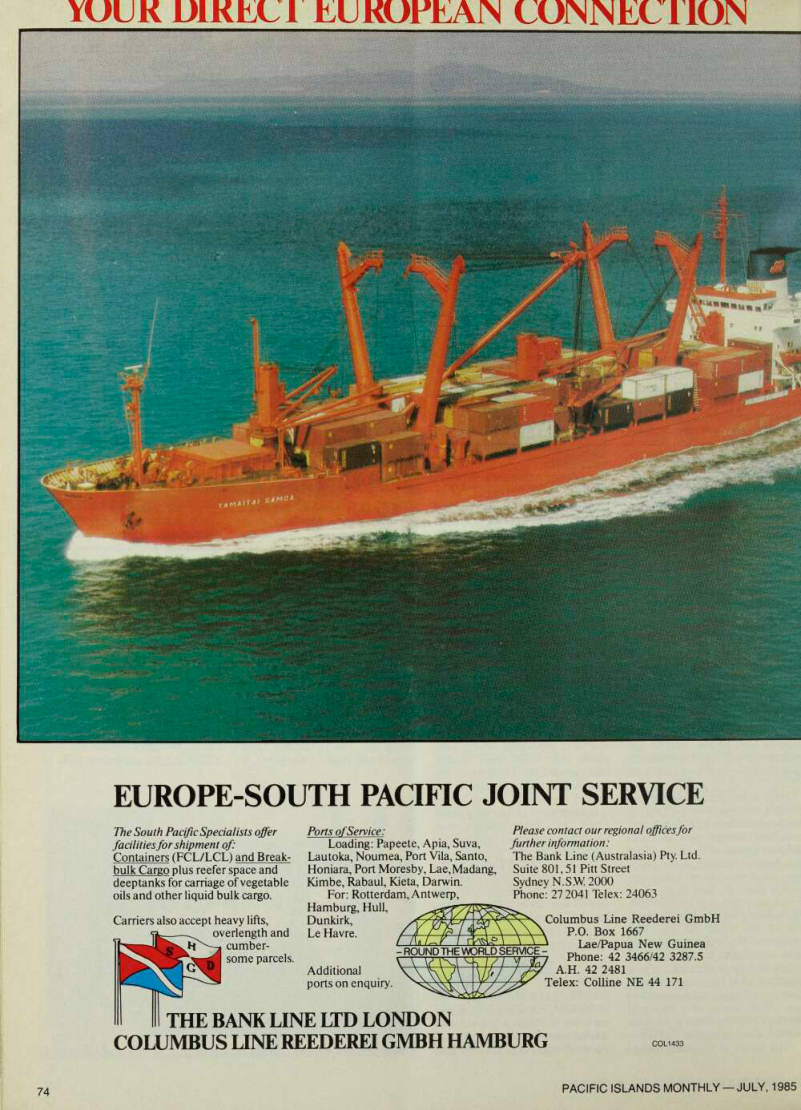
The galley, though small for a vessel of this size, is a model of efficiency. Cupboards above the deep twin-bowl sink hide a stainless steel dish rack, which drains into the sink. The fully-gimballed four-bur ner gas stove and oven is a Taylor Model 040. The immaculate hand rubbed teak finish in the galley, so
much the trademark of Nautor quality, is also to be seen through out this superbly fitted vessel.
On deck, Frank has three com plete sets of ground tackle, with 120 metres of chain scope to back them up. His three “picks” arc a 35 kg CQR and 2 x 35 kg Fishermens. A Lofrans Albatross model winch, with a lifting power of 600 kg, takes the back-break out of handling scope and anchors. Roller furling by Reckmann of Germany also makes life easier for the “deckies”.
Though Fix One... is normally Mediterranean-based, her current voyage has taken her via the Panama Canal, through the South Pacific to Caims. There she was hauled out for anti-fouling prior to
The superb navigation station on board the “Fix One of Hamble.” Frank Schellman, the professional skipper of the vessel, designed the layout and selected all the electronics.
The small, but efficient galley on board the “The One of Hamble.”
making passage for Darwin, Singa pore and the Maldives. Skipper Frank Schellmann, with crew mem bers Riocaod O’Taimigh from Ire land and Samantha Lendill from the U.K., hopes to have Fix One... back in the Mediterranean for the northern summer season. • SEVERANCE. From the very early days of their marriage, it was always the dream of Pat and Charlie Beasley to go cruising. Well, they eventually made it, and have along with them their two sons Charlie, 25, and Vincent, 19.
Charlie Beasley has always been a wooden boat fan, a characteristic more than evidenced in the superb Herreschof sailing dinghy that he has crafted as their yacht tender.
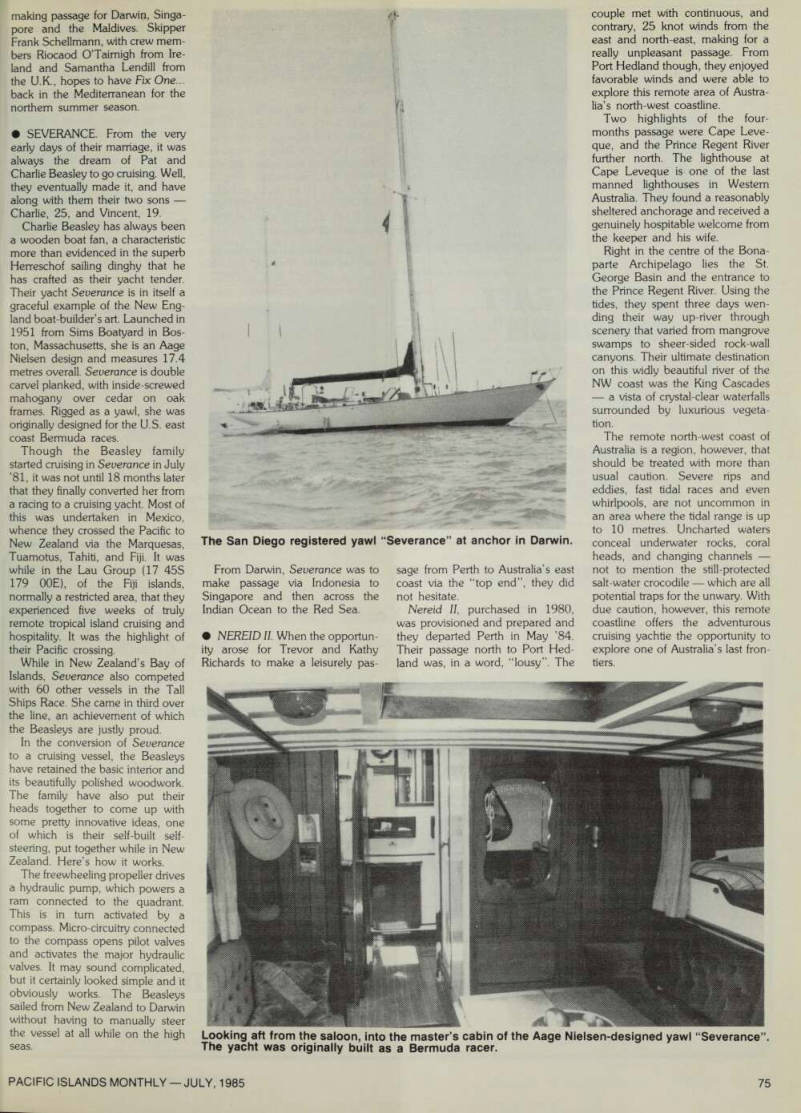
Their yacht Severance is in itself a graceful example of the New Eng land boat-builder’s art. Launched in 1951 from Sims Boatyard in Bos ton, Massachusetts, she is an Aage Nielsen design and measures 17.4 metres overall. Severance is double carvel planked, with inside-screwed mahogany over cedar on oak frames. Rigged as a yawl, she was originally designed for the U.S. east coast Bermuda races.
Though the Beasley family started cruising in Severance in July ’Bl, it was not until 18 months later that they finally converted her from a racing to a cruising yacht. Most of this was undertaken in Mexico, whence they crossed the Pacific to New Zealand via the Marquesas, Tuamotus, Tahiti, and Fiji. It was while in the Lau Group (17 45S 179 00E), of the Fiji islands, normally a restricted area, that they experienced five weeks of truly remote tropical island cruising and hospitality. It was the highlight of their Pacific crossing.
While in New Zealand’s Bay of Islands, Severance also competed with 60 other vessels in the Tall Ships Race. She came in third over the line, an achievement of which the Beasleys are justly proud.
In the conversion of Severance to a cruising vessel, the Beasleys have retained the basic interior and its beautifully polished woodwork.
The family have also put their heads together to come up with some pretty innovative ideas, one of which is their self-built self steering, put together while in New Zealand. Here’s how it works.
The freewheeling propeller drives a hydraulic pump, which powers a ram connected to the quadrant.
This is in turn activated by a compass. Micro-circuitry connected to the compass opens pilot valves and activates the major hydraulic valves. It may sound complicated, but it certainly looked simple and it obviously works. The Beasleys sailed from New Zealand to Darwin without having to manually steer the vessel at all while on the high seas.
From Darwin, Severance was to make passage via Indonesia to Singapore and then across the Indian Ocean to the Red Sea. • NEREID 11. When the opportun ity arose for Trevor and Kathy Richards to make a leisurely pas
sage from Perth to Australia’s east coast via the “top end”, they did not hesitate.
Nereid 11, purchased in 1980, was provisioned and prepared and they departed Perth in May ’B4.
Their passage north to Port Hed land was, in a word, “lousy”. The
couple met with continuous, and contrary, 25 knot winds from the east and north-east, making for a really unpleasant passage. From Port Hedland though, they enjoyed favorable winds and were able to explore this remote area of Austra lia’s north-west coastline.
Two highlights of the four months passage were Cape Leve que, and the Prince Regent River further north. The lighthouse at Cape Leveque is one of the last manned lighthouses in Western Australia. They found a reasonably sheltered anchorage and received a genuinely hospitable welcome from the keeper and his wife.
Right in the centre of the Bona parte Archipelago lies the St.
George Basin and the entrance to the Prince Regent River. Using the tides, they spent three days wen ding their way up-river through scenery that varied from mangrove swamps to sheer-sided rock-wall canyons. Their ultimate destination on this widly beautiful river of the NW coast was the King Cascades a vista of crystal-clear waterfalls surrounded by luxurious vegeta tion.
The remote north-west coast of Australia is a region, however, that should be treated with more than usual caution. Severe rips and eddies, fast tidal races and even whirlpools, are not uncommon in an area where the tidal range is up to 10 metres. Uncharted waters conceal underwater rocks, coral heads, and changing channels not to mention the still-protected salt-water crocodile which are all potential traps for the unwary. With due caution, however, this remote coastline offers the adventurous cruising yachtie the opportunity to explore one of Australia’s last fron tiers.
Looking aft from the saloon, into the master’s cabin of the Aage Nielsen-designed yawl “Severance”.
The yacht was originally built as a Bermuda racer.
The San Diego registered yawl “Severance” at anchor in Darwin.
Nereid II is a Duncanson 29, and she proved to be an excellent vessel for coastal passage-making. There are literally hundreds of the Dun canson breed sailing Australian waters, both privately owned and in the charter trade.
Built of GRP and sloop-rigged, the Richards have fitted out Nereid II with some thought for the condi tions they were likely to encounter.
Knowing that tidal waters and coral would be encountered, they de cided on a 10 kg Bruce and an 11 kg Danforth, each with 36.5 metres of 8 mm short link chain as scope, for their ground tackle.
The electronics is comprehensive and yet simple. The VHF radio is a Kestrel, with a 27 Meg. by GME. A depth-sounder by Seafarer and an
Autohelm 2000 complete the set up. A sextant, a Walker trailing log and mini hand-bearing compass was all that was needed for naviga tion. Nereid II is powered by a Volvo diesel of 5.5 kW and carries 136 litres of dieseline and 159 litres of water.
From Darwin, Nereid II and the Richards sailed east through Torres Strait and then south to Mooloola ba on the Sunshine Coast in south ern Queensland. Time had run ou for Trevor and Cathy, so Nereid I was trucked back to Perth by roac in itself a daunting task. Though they were unable to complete theii circumnavigation, the Richards wil long remember their passagt around Australia’s “top end”, anc the unique scenery and experience: it has to offer.
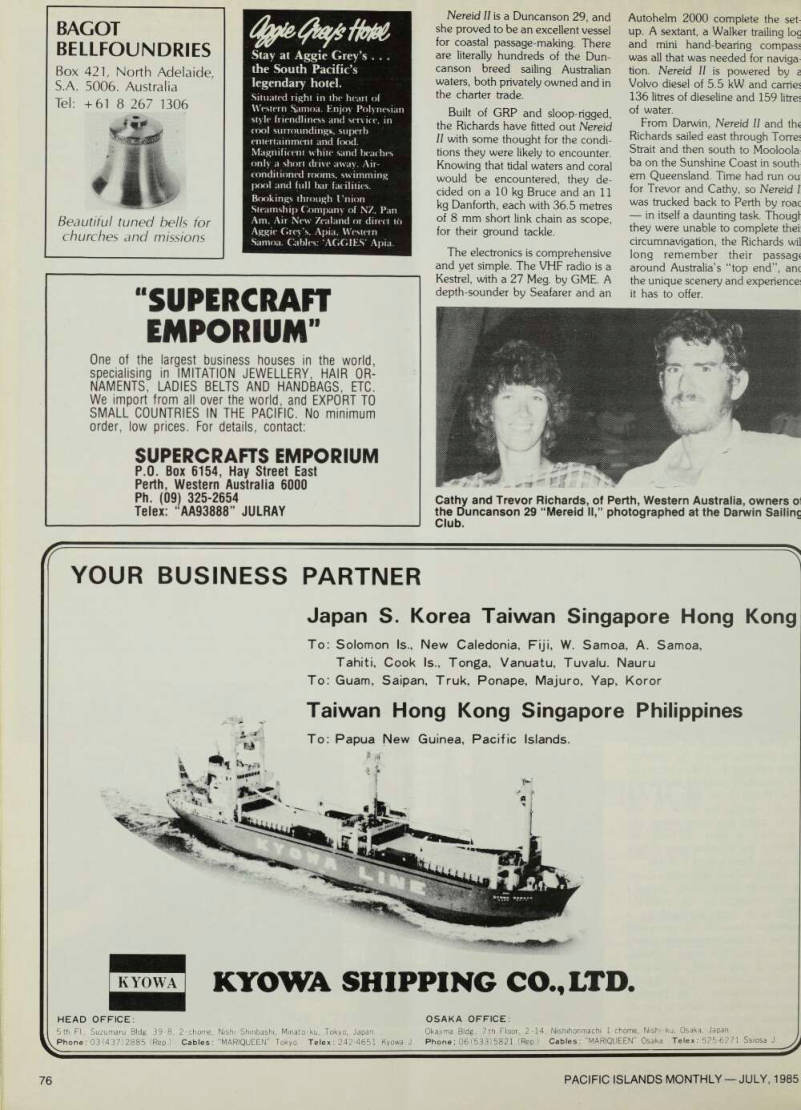
Cathy and Trevor Richards, of Perth, Western Australia, owners ol[?] the Duncanson 29 “Mereid II,” photographed at the Darwin Sailing Club.