people
pp. 71-72 · Read in the full issue
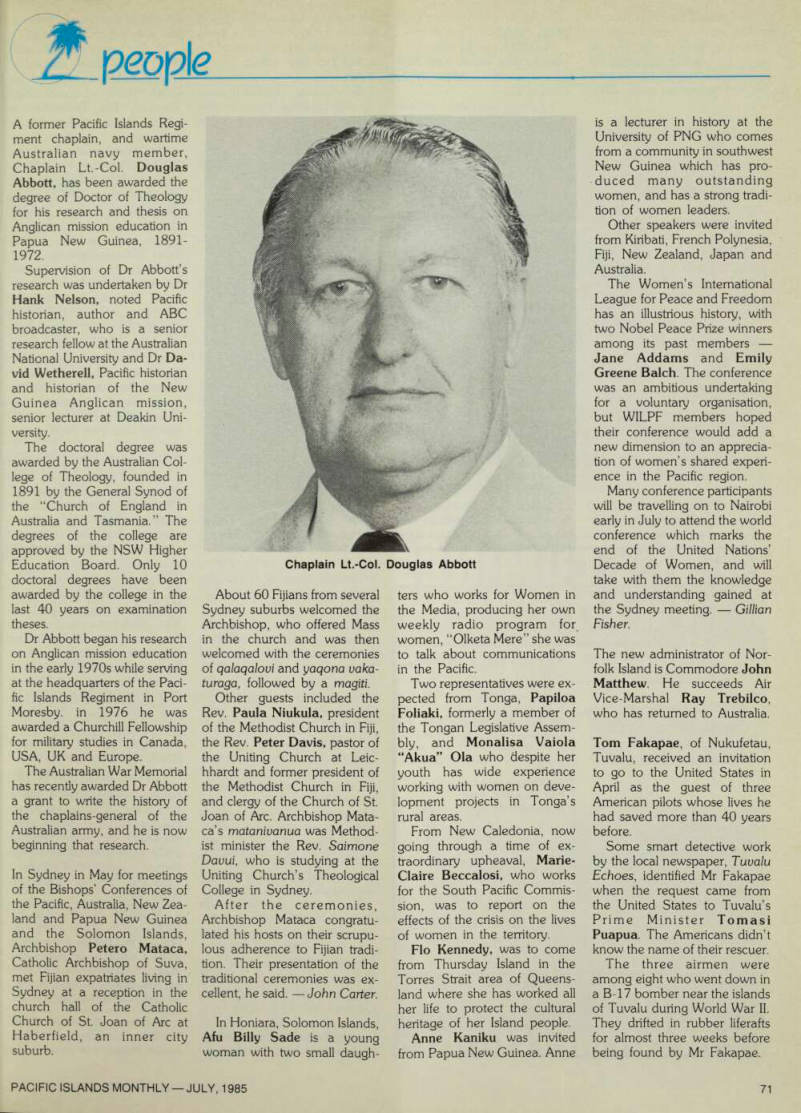
A former Pacific Islands Regi ment chaplain, and wartime Australian navy member, Chaplain Lt.-Col. Douglas Abbott, has been awarded the degree of Doctor of Theology for his research and thesis on Anglican mission education in Papua New Guinea, 1891- 1972.
Supervision of Dr Abbott’s research was undertaken by Dr Hank Nelson, noted Pacific historian, author and ABC broadcaster, who is a senior research fellow at the Australian National University and Dr Da vid Wetherell, Pacific historian and historian of the New Guinea Anglican mission, senior lecturer at Deakin Uni versity.
The doctoral degree was awarded by the Australian Col lege of Theology, founded in 1891 by the General Synod of the “Church of England in Australia and Tasmania.” The degrees of the college are approved by the NSW Higher Education Board. Only 10 doctoral degrees have been awarded by the college in the last 40 years on examination theses.
Dr Abbott began his research on Anglican mission education in the early 1970 s while serving at the headquarters of the Paci fic Islands Regiment in Port Moresby, in 1976 he was awarded a Churchill Fellowship for military studies in Canada, USA, UK and Europe.
The Australian War Memorial has recently awarded Dr Abbott a grant to write the history of the chaplains-general of the Australian army, and he is now beginning that research.
In Sydney in May for meetings of the Bishops’ Conferences of the Pacific, Australia, New Zea land and Papua New Guinea and the Solomon Islands, Archbishop Petero Mataca, Catholic Archbishop of Suva, met Fijian expatriates living in Sydney at a reception in the church hall of the Catholic Church of St. Joan of Arc at Haberfield, an inner city suburb.
About 60 Fijians from several Sydney suburbs welcomed the Archbishop, who offered Mass in the church and was then welcomed with the ceremonies of qalaqaloui and yaqona uaka turaga, followed by a magiti.
Other guests included the Rev. Paula Niukula, president of the Methodist Church in Fiji, the Rev. Peter Davis, pastor of the Uniting Church at Leic hhardt and former president of the Methodist Church in Fiji, and clergy of the Church of St.
Joan of Arc. Archbishop Mata ca’s matanivanua was Method ist minister the Rev. Saimone Dauui, who is studying at the Uniting Church’s Theological College in Sydney.
After the ceremonies, Archbishop Mataca congratu lated his hosts on their scrupu lous adherence to Fijian tradi tion. Their presentation of the traditional ceremonies was ex cellent, he said. —John Carter.
In Honiara, Solomon Islands, Afu Billy Sade is a young woman with two small daugh
ters who works for Women in the Media, producing her own weekly radio program for women, “Olketa Mere” she was to talk about communications in the Pacific.
Two representatives were ex pected from Tonga, Papiloa Foliaki, formerly a member of the Tongan Legislative Assem bly, and Monalisa Vaiola “Akua” Ola who despite her youth has wide experience working with women on deve lopment projects in Tonga’s rural areas.
From New Caledonia, now going through a time of ex traordinary upheaval, Marie- Claire Beccalosi, who works for the South Pacific Commis sion, was to report on the effects of the crisis on the lives of women in the territory.
Flo Kennedy, was to come from Thursday Island in the Torres Strait area of Queens land where she has worked all her life to protect the cultural heritage of her Island people.
Anne Kaniku was invited from Papua New Guinea. Anne
is a lecturer in history at the University of PNG who comes from a community in southwest New Guinea which has pro duced many outstanding women, and has a strong tradi tion of women leaders.
Other speakers were invited from Kiribati, French Polynesia, Fiji, New Zealand, Japan and Australia.
The Women’s International League for Peace and Freedom has an illustrious history, with two Nobel Peace Prize winners among its past members Jane Addams and Emily Greene Balch. The conference was an ambitious undertaking for a voluntary organisation, but WILPF members hoped their conference would add a new dimension to an apprecia tion of women’s shared experi ence in the Pacific region.
Many conference participants will be travelling on to Nairobi early in July to attend the world conference which marks the end of the United Nations’
Decade of Women, and will take with them the knowledge and understanding gained at the Sydney meeting. Gillian Fisher.
The new administrator of Nor folk Island is Commodore John Matthew. He succeeds Air Vice-Marshal Ray Trebilco, who has returned to Australia.
Tom Fakapae, of Nukufetau, Tuvalu, received an invitation to go to the United States in April as the guest of three American pilots whose lives he had saved more than 40 years before.
Some smart detective work by the local newspaper, Tuvalu Echoes, identified Mr Fakapae when the request came from the United States to Tuvalu’s Prime Minister Tomasi Fuapua. The Americans didn’t know the name of their rescuer.
The three airmen were among eight who went down in a B-17 bomber near the islands of Tuvalu during World War 11.
They drifted in rubber liferafts for almost three weeks before being found by Mr Fakapae.
Chaplain Lt.-Col. Douglas Abbott
Unfortunately, Mr Fakapae’s health was not good enough for him to make the trip. But he sent a heartfelt message of thanks and regrets to the men he had helped so many years ago.
Professor Garry Trompf of the University of Papua New Guinea’s History Department is writing a biography of the late Sir Percy Chatterton, the for mer missionary and politician who died last November at the age of 86.
Professor Trompf said he had many reasons for writing the book one of them was that he was a personal friend of Sir Percy.
“We did many things to gether and one of them was sitting down with him to talk about his life,” Professor Trompf said.
But Sir Percy had never mentioned a box which con tained his personal papers, me dals and certificates.
The contents of the box would greatly help Professor Trompf.
The book is to be called “Spirit of Independence" and it
would take four years to com plete, Professor Trompf said.
He said a careful selection of photographs would help high light the various stages of Sir Percy’s life.
Sir Percy was bom on Octo ber 8, 1898, in England.
He spent 60 years in PNG.
Olof Hedlund, a Swedish Un ited Nations volunteer who has worked for several years in Vanuatu, was voted the most popular man in Lolowai, east ern Ambae, when he left in April at the end of his contract.
Olof, an instructor in carpen try, surprised the editors of Vanuatu Weekly with his fluen cy in Bislama when he dropped to their Port-Vila office to say a word of farewell.
The paper described his time in Vanuatu as “years of hard work, popularity and fun.”
Papua New Guinea’s Chief Collector of Taxes John Lohberger is a determined man.
Marooned on a wrecked tri maran for 11 days off the coast of North Queensland in 1967, he was wrecked again on April
28 this year when his K 45,000 (about $A56,000) yacht Altair struck what was believed to be a log and sank within 10 mi nutes.
But, he says: “I’d like to keep up with yachting, but next time I’ll make sure I have a yacht that has a steel hull.”
The Altair was wrecked while making passage from Port Moresby to Cairns, Queens land.
On this occasion Mr Lohber ger and his companions were picked up within 11 hours rather than 11 days.
Two planes from the Austra lian Coastal Surveillance Centre found the yachtsmen, and one guided the Dutch merchantmen Nedlloyd-Bang kok, which was about 70 miles northeast of where the yacht sank, to their liferaft.
The Nedlloyd-Bangkok is owned by Nedlloyd Lines of Rotterdam which also owns the Amstelhock , which rescued Mr Lohberger, his brother Ernest, and five others on the wrecked trimaran in 1967.
The former Anglican Archbishop of PNG, David Hand, “sneaked back” into the country in May.
Bishop Hand, 66, now lives in Norfolk, England, but he was back to complete an unfinished task.
A small group of people, including his successor, Bishop Isaac Gadebo, were at Port Moresby’s Jackson’s Airport to welcome him.
Bishop Hand retired from active service in 1983 after working in PNG for 37 years.
He is living in Port Moresby “for the time being” and work ing on a particular segment of the church’s history from docu ments held in the New Guinea Collection of the University of PNG Library.
It concerns the resurrection of mission work in West New Britain, and the expansion of the church into the Highlands.
These were the two briefs given to “Father David” on his consecration as bishop in 1950 at St. Paul’s Cathedral, Dogura.
Now, in retirement, he has finally got the time to work on this part of the Anglican Church’s history in PNG.
Former Australian Broadcasting Corporation correspondent in
Port Moresby, Sean Dorney, has resigned from the ABC.
Mr Domey, who had been living in Brisbane, moved to Darwin in May to work for the Chief Minister of the Northern Territory, lan Tuxworth, as press secretary and media co ordinator.
Mr Domey worked with the ABC for 14 years eight ol those in Papua New Guinea.
Three of those were spent on secondment to the National Broadcasting Commission.
His wife, Pauline, comes from Manus Province. Thev, have two young children, Xavier and Jervina.
Mr Domey was expelled from Papua New Guinea by the government last Septembei after the ABC television prog ram Four Corners screened ar interview with OPM leadei James Nyaro, which Waigan bureaurcrats claimed was filmed on the PNG side of the border with Irian Jaya.
The Foundation for the Peoples of the South Pacific has announced that Dr Barnard P Hosie, the foundation’s Pacific regional director of progranr planning, has been appointee to succeed Mrs Tina Ralston as country director in Fiji.
Starting as the supervisor oi an FSP Cyclone Oscar re habilitation program in 1982, Mrs Ralston went on tc administer two USAID-funded programs, one for rural deve lopment programs in Fiji and a second for regional training.
The regional training program has already sent 50 Pacific leaders from nine countries to the United States for various specialised training courses.
Dr Hosie joined the FSP after a distinguished career in educa tion in Australia. He was Princi pal of Marist College, Bur nie,Tasmania, from 1967 tc 1972. During this period he was elected secretary of the State ol Tasmania School Principals’
Association.
He joined FSP in 1974 and spent a year in the New York office. He opened the founda tion’s California office in 1976 in Los Angeles. In 1978 he became the Foundation’s Paci fic regional representative.
Dr Hosie was accompanied to Fiji by his wife, Joan Blan chard Hosie.