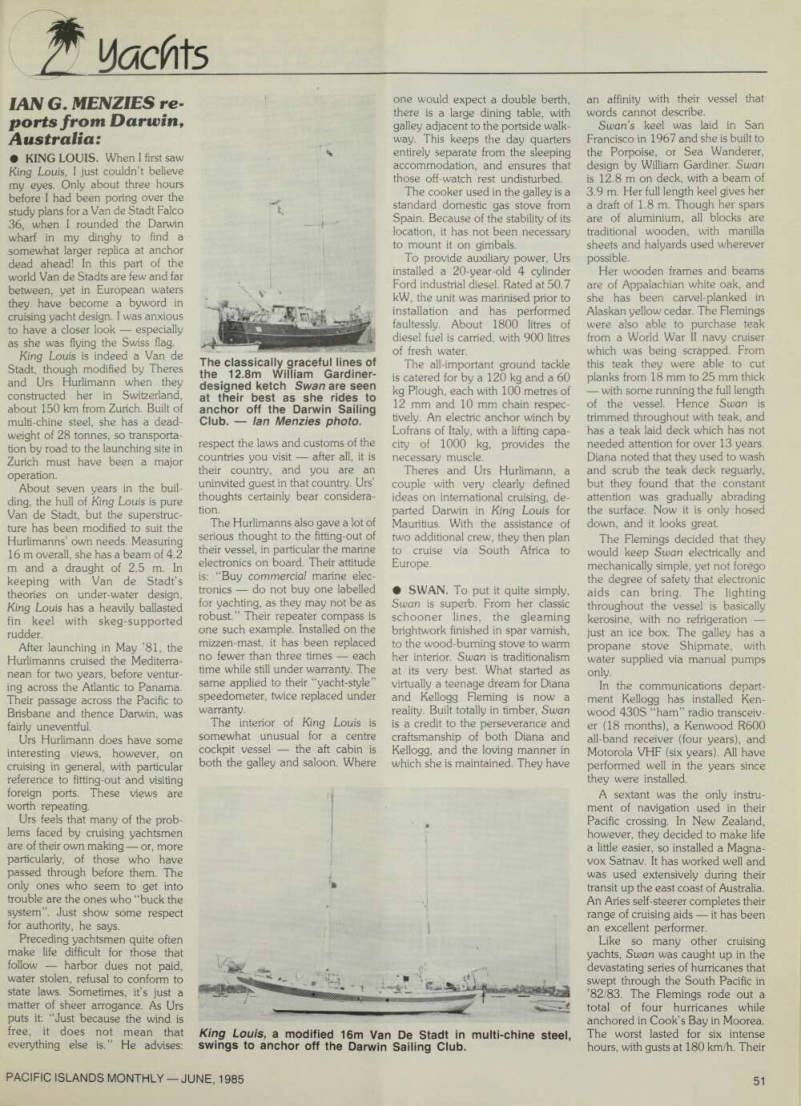
yac hts
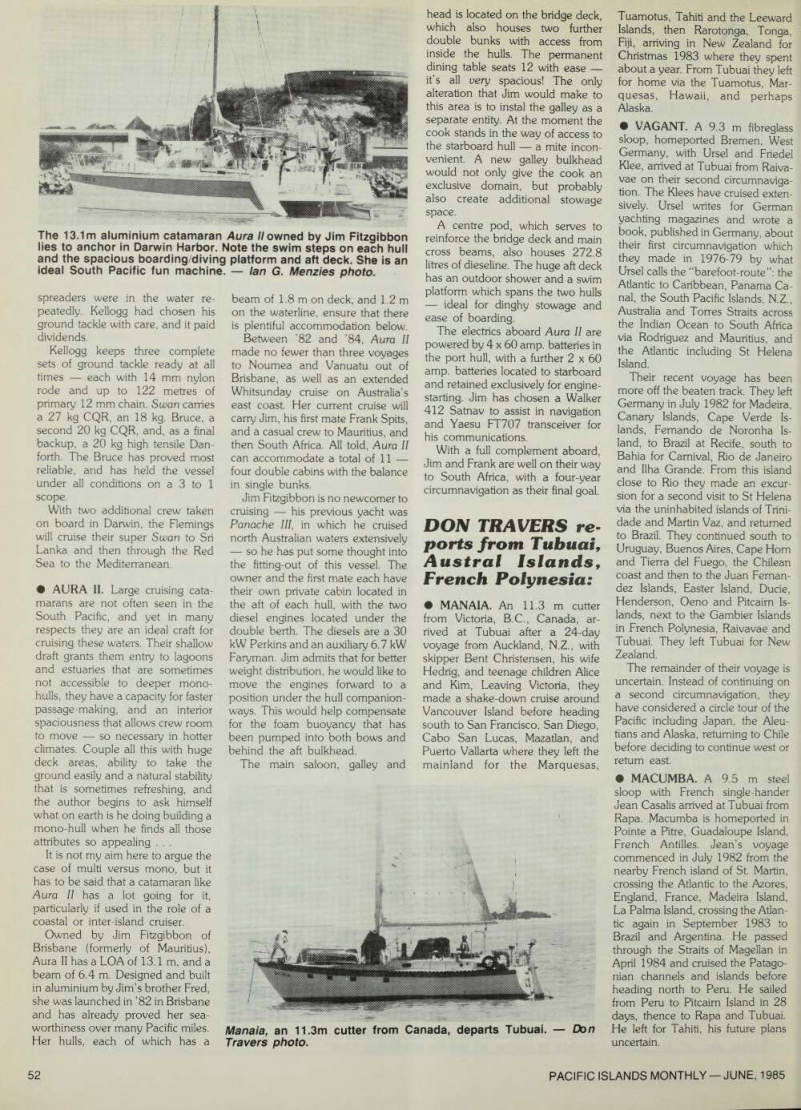
pp. 51-52 · Read in the full issue
Lan G.Menzies Re
ports from Darwin ,
Australia:
• KING LOUIS. When I first saw King Louis, I just couldn’t believe my eyes. Only about three hours before I had been poring over the study plans for a Van de Stadt Falco 36, when I rounded the Darwin wharf in my dinghy to find a somewhat larger replica at anchor dead ahead! In this part of the world Van de Stadts are few and far between, yet in European waters they have become a byword in cruising yacht design. I was anxious to have a closer look especially as she was flying the Swiss flag.
King Louis is indeed a Van de Stadt, though modified by Theres and Urs Hurlimann when they constructed her in Switzerland, about 150 km from Zurich. Built of multi-chine steel, she has a dead weight of 28 tonnes, so transporta tion by road to the launching site in Zurich must have been a major operation.
About seven years in the buil ding, the hull of King Louis is pure Van de Stadt, but the superstruc ture has been modified to suit the Hurlimanns’ own needs. Measuring 16 m overall, she has a beam of 4.2 m and a draught of 2.5 m. In keeping with Van de Stadt’s theories on under-water design, King Louis has a heavily ballasted fin keel with skeg-supported rudder.
After launching in May ’Bl, the Hurlimanns cruised the Mediterra nean for two years, before ventur ing across the Atlantic to Panama.
Their passage across the Pacific to Brisbane and thence Darwin, was fairly uneventful.
Urs Hurlimann does have some interesting views, however, on cruising in general, with particular reference to fitting-out and visiting foreign ports. These views are worth repeating.
Urs feels that many of the prob lems faced by cruising yachtsmen are of their own making or, more particularly, of those who have passed through before them. The only ones who seem to get into trouble are the ones who “buck the system”. Just show some respect for authority, he says.
Preceding yachtsmen quite often make life difficult for those that follow harbor dues not paid, water stolen, refusal to conform to state laws. Sometimes, it’s just a matter of sheer arrogance. As Urs puts it: “Just because the wind is free, it does not mean that everything else is.” He advises:
respect the laws and customs of the countries you visit after all, it is their country, and you are an uninvited guest in that country. Urs’ thoughts certainly bear considera tion.
The Hurlimanns also gave a lot of serious thought to the fitting-out of their vessel, in particular the marine electronics on board. Their attitude is: “Buy commercial marine elec tronics do not buy one labelled for yachting, as they may not be as robust.” Their repeater compass is one such example. Installed on the mizzen-mast, it has been replaced no fewer than three times each time while still under warranty. The same applied to their “yacht-style” speedometer, twice replaced under warranty.
The interior of King Louis is somewhat unusual for a centre cockpit vessel the aft cabin is both the galley and saloon. Where
one would expect a double berth, there is a large dining table, with galley adjacent to the portside walk way. This keeps the day quarters entirely separate from the sleeping accommodation, and ensures that those off-watch rest undisturbed.
The cooker used in the galley is a standard domestic gas stove from Spain. Because of the stability of its location, it has not been necessary to mount it on gimbals.
To provide auxiliary power, Urs installed a 20-year-old 4 cylinder Ford industrial diesel. Rated at 50.7 kW, the unit was marinised prior to installation and has performed faultessly. About 1800 litres of diesel fuel is carried, with 900 litres of fresh water.
The all-important ground tackle is catered for by a 120 kg and a 60 kg Plough, each with 100 metres of 12 mm and 10 mm chain respec tively. An electric anchor winch by Lofrans of Italy, with a lifting capa city of 1000 kg, provides the necessary muscle.
Theres and Urs Hurlimann, a couple with very clearly defined ideas on international cruising, de parted Darwin in King Louis for Mauritius. With the assistance of two additional crew, they then plan to cruise via South Africa to Europe. • SWAN. To put it quite simply, Swan is superb. From her classic schooner lines, the gleaming brightwork finished in spar varnish, to the wood-burning stove to warm her interior. Swan is traditionalism at its very best. What started as virtually a teenage dream for Diana and Kellogg Fleming is now a reality. Built totally in timber, Swan is a credit to the perseverance and craftsmanship of both Diana and Kellogg, and the loving manner in which she is maintained. They have
an affinity with their vessel that words cannot describe.
Swan’s keel was laid in San Francisco in 1967 and she is built to the Porpoise, or Sea Wanderer, design by William Gardiner. Swan is 12.8 m on deck, with a beam of 3.9 m. Her full length keel gives her a draft of 1.8 m. Though her spars are of aluminium, all blocks are traditional wooden, with manilla sheets and halyards used wherever possible.
Her wooden frames and beams are of Appalachian white oak, and she has been carvel-planked in Alaskan yellow cedar. The Flemings were also able to purchase teak from a World War II navy cruiser which was being scrapped. From this teak they were able to cut planks from 18 mm to 25 mm thick with some running the full length of the vessel. Hence Swan is trimmed throughout with teak, and has a teak laid deck which has not needed attention for over 13 years.
Diana noted that they used to wash and scrub the teak deck reguarly, but they found that the constant attention was gradually abrading the surface. Now it is only hosed down, and it looks great.
The Flemings decided that they would keep Swan electrically and mechanically simple, yet not forego the degree of safety that electronic aids can bring. The lighting throughout the vessel is basically kerosine, with no refrigeration just an ice box. The galley has a propane stove Shipmate, with water supplied via manual pumps only.
In the communications depart ment Kellogg has installed Ken wood 430 S “ham” radio transceiv er (18 months), a Kenwood R6OO all-band receiver (four years), and Motorola VHF (six years). All have performed well in the years since they were installed.
A sextant was the only instru ment of navigation used in their Pacific crossing. In New Zealand, however, they decided to make life a little easier, so installed a Magna vox Satnav. It has worked well and was used extensively during their transit up the east coast of Australia.
An Aries self-steerer completes their range of cruising aids it has been an excellent performer.
Like so many other cruising yachts, Swan was caught up in the devastating series of hurricanes that swept through the South Pacific in ’B2/83. The Flemings rode out a total of four hurricanes while anchored in Cook’s Bay in Moorea.
The worst lasted for six intense hours, with gusts at 180 km/h. Their
King Louis, a modified 16m Van De Stadt in multi-chine steel, swings to anchor off the Darwin Sailing Club.
The classically graceful lines of the 12.8m William Gardiner designed ketch Swan are seen at their best as she rides to anchor off the Darwin Sailing Club. - Ian Menzies photo.
spreaders were in the water re peatedly. Kellogg had chosen his ground tackle with care, and it paid dividends.
Kellogg keeps three complete sets of ground tackle ready at all times each with 14 mm nylon rode and up to 122 metres of primary 12 mm chain. Swan carries a 27 kg CQR, an 18 kg. Bruce, a second 20 kg CQR, and, as a final backup, a 20 kg high tensile Dan forth. The Bruce has proved most reliable, and has held the vessel under all conditions on a 3 to 1 scope.
With two additional crew taken on board in Darwin, the Flemings will cruise their super Swan to Sri Lanka and then through the Red Sea to the Mediterranean. • AURA 11. Large cruising cata marans are not often seen in the South Pacific, and yet in many respects they are an ideal craft for cruising these waters. Their shallow draft grants them entry to lagoons and estuaries that are sometimes not accessible to deeper mono hulls, they have a capacity for faster passage-making, and an interior spaciousness that allows crew room to move so necessary in hotter climates. Couple all this with huge deck areas, ability to take the ground easily and a natural stability that is sometimes refreshing, and the author begins to ask himself what on earth is he doing building a mono-hull when he finds all those
attributes so appealing . . .
It is not my aim here to argue the case of multi versus mono, but it has to be said that a catamaran like Aura II has a lot going for it, particularly if used in the role of a coastal or inter-island cruiser.
Owned by Jim Fitzgibbon of Brisbane (formerly of Mauritius), Aura II has a LOA of 13.1 m, and a beam of 6.4 m. Designed and built in aluminium by Jim’s brother Fred, she was launched in ’B2 in Brisbane and has already proved her sea worthiness over many Pacific miles.
Her hulls, each of which has a
beam of 1.8 m on deck, and 1.2 m on the waterline, ensure that there is plentiful accommodation below.
Between ’B2 and ’B4, Aura II made no fewer than three voyages to Noumea and Vanuatu out of Brisbane, as well as an extended Whitsunday cruise on Australia’s east coast. Her current cruise will carry Jim, his first mate Frank Spits, and a casual crew to Mauritius, and then South Africa. All told, Aura II can accommodate a total of 11 four double cabins with the balance in single bunks.
Jim Fitzgibbon is no newcomer to cruising his previous yacht was Panache 111, in which he cruised north Australian waters extensively so he has put some thought into the fitting-out of this vessel. The owner and the first mate each have their own private cabin located in the aft of each hull, with the two diesel engines located under the double berth. The diesels are a 30 kW Perkins and an auxiliary 6.7 kW Faryman. Jim admits that for better weight distribution, he would like to move the engines forward to a position under the hull companion ways. This would help compensate for the foam buoyancy that has been pumped into both bows and behind the aft bulkhead.
The main saloon, galley and
head is located on the bridge deck, which also houses two further double bunks with access from inside the hulls. The permanent dining table seats 12 with ease it’s all very spacious! The only alteration that Jim would make to this area is to instal the galley as a separate entity. At the moment the cook stands in the way of access to the starboard hull a mite incon venient. A new galley bulkhead would not only give the cook an exclusive domain, but probably also create additional stowage space.
A centre pod, which serves to reinforce the bridge deck and main cross beams, also houses 272.8 litres of dieseline. The huge aft deck has an outdoor shower and a swim platform which spans the two hulls ideal for dinghy stowage and ease of boarding.
The electrics aboard Aura II are powered by 4 x 60 amp. batteries in the port hull, with a further 2 x 60 amp. batteries located to starboard and retained exclusively for engine starting. Jim has chosen a Walker 412 Satnav to assist in navigation and Yaesu FT7O7 transceiver for his communications.
With a full complement aboard, Jim and Frank are well on their way to South Africa, with a four-year circumnavigation as their final goal.
Don Travers Re
ports from Tubuai,
Austral islands,
French Polynesia:
• MANAIA. An 11.3 m cutter from Victoria, 8.C., Canada, ar rived at Tubuai after a 24-day voyage from Auckland, N.Z., with skipper Bent Christensen, his wife Hedrig, and teenage children Alice and Kim, Leaving Victoria, they made a shake-down cruise around Vancouver Island before heading south to San Francisco, San Diego, Cabo San Lucas, Mazatlan, and Puerto Vallarta where they left the mainland for the Marquesas,
Tuamotus, Tahiti and the Leeward Islands, then Rarotonga, Tonga, Fiji, arriving in New Zealand for Christmas 1983 where they spent about a year. From Tubuai they left for home via the Tuamotus, Mar quesas, Hawaii, and perhaps Alaska. • VACANT. A 9.3 m fibreglass sloop, homeported Bremen, West Germany, with Ursel and Friedel Klee, arrived at Tubuai from Raiva vae on their second circumnaviga tion. The Klees have cruised exten sively. Ursel writes for German yachting magazines and wrote a book, published in Germany, about their first circumnavigation which they made in 1976-79 by what Ursel calls the “barefoot-route”: the Atlantic to Caribbean, Panama Ca nal, the South Pacific Islands, N.Z., Australia and Torres Straits across the Indian Ocean to South Africa via Rodriguez and Mauritius, and the Atlantic including St Helena Island.
Their recent voyage has been more off the beaten track. They left Germany in July 1982 for Madeira, Canary Islands, Cape Verde Is lands, Fernando de Noronha Is land, to Brazil at Recife, south to Bahia for Carnival, Rio de Janeiro and Ilha Grande. From this island close to Rio they made an excur sion for a second visit to St Helena via the uninhabited islands of Trini dade and Martin Vaz, and returned to Brazil. They continued south to Uruguay, Buenos Aires, Cape Horn and Tierra del Fuego, the Chilean coast and then to the Juan Fernan dez Islands, Easter Island, Ducie, Henderson, Oeno and Pitcairn Is lands, next to the Gambier Islands in French Polynesia, Raivavae and Tubuai. They left Tubuai for New Zealand.
The remainder of their voyage is uncertain. Instead of continuing on a second circumnavigation, they have considered a circle tour of the Pacific including Japan, the Aleu tians and Alaska, returning to Chile before deciding to continue west or return east. • MACUMBA. A 9.5 m steel sloop with French single-hander Jean Casalis arrived at Tubuai from Rapa. Macumba is homeported in Pointe a Pitre, Guadaloupe Island, French Antilles. Jean’s voyage commenced in July 1982 from the nearby French island of St. Martin, crossing the Atlantic to the Azores, England, France, Madeira Island, La Palma Island, crossing the Atlan tic again in September 1983 to Brazil and Argentina. He passed through the Straits of Magellan in April 1984 and cruised the Patago nian channels and islands before heading north to Peru. He sailed from Peru to Pitcairn Island in 28 days, thence to Rapa and Tubuai.
He left for Tahiti, his future plans uncertain.
The 13.1m aluminium catamaran Aura II owned by Jim Fitzgibbon lies to anchor in Darwin Harbor. Note the swim steps on each hull and the spacious boarding/diving platform and aft deck. She is an ideal South Pacific fun machine. - Ian G. Menzies photo.
Manaia, an 11.3m cutter from Canada, departs Tubuai. - Don Travers photo.