greets new French plan
pp. 22-23 · Read in the full issue
the month
New Caledonia
Sound of one hand dapping greets new French plan
Initial reaction in New Cale donia to the French gov ernment’s plans for the future of the territory was confusion. On one level there was relief that the Pisani time table for independence next January had been dropped, but there was still a big question mark over the proposed divi sion of New Caledonia into four regions. However as more de tails have come out of Paris reaction has divided into two camps, one of outright opposi tion and the other of reluctant acceptance.
The biggest opponents of the scheme are the Rassemblement pour La Caledonie dans la Republique (R.P.C.R.), and the Front Caledonien, both of which are strongly opposed to any form of independence.
At its national congress on April 28, three days after the announcement from Paris, the R.P.C.R. rejected the plan in its entirety. To a rousing cheer
The frustrations and complexities of New Caledo nia’s politics continue to hamper a smooth transition to the Kanak independence to which the French government is now firmly committed. Another plan has been proposed by President Mitterrand’s special envoy, Mr Edgard Pisani, and accepted by Paris. But wrangling over it continues, angrily on many sides, in Noumea and elsewhere in the beleaguered territory.
Reporting for P.I.M. SUE WILLIAMS notes that the merit of any plan depends on the viewpoint of its beholders. Meantime as she reports separately, fresh violence has dashed hopes of improvement in the situation.
from the 2000-strong audience party president, Jacques Laf leur, declared: ”Our position has not changed and will not change. We are resolutely against independence should it be socialist, Kanak, or other.”
Lafleur also threatened to call a boycott of regional elections in August this year. These will
decide the make-up of the four councils to administer the new divisions in the north, south, the islands, and Noumea.
Preliminary counts show the R.P.C.R. could be the big loser in the poll. At the moment the party has an overwhelming majority in the territorial assem bly, holding 34 of the 42 seats.
However, the elections will almost certainly reverse the situation with at least two and possibly three of the regions tipped to fall into the hands of the Kanak Socialist National Liberation Front (F.L.N.K.S.).
Part of the reason for the turnabout is the way the seats will be allocated in the division.
According to the calculations of Mr Lafleur, the north, south, and islands, will have 25 repre sentatives for a population of 61,000, or one representative for each two to three thousand people. Noumea, however, will have only 18 seats for a popula tion of 85,100, or one repre sentative per 4700 people. Mr Lafleur considers this to be a classic gerrymander in the true Queensland style.
Such was the opposition to this plan at the R.P.C.R. con gress that the audience over whelmingly supported the call by Mr Lafleur to ban any further demonstrations by the F.L.N.K.S. in Noumea. When asked how he would prevent such demonstrations from occurring the R.P.C.R. presi dent replied: ”Be here when it happens. ”
The R.P.C.R. views have also been echoed by the right wing Front Caledonien, and the local Chamber of Commerce and Industry. Chamber presi dent Arnold Daly believes it is not only politically unjust but economically unsound. ’’Each region has too many powers to live together and not enough power to go it alone. New Caledonia must be one. We are too small econonically to be divided. We depend upon each other. ”
The Front Caledonien goes
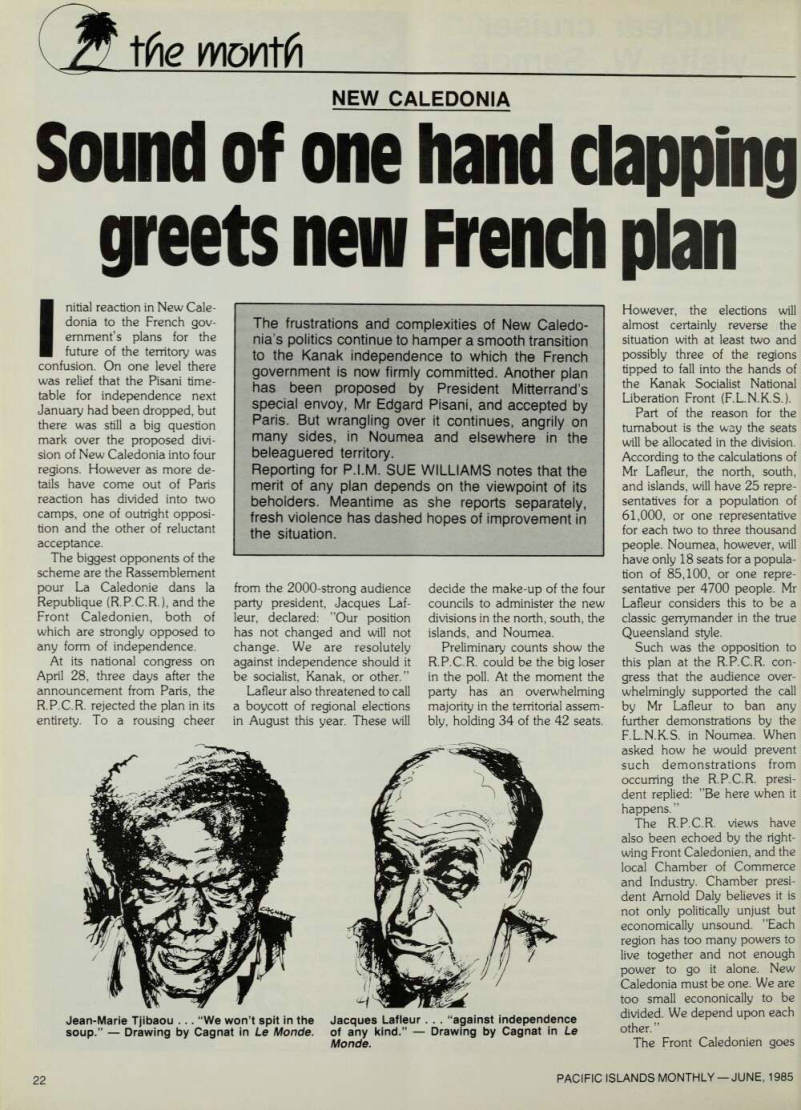
Jean-Marie Tjibaou . . . “We won’t spit in the Jacques Lafleur .. . “against independence soup.” - Drawing by Cagnat in Le Monde, of any kind.” - Drawing by Cagnat in Le Monde.
one step further, saying the plan is ’’not only anti-economic and anti-social, but is thorough ly racist. It reduces the electoral and democratic weight of the non-Melanesians and permits the by-passing of the Constitu tion which is based on one man, one vote.”
The views of the F.L.N.K.S. are not much more positive. ”We will not spit in the soup,” declared Kanak leader, Jean- Marie Tjibaou, in Paris shortly after the announcement of the plan by the French prime minis ter, Laurent Fabius. Mr Tjibaou would not be drawn much further at his first press confer ence, but a week later, in West Germany, he went on to de scribe the plan as ’’negative, because according to the first calculation, the anti-indepen dentists have a slight advantage and the F.L.N.K.S. have not been given a big enough majority. ”
He is also critical of the French government’s announcement of an upgraded military base for New Caledo nia and its decision over the exact timing of the referendum on the independence question.
The official reaction of the F.L.N.K.S. will be decided at its congress to be held on May 25 and 26 at Hienghene, in the far north of New Caledonia.
Mr Tjibaou has said that if that congress decides to sup port the plan and take part in the regional election, the F.L.N.K.S. will ask that the referendum be held before the French legislative elections in 1986. The independentists are concerned that these elections will see a change of power in the French parliament with the result that the question of New Caledonia’s independence will be pushed into the background.
This, of course, is exactly what the anti-independence forces in the territory are counting on.
The referendum was initially scheduled for July this year in the plan proposed in January by the French government’s special envoy, Edgard Pisani.
However, it soon became apparent that any referendum on the question of sovereignty for the territory would be lost if the non-Melanesian population was allowed to take part.
President Mitterrand has pre viously indicated that this sec tion of the community should
not be excluded, but he is also firmly committed to independ ence for New Caledonia. Con sequently the referendum was put back to September and now, under the Fabius plan, will be held ”no later than Decem ber 31, 1987.”
Probably the most positive reaction to the Fabius plan has come from the Kanak Socialist Liberation Movement (L.K.S.), led by Nidoish Naisseline.
The L.K.S. has indicated it is ready to go with the plan, which it sees as preparing the ground for independence. It has also applauded the regionalisation of New Caledonia as a way of opening up the bush and the islands for economic deve lopment in a fair and equitable manner, as opposed to the R.P.C.R.’s alternative plan of dividing the territory into two regions, the cast and west coasts, which the L.K.S. be lieves would have created an apartheid situation.
This optimistic outlook is also starting to ripple through to the tourist industry which has taken a particularly savage beating in the last seven months. While some sections of the F.L.N.K.S. have been annoyed by the delay in the referendum, most tourist industry leaders are hopeful it will provide the brea thing space necessary to get the territory’s economy back on its feet. They are already planning new promotions to start bring ing the holidaymakers back.
EDGARD PISANI, the man who has borne the brunt of the New Caledonian crisis, has been promoted to the new post of Minister for New Cale donia “as a reward for his achievements.” He will have a direct voice in the French Cabinet as the territory pre pares for regional elections in August. Pisani’s position as High Commissioner in Noumea will be taken by the veteran French diplomat, Fer nand Wibaux, 63, until recent ly ambassador to the Leba non. When the announcement was made Pisani was on his way to Paris to attend the May 29 National Assembly debate on the new French govern ment blueprint for New Cale donia’s future, based largely on his recommendations.