[?]ows out of Me Pacific
pp. 17-19 · Read in the full issue
Me Pacific
heavily-discounted air fares.
Given Mr Trippe’s reliance on clipper ship logs to pick his way across the Pacific, it seems no coincidence that he named the airline’s first Martin M-130 flying boat, then America’s largest airliner, the China Clipper.
The plane was named after a sailing boat which carried the American flag and crossed the Pacific 100 years before.
And China Clipper made its mark- flying from San Francis co to the Philippines via Hon-
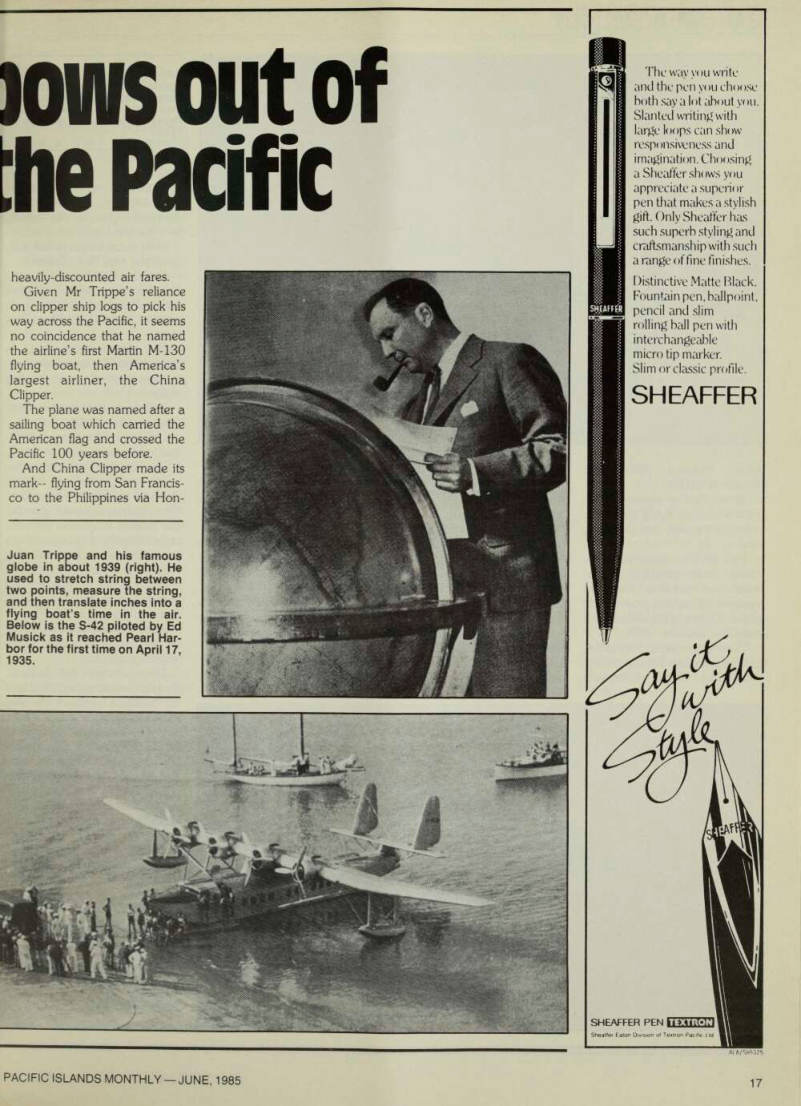
Juan Trippe and his famous globe in about 1939 (right). He used to stretch string between two points, measure the string, and then translate inches into a flying boat’s time in the air.
Below is the S-42 piloted by Ed Musick as it reached Pearl Har bor for the first time on April 17, 1935.
olulu, Midway, Wake, and Guam in 1935.
Now, half a century later, Pan American, flying the Pacific with giant jumbo jets, is pulling out.
The airline’s withdrawal has been understandably some what more subdued than the razzamatazz which greeted the China Clipper’s departure from San Francisco in 1935.
Twenty-two aerial bombs ex ploded over San Francisco Bay, heralding China Clipper’s
take off run.
Two of the bombs released American flags, which floated down by parachute.
Thirty planes swooped over head, car horns tooted, ship whistles sounded, and a fire boat spouted waterjets.
And the flying boat carried 1837 pounds of mail, in addi tion to a heavy fuel load.
Scheduled passenger service was pencilled in for October, 1936, but Juan Trippe organ ised his own flight for a week
earlier.
The clipper, comfortable and luxurious, contained a central lounge wider than a Pullman club car.
And as a special touch, four copies of Gone With the Wind, the latest bestseller, were on board.
The imperturbable Mr Trippe won traffic rights to Hongkong with the “falling apple” prin ciple.
He gained rights to Portu guese Macau, then sat back to
wait.
Pressure from British businessmen in Hongkong dropped rights to the colony into his lap.
Next came a wish to link with Australia and New Zealand.
But the British wanted unli mited landing rights in Hawaii before Pan Am would be given any in Australia or New Zea land.
The Americans decided to isolate New Zealand from Aus tralia in negotations for landing rights.
If the two Antipodean coun tries could be split, then they could be chipped away from the mother country.
Mr Trippe sent Australian navigator Harold Gatty to New Zealand with this argument: Pan American would give NZ the chance to be in at the start, rather than be a backwater in a South Pacific air service linking Hawaii and Australia.
New Zealand yielded full commercial traffic rights to Pan Am on March 11, 1937.
Juan Trippe’s plan was simi lar to the Hongkong “falling apple” principle.
Once serving New Zealand, Pan Am would sit back and wait for business pressure to drop Australia into his lap.
If this failed, he planned to hire a yacht and announce that the craft was ready to carry airmail and passengers from New Zealand to Australia.
The idea was to shame Aus tralia into complying.
Pan Am flew into NZ quite soon after winning traffic rights, and on the first flight by pilot Eddie Musick in a survey plane,
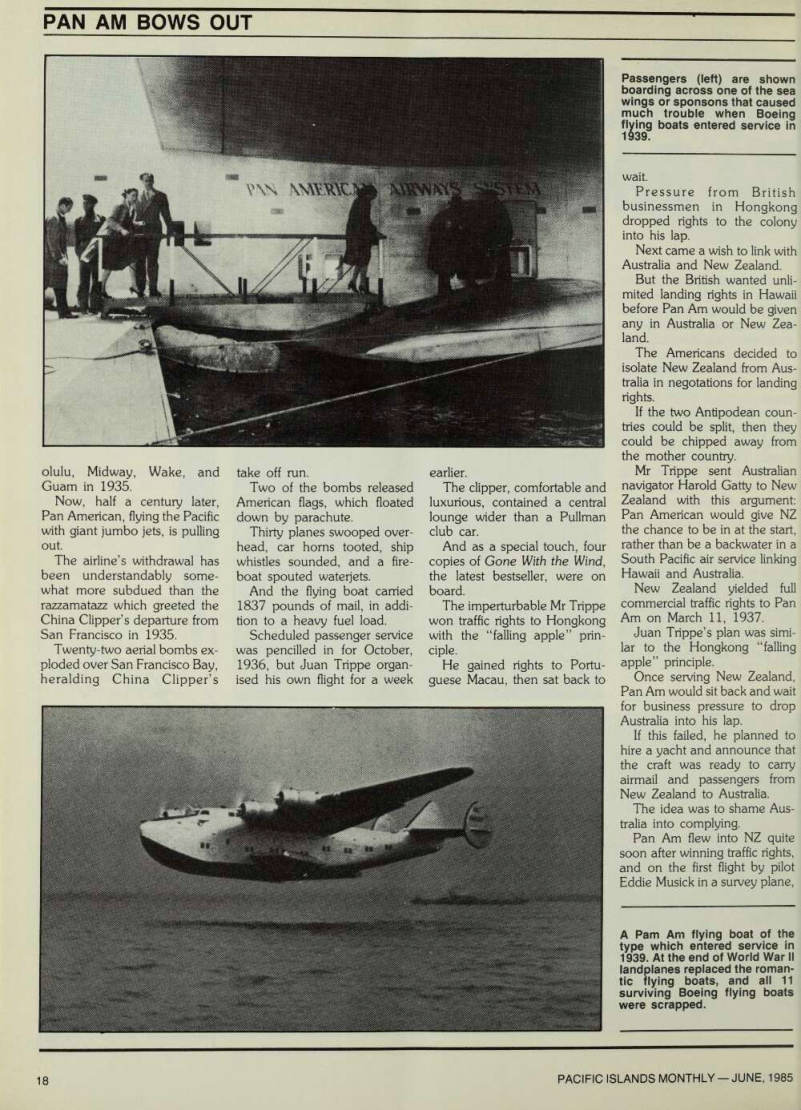
Passengers (left) are shown boarding across one of the sea wings or sponsons that caused much trouble when Boeing flying boats entered service in 1939.
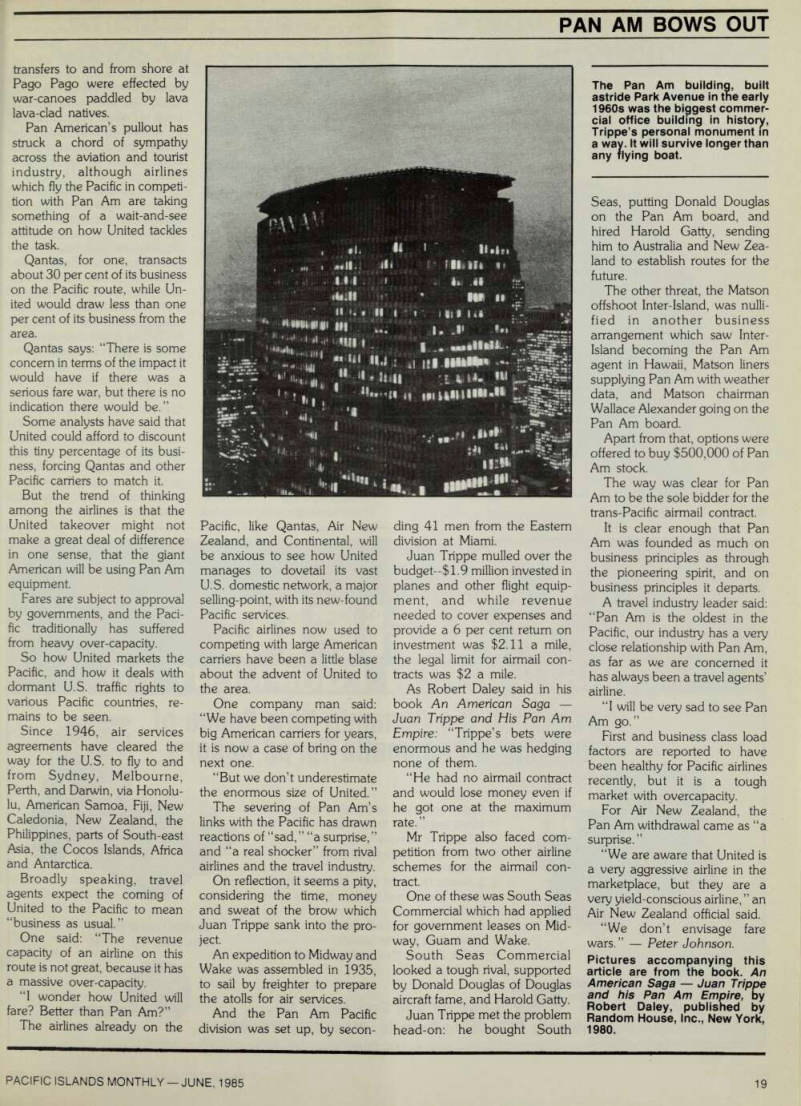
A Pam Am flying boat of the type which entered service in 1939. At the end of World War II landplanes replaced the roman tic flying boats, and all 11 surviving Boeing flying boats were scrapped.
transfcrs to and from shore at Pago Pago were effected by war-canoes paddled by lava lava-clad natives.
Pan American’s pullout has struck a chord of sympathy across the aviation and tourist industry, although airlines which fly the Pacific in competi tion with Pan Am are taking something of a wait-and-see attitude on how United tackles the task.
Qantas, for one, transacts about 30 per cent of its business on the Pacific route, while Un ited would draw less than one per cent of its business from the area.
Qantas says: “There is some concern in terms of the impact it would have if there was a serious fare war, but there is no indication there would be.”
Some analysts have said that United could afford to discount this tiny percentage of its busi ness, forcing Qantas and other Pacific carriers to match it.
But the trend of thinking among the airlines is that the United takeover might not make a great deal of difference in one sense, that the giant American will be using Pan Am equipment.
Fares are subject to approval by governments, and the Paci fic traditionally has suffered from heavy over-capacity.
So how United markets the Pacific, and how it deals with dormant U.S. traffic rights to various Pacific countries, re mains to be seen.
Since 1946, air services agreements have cleared the way for the U.S. to fly to and from Sydney, Melbourne, Perth, and Darwin, via Honolu lu, American Samoa, Fiji, New Caledonia, New Zealand, the Philippines, parts of South-east Asia, the Cocos Islands, Africa and Antarctica.
Broadly speaking, travel agents expect the coming of United to the Pacific to mean “business as usual.”
One said: “The revenue capacity of an airline on this route is not great, because it has a massive over-capacity.
“I wonder how United will fare? Better than Pan Am?”
The airlines already on the
Pacific, like Qantas, Air New Zealand, and Continental, will be anxious to see how United manages to dovetail its vast U.S. domestic network, a major selling-point, with its new-found Pacific services.
Pacific airlines now used to competing with large American carriers have been a little blase about the advent of United to the area.
One company man said: “We have been competing with big American carriers for years, it is now a case of bring on the next one.
“But we don’t underestimate the enormous size of United.”
The severing of Pan Am’s links with the Pacific has drawn reactions of “sad,” “a surprise,” and “a real shocker” from rival airlines and the travel industry.
On reflection, it seems a pity, considering the time, money and sweat of the brow which Juan Trippe sank into the pro ject.
An expedition to Midway and Wake was assembled in 1935, to sail by freighter to prepare the atolls for air services.
And the Pan Am Pacific division was set up, by secon
ding 41 men from the Eastern division at Miami.
Juan Trippe mulled over the budget—sl.9 million invested in planes and other flight equip ment, and while revenue needed to cover expenses and provide a 6 per cent return on investment was $2.11 a mile, the legal limit for airmail con tracts was $2 a mile.
As Robert Daley said in his book An American Saga Juan Trippe and His Pan Am Empire: “Trippe’s bets were enormous and he was hedging none of them.
“He had no airmail contract and would lose money even if he got one at the maximum rate.”
Mr Trippe also faced com petition from two other airline schemes for the airmail con tract.
One of these was South Seas Commercial which had applied for government leases on Mid way, Guam and Wake.
South Seas Commercial looked a tough rival, supported by Donald Douglas of Douglas aircraft fame, and Harold Gatty.
Juan Trippe met the problem head-on: he bought South
Seas, putting Donald Douglas on the Pan Am board, and hired Harold Gatty, sending him to Australia and New Zea land to establish routes for the future.
The other threat, the Matson offshoot Inter-Island, was nulli fied in another business arrangement which saw Inter- Island becoming the Pan Am agent in Hawaii, Matson liners supplying Pan Am with weather data, and Matson chairman Wallace Alexander going on the Pan Am board.
Apart from that, options were offered to buy $500,000 of Pan Am stock.
The way was clear for Pan Am to be the sole bidder for the trans-Pacific airmail contract.
It is clear enough that Pan Am was founded as much on business principles as through the pioneering spirit, and on business principles it departs.
A travel industry leader said; “Pan Am is the oldest in the Pacific, our industry has a very close relationship with Pan Am, as far as we are concerned it has always been a travel agents’ airline.
“I will be very sad to see Pan Am go.”
First and business class load factors are reported to have been healthy for Pacific airlines recently, but it is a tough market with overcapacity.
For Air New Zealand, the Pan Am withdrawal came as “a surprise. ”
“We are aware that United is a very aggressive airline in the marketplace, but they are a very yield-conscious airline,” an Air New Zealand official said.
“We don’t envisage fare
wars. ”
Peter Johnson.
Pictures accompanying this article are from the book. An American Saga Juan Trippe and his Pan Am Empire, by Robert Daley, published by Random House, Inc., New York, 1980.
The Pan Am building, built astride Park Avenue in the early
1960s was the biggest commer
cial office building in history, Trippe’s personal monument in a way. It will survive longer than any flying boat.