Building the nervous system of
pp. 41-42 · Read in the full issue
a magnificently alien land
Uniting a Nation: The Postal and Telecommunication Services of Papua New Guinea. By James Sinclair.
Published 1984 by Oxford Uni versity Press. ISBN 0 19554437 4. Price SA2O.
Nothing in Papua New Guinea was ever easy for the outsider.
The land had to much in tegrity to give itself away with out a struggle. And the chal lenge of providing an effective communications system in this magnificently alien environ ment provided perhaps the greatest struggle of all.
In the arena of telecommuni cations, it was laconic, affable Bill Carter a youthful en gineer with the Postmaster- General’s Department in Parkes, New South Wales who took PNG by the scruff of the neck and said “Tok!”
Bill Carter didn’t do it alone, of course. But it was he who assembled and led the very
talented team of Australians and Papua New Guineans who collectively were able to pro vide PNG with an effective and modern telecommunications network: if you like, the ner vous system of a nation in need of rapid economic and political development.
The achievements of Bill Carter and his department can be summarised briefly.
By the time of Independence in 1975, all of PNG’s major towns and many minor ones were interconnected by the one telecommunications system.
The most remote patrol posts and plantations could partici pate in the life of the nation through a complementary net work of outstation radios.
The national telephone sys tem was 98 per cent automatic.
National and international sub scriber trunk dialling was avail able to 97 per cent of the phones in the system. Intercon nected telex and telegraph
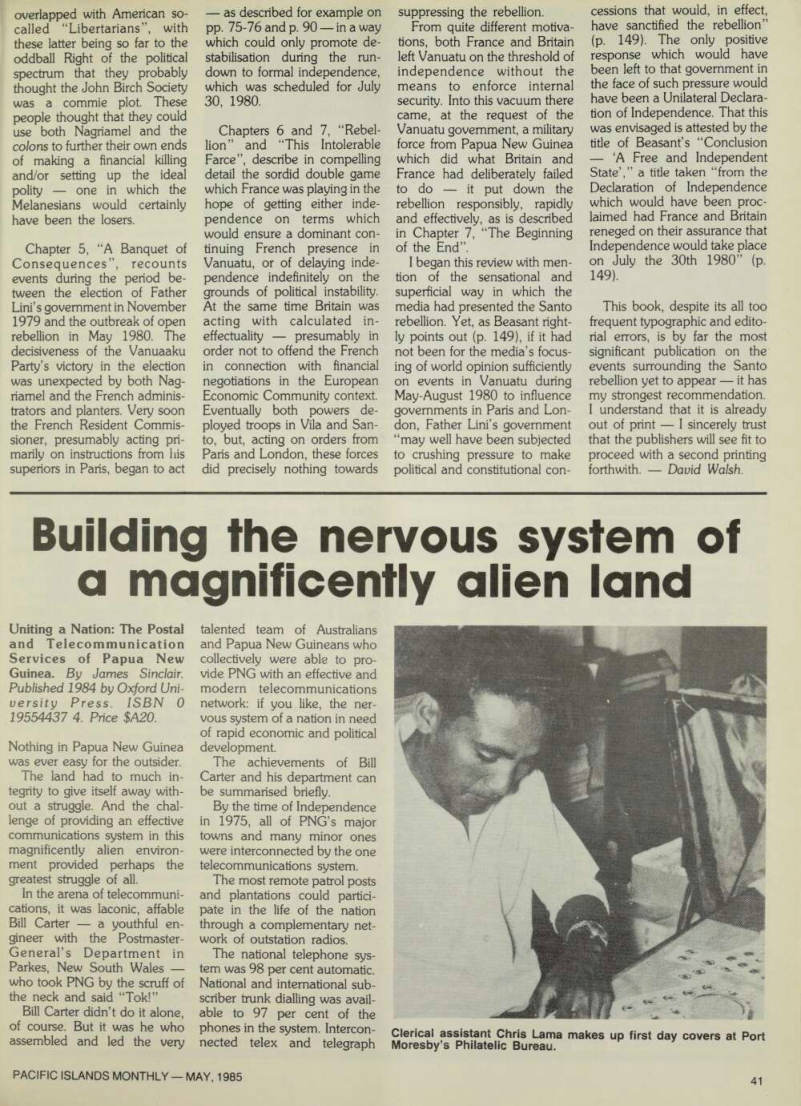
Clerical assistant Chris Lama makes up first day covers at Port Moresby’s Philatelic Bureau.
services covered all of PNG.
The postal system was hand ling more than 50 million items a year (the level of consumer complaint seemed to be about the global average).
In just two decades, PNG had acquired a postal and, perhaps more importantly, a telecommunications system that rivalled any in the world.
Uniting A Nation is James Sinclair’s most recent book on
Png.
He has done the country a real service in documenting im portant aspects of its colonial history (among his other works are Sepik Pilot and Wings Of Gold).
This book is the definitive account of the history and development of PNG’s tele communications system (with interesting side trips into the world of postal services, tele phones and philately).
In fact, Uniting A Nation, and lan Mackay’s seminal Broad casting In Papua New Guinea, are companion works which constitute an essential duo for anyone interested in the deve lopment of communications and broadcasting in the Third World.
Sinclair’s book covers a timespan from the late 19th century, when PNG was first being extensively settled by
foreigners, to the recent past.
Those early days were espe cially rigorous and brutish for expatriates.
The arrival of the mail boat was one of the few highlights of one’s life, and was always an eagerly-awaited event.
Anglican priest, Arthur Chighall, wrote in 1915: “I wake up in the morning to wonder, once again, what has become of the mail? It is only six ©-clock and there is nothing particular to get up for. What is the use of getting up when the mails have stopped coming what is the use of anything?”
Well, that’s one Anglican priest in dire need of furlough but I can sympathise with the feelings.
As a young teacher in the Chimbu bush in the early 19605, I would listen anxiously in my classroom each morning for the mail plane from Goroka to pass overhead on its way to Kerowagi, 10 kilometres away.
The moment it flew over head, two of the senior boys would be delegated to walk to the government post at Kero wagi to collect the mail and supplies a time-honored cus tom in PNG, as Sinclair so adequately records.
Getting the mail, as a woman missionary wrote in the late 19th century, was “a feast for
the hungry soul.”
The significant part of Sinc lair’s book, however, revolves around the personality and political skills of Bill Carter.
Providing PNG with a modem telecommunications system was no pushover. To the PNG administration, Carter’s depart ment was just another mendi cant on the public purse. There was no room for special pleading.
In the early years, Carter fought vigorously but unsuc cessfully for telecommunica tions to be accorded a higher priority in the budget process.
Carter had been dragged from the obscurity of western NSW to be appointed director in October, 1954.
Sinclair traces the difficulties Carter encountered with an outmoded communications system, the successive bureaucratic disappointments he suffered and, finally, in 1968, the triumph of securing the first World Bank loan PNG had ever received. And it was a good one: for it enabled the development of an effective communications system in PNG. Bill Carter’s department got it because it was far better prepared than any other in strumentality in PNG.
Carter had an impressive
team of engineering administra tors to back him up.
People like Bill Peckover, Vem Hodgson (tragically killed in a helicopter crash in 1970), and Tom Pearson, who later went on to mastermind a period of rapid technological deve lopment in the National Broad casting Commission, and who died too young last year.
The World Bank loan so important to the development of telecommunications and, ultimately, to the political and economic development of PNG, came about because Car ter and his collegues were thor oughly prepared for what Sinc lair terms “the great leap for ward” and they were ready for it because they were men of energy and vision: engineers who had a keen appreciation of the social and economic en vironment in which they were operating.
Carter and his men were professionals to the quick but the real hero of Uniting A Nation is Papua New Guinea itself which, when all is said and done, usually managed to bring out the best in those outsiders who lived and worked there.
There are lots of names in this book, it’s a real who’s who of PNG telecommunications and there is a wealth of techni cal and statistical detail for those who are keen to go further than the history and the politics.
It’s a shame, though, that Uniting A Nation lacks an in dex. It really needs one and I’m surprised that Oxford didn’t oblige.
The book would have bene fited also from the inclusion of a few maps. These criticisms are important for a book that is definitive in every other sense.
But these aside, Uniting A Nation is a bold and ultimately successful attempt to inter weave the development of tele communications in PNG with the political development of the nation Keith Jackson. (Keith Jackson worked as a journalist and broadcasting administrator in Papua New Guinea, and is now Controller of Corporate Relations with the Australian Broadcasting Corporation.)
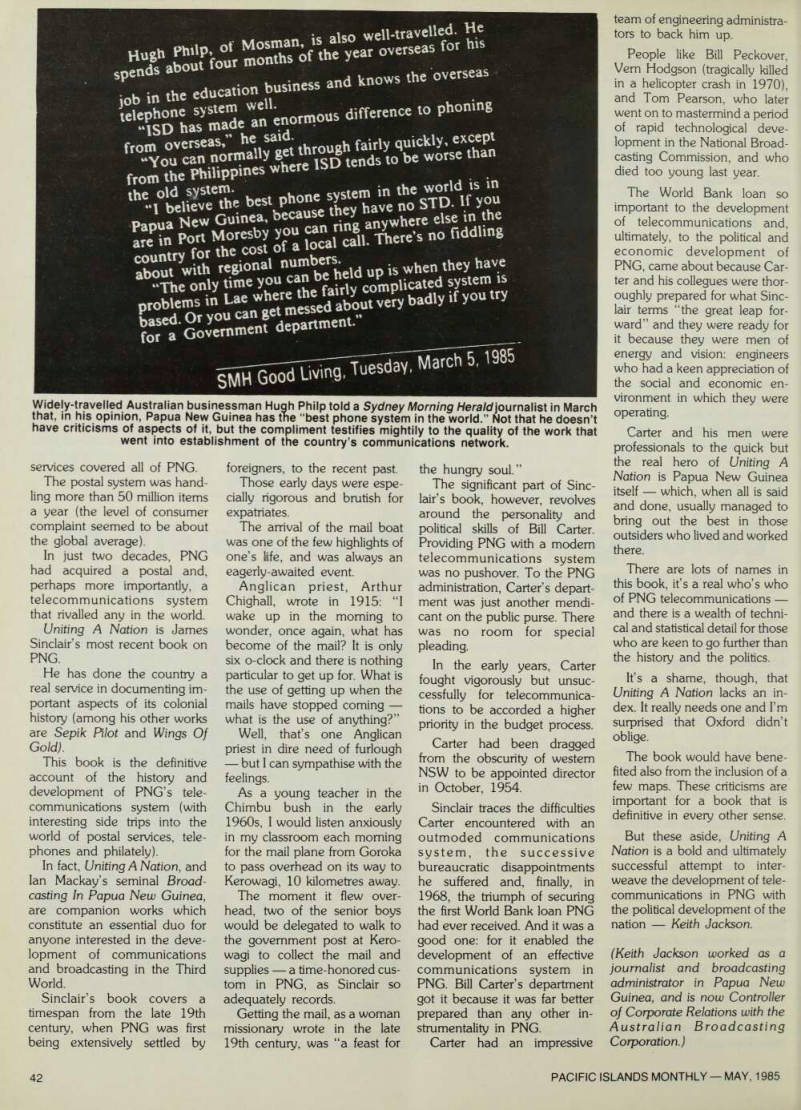
Widely-travelled Australian businessman Hugh Philp told a Sydney Morning Herald journalist in March that, in his opinion, Papua New Guinea has the “best phone system in the world.” Not that he doesn’t have criticisms of aspects of it, but the compliment testifies mightily to the quality of the work that went into establishment of the country’s communications network.