extraordinary
pp. 33-37 · Read in the full issue


John Watts, coffee planter extraordinary
John Watts, planter, businessman, and Member of the Papua New Guinea House of Assembly, died last November at the age of 64. CHRIS ASHTON, who knew him for 18 years, and who reported on PNG affairs from Port Moresby for Australian newspapers between 1972 and 1975, recalls this post-war settler of the Wahgi Valley.
John Watts was a most incredi ble pioneer. I remember him rather as a dreamer, someone who enjoyed chewing the cud late into the night, a thinker with a passion for books and ideas, and people who stimu lated his curiosity for unravell ing life’s mysteries. He relished the cut and thrust of civilised discussion and debate that ranged across the sweep of human history for what it showed us about ourselves.
Through the homestead of Ulya Plantation passed an end less flow of guests --anthropologists, government officials, diplomats, journalists, artists, film-makers, developing world ’’experts” as much as Papua New Guineans who were drawn, one and all, into discussion of the theory and practice of colonial rule and nation-building from a thousand tribes, the trauma of social change and the comedy and tragedy of Third World politics.
I first met him in 1966. Then, and ever after, he struck me as a gentle,sensitive, idealist; a shy man who should have been a teacher or a writer rather than a coffee planter. And yet, he had paid his dues in building some thing out of nothing from the bush. Nearly 30 years ago he and his wife, Edith, had arrived with two very small children and little more than the clothes they stood up in.
John was a qualified ac countant and therefore able to generate a cash flow, working first in the Mount Hagen district office as a clerk-bookkeeper, then for ”Kuta” Danny Leahy, and eventually as general manager and managing director, of Hagen Coffee, which bought, processed and
exported local coffee to world markets.
Edith meantime built Ulya Plantation from the 175-acre block which lay at the foot of the southern wall of the Wahgi Valley, the runt in the litter of farming blocks allotted to ex servicemen in the 19505, a tract of swampland, of matted kunai and pitpit too wet even for the local tribesmen to graze their pigs.
For two years Edith super vised a labor line which dug a grid of ditches seven feet deep around the block to drain it.
Seedlings were planted. Today Ulya is 300 acres of fully-grown coffee, by consensus among the finest plantations in the valley.
A struggle though it was, particularly in the early days, John and Edith were also com munity leaders, as much to the tribespeople as to the expatri ates. Edith was a qualified nurse who turned her training to instructing the women of the Kuli Konda, the neighboring tribe, in child care and nutrition.
Over the years she saved scores of babies from cerebral malaria.
For many years she was also a member of the district advis ory council, the child welfare council, and an adviser to the children’s district court. She led the Kuli Konda women in a project of her own making to beautify Mount Hagen with trees, shrubs and flowers. The Somare government acknow ledged her community service by awarding her the MBE.
For his part, John was elected Member for the West ern Highlands in the second House of Assembly, 1968-72.
His particular contribution in a time of transition and un-
certainty about the future was to bring to politics a disciplined mind and a talent for mastering detail which most of his col leagues lacked. He largely formulated the principles of a new, predominantly Highlands, party, Compass, which, as the United Party, continues still.
But he lacked the taste for the wheeling and dealing and the cut and thrust of parliamentary debate. After one term, recog nising the moment had come for Papua New Guineans to take the helm, he did not seek re-election.
The prospects of John Watts putting down roots and ending his days in the Wahgi Valley were unlikely. He was born in West Wyalong, NSW, the son of a Commonwealth Bank branch manager. His childhood was a succession of postings from one country town to the next ... Taree, Dubbo, Kemp sey, Launceston ... Everything pointed to his following his father’s footsteps.
He left school at 14 to join the Commonwealth Bank, but resigned at the outbreak of war to join, first, the army and then the R.A.A.F. so that he could fly. With an R.A.A.F. squadron he was posted to England and
continued on page 37
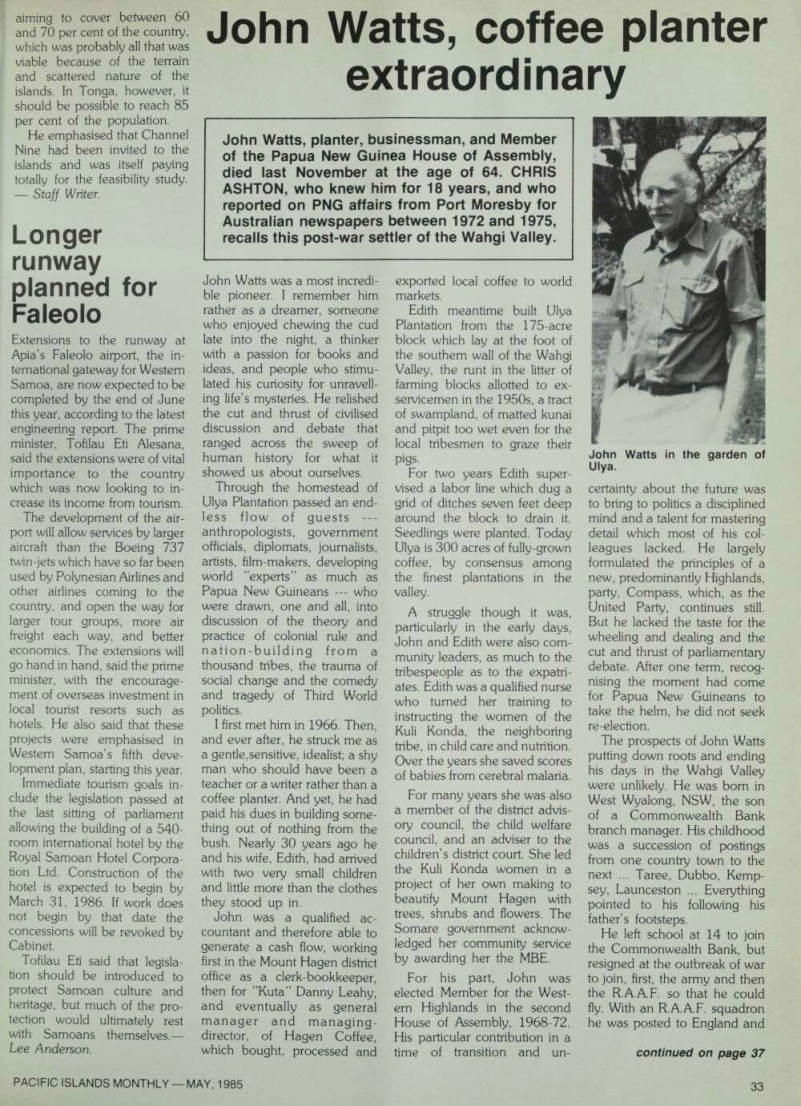
John Watts in the garden of Ulya.
for three years flew bombing sorties in Lancasters over Ger many.
I remember him once telling me of crews on the verge of mutiny at the prospect of bom bing Dresden, a beautiful city of no strategic value to the Allies.
By then, he said, the crews believed their enemies were the Russians, not the German people.
At the war’s end he was repatriated and demobbed. He married Edith, nee Ratcliff, and rejoined the Commonwealth Bank and the disciplines and routines of his pre-war career. It was in vain. The war had given him a hunger for something wider, something with an ele ment of risk which the bank could not satisfy. He stuck it for nine years, until he saw an article by Osmar White in The Age of Melbourne about the Wahgi Valley and the chance of farming blocks for ex-service men.
In 1955 he went there to see for himself. Edith stayed behind until he could give assurance of a job to get them started.
Several other better-paid jobs using his accountancy skills were offered in other parts of the country but he took the clerical post in Mount Hagen to be sure of getting the farming block. His family joined him the following year.
The way in which John was laid to rest, and those who came to pay their last respects, say much about the man. Pic ture the garden of Ulya Planta tion, two acres enclosed in a sea of coffee a setting as close to paradise as you could hope to find on earth; the sweep of lawn, the clumps of feathered bamboo, the stands of albizzia and swamp mahogany, the profusion of bougainvillea, aga panthus, and hibiscus, tropical and temperate climate flowers everywhere.
Picture at the edge of the garden the homestead, a sprawling thatched building, whose walls and floors and ceiling are fashioned from bam boo, split and woven, which creak as you move across it.
Against the protests of his fam ily, and everyone who ever visited Ulya, John longed to
pull it down and build a ’’prop er” house. Somehow he never got around to it.
Picture the flower-decked burial site in a clearing in the garden and the ministers of various local missions Luther ans, Seventh-day Adventists, Roman Catholics speaking over his grave of the friendship and respect he inspired, regard less of the fact he was no church-going Christian.
Picture the community lead ers of the Wahgi Valley -government officials, politi cians, planters and business men driving to Ulya to offer condolences to his widow and three children.
And picture the Kuli Konda, resplendent in traditional cos tume, trooping in to pay tribute to an icon of sorts, a pole they asked Edith to erect at the graveside, on which was hung a picture of John together with one of his shirts and a pair of trousers. For three days Edith sat there at a table and received them.
It would be idle to pretend that John Watts died in peace.
He died tormented *by un certainty and a sense of grie vance. Four years ago he de cided, reluctantly, that Ulya must be sold. Rising costs, he felt, particularly of labor, would eventually doom coffee planta tions to bankruptcy.
He found a buyer in a neighboring, British-owned, tea estate, but the Minister for Lands, without explanation,
would not approve the sale. He found a second buyer, a locally based Papua New Guinea busi ness group whose leaders themselves pressed the Minister for approval. Once more, the effort was in vain.
The stress of this limbo exist ence took its toll. There seemed no way out. He suffered one heart attack, and then, very
shortly afterwards, a second and fatal one.
Upon John’s death, prime minister Somare appointed Barry Holloway acting Minister for Lands and directed him to sort out the matter at once. Ten days after John Watts died the sale was approved.
Rest in peace, John. —
Chris
Ashton.
The Kuli Konda people pay their last tribute to John Watts.