people
p. 29 · Read in the full issue
Australia’s new high commis sioner to Kiribati is William Rowe. A career diplomat with 21 years’ experience in Austra lia’s foreign service, including two years (1978-79) as consul general in Honolulu, Mr Rowe succeeds John Mahoney, who had been in the post since 1982.
Dr Tupeni Baba has resigned his post as registrar of the University of the South Pacific, and has returned to teaching in the USP’s School of Education.
Pending the appointment of a new registrar, the deputy registrar, Philip Rama, took over the post in an acting capacity.
The Vanuatu capital, Port-Vila, has a new mayor. He is Puyo Festa, who is of French origin but now holds Vanuatu citi zenship.
Mr Festa is the first member of the Vanuaaku Party to be elected to the position of mayor.
The new deputy mayor, David Tanarango, is also a Vanuaaku Party member.
In a speech following his election, Mr Festa said that the fact that he was “white” should be no barrier in his new job.
He added: “I am a citizen of this country and have been a firm supporter of the Vanuaaku Party for the last 10 years. I will strive to execute the duties of the mayor. If I am capable, I will succeed, but if I am not then I will not succeed.”
A Papua New Guinea war veteran, Bouwe Pawa, of Lae, has received a special achieve ment award from the Australian Government For the past 12 years Mr Pawa has been cura tor of Lae War Cemetery, where 3600 Australian and 441 Indian soldiers are buried. In recognition of his dedication to maintaining the cemetery in park-like condition, the Na tional Australia Day Committee awarded him its Achievement Medallion. Mr Pawa served with the Australian Army in World War II and retired from the Pacific Island Regiment as
its regimental sergeant-major in 1973. He has a son who is a captain in the PNG Defence Force.
President Reagan has appointed Benigno K. Filial as chairman of the Northern Mariana Islands Commission on Federal Law. Saipan-bom Mr Fitial, 39, succeeds James A. Joseph.
The new chairman is a mem ber of the Fourth Northern Marianas Commonwealth Legislature.
Other appointees to the com mission named by President Reagan were Joel J. Bergsma, Dewey Lawes Falcone, Ed ward Dig. Fangelinan, and Pedro Agulto Tenorio, lieute nant-governor of the CNMI.
Writing in The Guardian, Lon don journalist Jane Dibblin reports; Interest in the affairs of the Pacific was aroused in Britain by the recent visit of New Zealand’s Prime Minister David Lange. Yet the visit in the same week of two women protesting against the nuclear assault on their part of the world went largely unnoticed.
Chailang, a Chamorro woman from the Marianas in the northern Pacific near the Philippines, and Titewhai Harawira, a Maori woman from Aotearoa (her people’s name for New Zealand), were travelling to 10 cities around the UK on a tour organised by Greenham (anti-nuclear pro test) women.
When they held a press con ference at the House of Com mons they were graced with the attention of a mere two MPs (both Labor, one arriving very late) and not a word in the mainstream press.
That is particularly disturbing because New Zealand’s recent nuclear-free declaration has come out of 10 years of intense lobbying by indigenous groups in the Pacific.
In today’s troubled times in New Caledonia, the headquar ters of the South Pacific Com mission in Noumea appears as
an oasis of tranquillity. Sur rounded by vivid flowering trees, the distinctive pentagon shape of the buildings betrays their initial purpose as headquarters of the U.S. forces during the Second World War 11.
The present peaceful occu pant, the South Pacific Com mission, is quietly carrying on its work of providing technical assistance, training and advice in a variety of fields to the countries of the region. The corridors now echo to the sound of secretary’s high heels instead of the boots of soldiers.
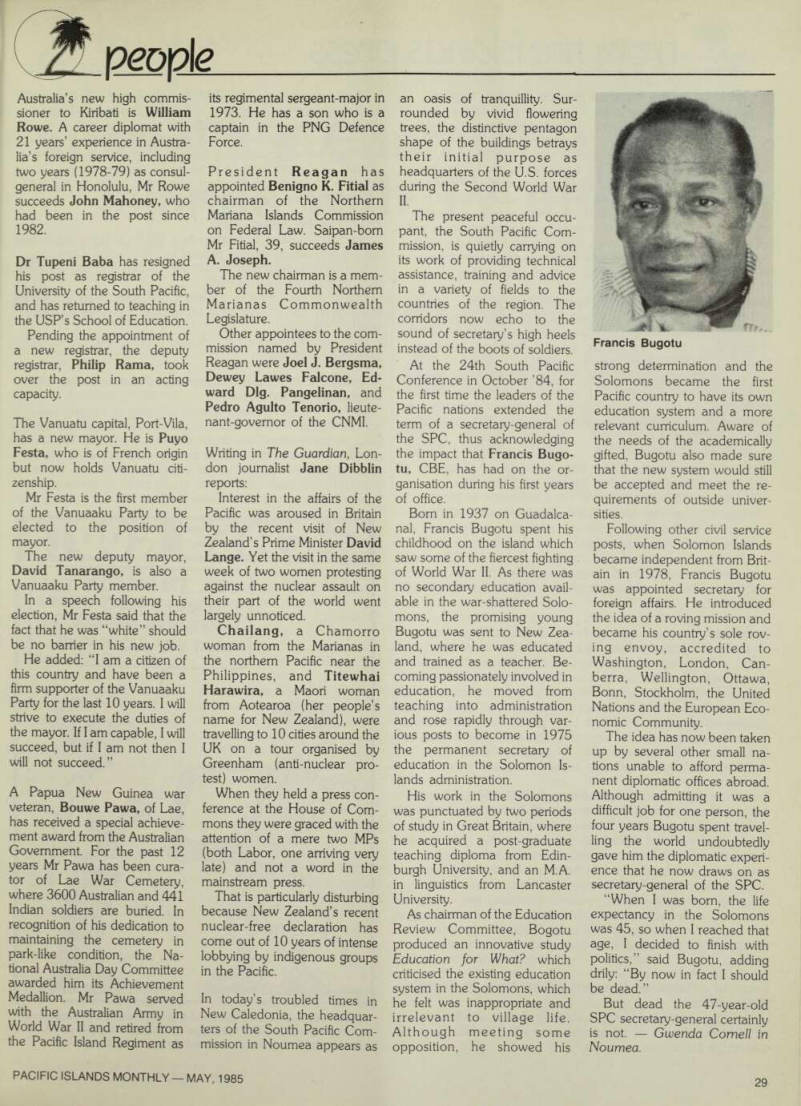
At the 24th South Pacific Conference in October ’B4, for the first time the leaders of the Pacific nations extended the term of a secretary-general of the SPC, thus acknowledging the impact that Francis Bugo tu, CBE, has had on the or ganisation during his first years of office.
Born in 1937 on Guadalca nal, Francis Bugotu spent his childhood on the island which saw some of the fiercest fighting of World War 11. As there was no secondary education avail able in the war-shattered Solo mons, the promising young Bugotu was sent to New Zea land, where he was educated and trained as a teacher. Be coming passionately involved in education, he moved from teaching into administration and rose rapidly through var ious posts to become in 1975 the permanent secretary of education in the Solomon Is lands administration.
His work in the Solomons was punctuated by two periods of study in Great Britain, where he acquired a post-graduate teaching diploma from Edin burgh University, and an M.A. in linguistics from Lancaster University.
As chairman of the Education Review Committee, Bogotu produced an innovative study Education for What? which criticised the existing education system in the Solomons, which he felt was inappropriate and irrelevant to village life.
Although meeting some opposition, he showed his
strong determination and the Solomons became the first Pacific country to have its own education system and a more relevant curriculum. Aware of the needs of the academically gifted, Bugotu also made sure that the new system would still be accepted and meet the re quirements of outside univer sities.
Following other civil service posts, when Solomon Islands became independent from Brit ain in 1978, Francis Bugotu was appointed secretary for foreign affairs. He introduced the idea of a roving mission and became his country’s sole rov ing envoy, accredited to Washington, London, Can berra, Wellington, Ottawa, Bonn, Stockholm, the United Nations and the European Eco nomic Community.
The idea has now been taken up by several other small na tions unable to afford perma nent diplomatic offices abroad.
Although admitting it was a difficult job for one person, the four years Bugotu spent travel ling the world undoubtedly gave him the diplomatic experi ence that he now draws on as secretary-general of the SPC.
“When I was born, the life expectancy in the Solomons was 45, so when I reached that age, I decided to finish with politics,” said Bugotu, adding drily: “By now in fact I should be dead.”
But dead the 47-year-old SPC secretary-general certainly is not. Gwenda Cornell in Noumea.
Francis Bugotu