yachts
pp. 58-59 · Read in the full issue
Lan G. Menzies Re
ports from Darwin ,
Australia:
• Fancy Free Of Bem
BRIDGE. Previously reported in Port Moresby by Kay Bason (PIM Dec. ’B4), Fancy Free has now cleared Darwin and is well on her way to Mauritius.
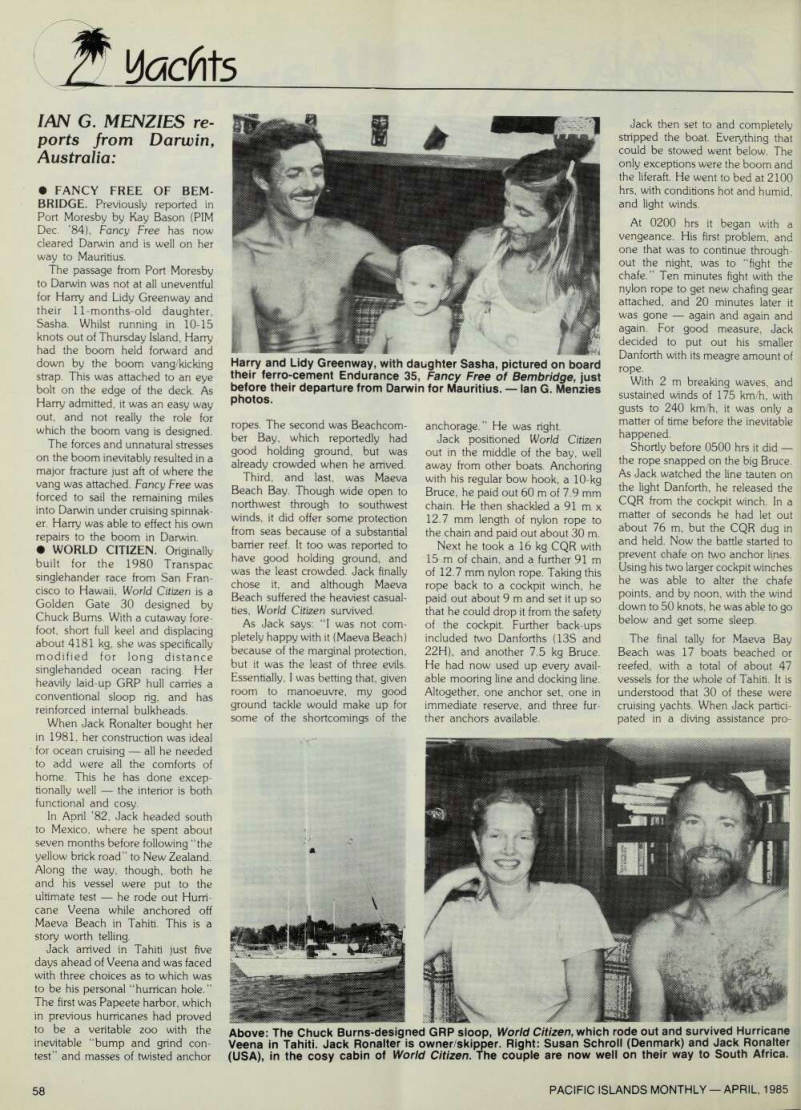
The passage from Port Moresby to Darwin was not at all uneventful for Harry and Lidy Greenway and their 11-months-old daughter, Sasha. Whilst running in 10-15 knots out of Thursday Island, Harry had the boom held forward and down by the boom vang/kicking strap. This was attached to an eye bolt on the edge of the deck. As Harry admitted, it was an easy way out, and not really the role for which the boom vang is designed.
The forces and unnatural stresses on the boom inevitably resulted in a major fracture just aft of where the vang was attached. Fancy Free was forced to sail the remaining miles into Darwin under cruising spinnak er. Harry was able to effect his own repairs to the boom in Darwin. • WORLD CITIZEN. Originally built for the 1980 Transpac singlehander race from San Fran cisco to Hawaii, World Citizen is a Golden Gate 30 designed by Chuck Burns. With a cutaway fore foot, short full keel and displacing about 4181 kg, she was specifically modified for long distance singlehanded ocean racing. Her heavily laid-up GRP hull carries a conventional sloop rig, and has reinforced internal bulkheads.
When Jack Ronalter bought her in 1981, her construction was ideal for ocean cruising all he needed to add were all the comforts of home. This he has done excep tionally well the interior is both functional and cosy.
In April ’B2, Jack headed south to Mexico, where he spent about seven months before following “the yellow brick road” to New Zealand.
Along the way, though, both he and his vessel were put to the ultimate test he rode out Hurri cane Veena while anchored off Maeva Beach in Tahiti. This is a story worth telling.
Jack arrived in Tahiti just five days ahead of Veena and was faced with three choices as to which was to be his personal “hurrican hole.”
The first was Papeete harbor, which in previous hurricanes had proved to be a veritable zoo with the inevitable “bump and grind con test” and masses of twisted anchor
ropes. The second was Beachcom ber Bay, which reportedly had good holding ground, but was already crowded when he arrived.
Third, and last, was Maeva Beach Bay. Though wide open to northwest through to southwest winds, it did offer some protection from seas because of a substantial barrier reef. It too was reported to have good holding ground, and was the least crowded. Jack finally chose it. and although Maeva Beach suffered the heaviest casual ties, World Citizen survived.
As Jack says: “I was not com pletely happy with it (Maeva Beach) because of the marginal protection, but it was the least of three evils.
Essentially, I was betting that, given room to manoeuvre, my good ground tackle would make up for some of the shortcomings of the
anchorage.” He was right.
Jack positioned World Citizen out in the middle of the bay, well away from other boats. Anchoring with his regular bow hook, a 10-kg Bruce, he paid out 60 m of 7.9 mm chain. He then shackled a 91 m x 12.7 mm length of nylon rope to the chain and paid out about 30 m.
Next he took a 16 kg CQR with 15 m of chain, and a further 91 m of 12.7 mm nylon rope. Taking this rope back to a cockpit winch, he paid out about 9 m and set it up so that he could drop it from the safety of the cockpit. Further back-ups included two Danforths (13S and 22H), and another 7.5 kg Bruce.
He had now used up every avail able mooring line and docking line.
Altogether, one anchor set, one in immediate reserve, and three fur ther anchors available.
Jack then set to and completely stripped the boat. Everything that could be stowed went below. The only exceptions were the boom and the liferaft. He went to bed at 2100 hrs, with conditions hot and humid, and light winds.
At 0200 hrs it began with a vengeance. His first problem, and one that was to continue through out the night, was to “fight the chafe.” Ten minutes fight with the nylon rope to get new chafing gear attached, and 20 minutes later it was gone again and again and again. For good measure, Jack decided to put out his smaller Danforth with its meagre amount of rope.
With 2 m breaking waves, and sustained winds of 175 km/h, with gusts to 240 km/h, it was only a matter of time before the inevitable happened.
Shortly before 0500 hrs it did the rope snapped on the big Bruce.
As Jack watched the line tauten on the light Danforth, he released the CQR from the cockpit winch. In a matter of seconds he had let out about 76 m, but the CQR dug in and held. Now the battle started to prevent chafe on two anchor lines.
Using his two larger cockpit winches he was able to alter the chafe points, and by noon, with the wind down to 50 knots, he was able to go below and get some sleep.
The final tally for Maeva Bay Beach was 17 boats beached or reefed, with a total of about 47 vessels for the whole of Tahiti. It is understood that 30 of these were cruising yachts. When Jack partici pated in a diving assistance pro-
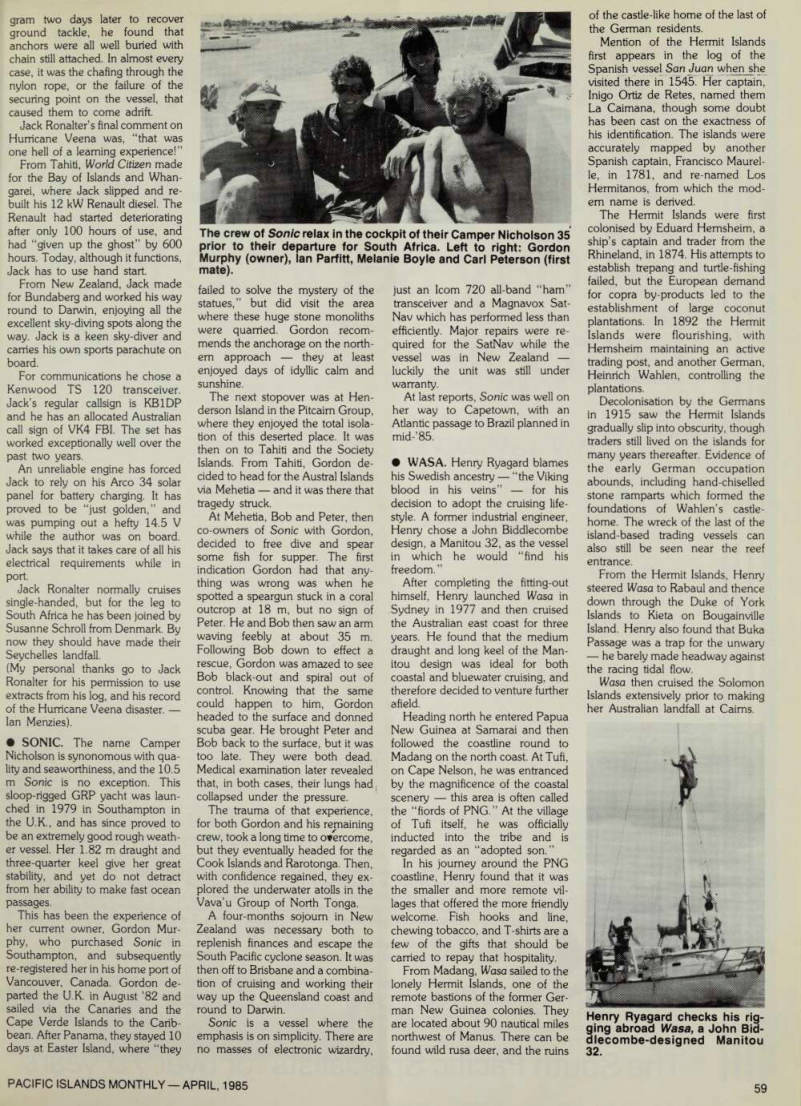
Above: The Chuck Burns-designed GRP sloop, World Citizen, which rode out and survived Hurricane Veena in Tahiti. Jack Ronalter is owner/skipper. Right; Susan Schroll (Denmark) and Jack Ronalter (USA), in the cosy cabin of World Citizen. The couple are now well on their way to South Africa.
Harry and Lidy Greenway, with daughter Sasha, pictured on board their ferro-cement Endurance 35, Fancy Free of Bembridge, just before their departure from Darwin for Mauritius.-lan G. Menzies photos.
gram two days later to recover ground tackle, he found that anchors were all well buried with chain still attached. In almost every case, it was the chafing through the nylon rope, or the failure of the securing point on the vessel, that caused them to come adrift.
Jack Ronalter’s final comment on Hurricane Veena was, “that was one hell of a learning experience!”
From Tahiti, World Citizen made for the Bay of Islands and Whan garei, where Jack slipped and re built his 12 kW Renault diesel. The Renault had started deteriorating after only 100 hours of use, and had “given up the ghost” by 600 hours. Today, although it functions, Jack has to use hand start.
From New Zealand, Jack made for Bundaberg and worked his way round to Darwin, enjoying all the excellent sky-diving spots along the way. Jack is a keen sky-diver and carries his own sports parachute on board.
For communications he chose a Kenwood TS 120 transceiver.
Jack’s regular callsign is KBIDP and he has an allocated Australian call sign of VK4 FBI. The set has worked exceptionally well over the past two years.
An unreliable engine has forced Jack to rely on his Arco 34 solar panel for battery charging. It has proved to be “just golden,” and was pumping out a hefty 14.5 V while the author was on board.
Jack says that it takes care of all his electrical requirements while in port.
Jack Ronalter normally cruises single-handed, but for the leg to South Africa he has been joined by Susanne Schroll from Denmark. By now they should have made their Seychelles landfall. (My personal thanks go to Jack Ronalter for his permission to use extracts from his log, and his record of the Hurricane Veena disaster. lan Menzies). • SONIC. The name Camper Nicholson is synonomous with qua lity and seaworthiness, and the 10.5 m Sonic is no exception. This sloop-rigged GRP yacht was laun ched in 1979 in Southampton in the U.K., and has since proved to be an extremely good rough weath er vessel. Her 1.82 m draught and three-quarter keel give her great stability, and yet do not detract from her ability to make fast ocean passages.
This has been the experience of her current owner, Gordon Mur phy, who purchased Sonic in Southampton, and subsequently re-registered her in his home port of Vancouver, Canada. Gordon de parted the U.K. in August ’B2 and sailed via the Canaries and the Cape Verde Islands to the Carib bean. After Panama, they stayed 10 days at Easter Island, where “they
failed to solve the mystery of the statues,” but did visit the area where these huge stone monoliths were quarried. Gordon recom mends the anchorage on the north ern approach they at least enjoyed days of idyllic calm and sunshine.
The next stopover was at Hen derson Island in the Pitcairn Group, where they enjoyed the total isola tion of this deserted place. It was then on to Tahiti and the Society Islands. From Tahiti, Gordon de cided to head for the Austral Islands via Mehetia and it was there that tragedy struck.
At Mehetia, Bob and Peter, then co-owners of Sonic with Gordon, decided to free dive and spear some fish for supper. The first indication Gordon had that any thing was wrong was when he spotted a speargun stuck in a coral outcrop at 18 m, but no sign of Peter. He and Bob then saw an arm waving feebly at about 35 m.
Following Bob down to effect a rescue, Gordon was amazed to see Bob black-out and spiral out of control. Knowing that the same could happen to him, Gordon headed to the surface and donned scuba gear. He brought Peter and Bob back to the surface, but it was too late. They were both dead.
Medical examination later revealed that, in both cases, their lungs had. collapsed under the pressure.
The trauma of that experience, for both Gordon and his remaining crew, took a long time to overcome, but they eventually headed for the Cook Islands and Rarotonga. Then, with confidence regained, they ex plored the underwater atolls in the Vava’u Group of North Tonga.
A four-months sojourn in New Zealand was necessary both to replenish finances and escape the South Pacific cyclone season. It was then off to Brisbane and a combina tion of cruising and working their way up the Queensland coast and round to Darwin.
Sonic is a vessel where the emphasis is on simplicity. There are no masses of electronic wizardry,
just an Icom 720 all-band “ham” transceiver and a Magnavox Sat- Nav which has performed less than efficiently. Major repairs were re quired for the SatNav while the vessel was in New Zealand luckily the unit was still under warranty.
At last reports, Sonic was well on her way to Capetown, with an Atlantic passage to Brazil planned in mid-’B5. • WASA. Henry Ryagard blames his Swedish ancestry “the Viking blood in his veins” for his decision to adopt the cruising life style. A former industrial engineer, Henry chose a John Biddlecombe design, a Manitou 32, as the vessel in which he would “find his freedom. ”
After completing the fitting-out himself, Henry launched Wasa in Sydney in 1977 and then cruised the Australian east coast for three years. He found that the medium draught and long keel of the Man itou design was ideal for both coastal and bluewater cruising, and therefore decided to venture further afield.
Heading north he entered Papua New Guinea at Samarai and then followed the coastline round to Madang on the north coast. At Tufi, on Cape Nelson, he was entranced by the magnificence of the coastal scenery this area is often called the “fiords of PNG.” At the village of Tufi itself, he was officially inducted into the tribe and is regarded as an “adopted son.”
In his journey around the PNG coastline, Henry found that it was the smaller and more remote vil lages that offered the more friendly welcome. Fish hooks and line, chewing tobacco, and T-shirts are a few of the gifts that should be carried to repay that hospitality.
From Madang, Wasa sailed to the lonely Hermit Islands, one of the remote bastions of the former Ger man New Guinea colonies. They are located about 90 nautical miles northwest of Manus. There can be found wild rusa deer, and the ruins
of the castle-like home of the last of the German residents.
Mention of the Hermit Islands first appears in the log of the Spanish vesse[ San Juan when she visited there in 1545. Her captain, Inigo Ortiz de Retes, named them La Caimana, though some doubt has been cast on the exactness of his identification. The islands were accurately mapped by another Spanish captain, Francisco Maurel le, in 1781, and re-named Los Hermitanos, from which the mod em name is derived.
The Hermit Islands were first colonised by Eduard Hemsheim, a ship’s captain and trader from the Rhineland, in 1874. His attempts to establish trepang and turtle-fishing failed, but the European demand for copra by-products led to the establishment of large coconut plantations. In 1892 the Hermit Islands were flourishing, with Hemsheim maintaining an active trading post, and another German, Heinrich Wahlen, controlling the plantations.
Decolonisation by the Germans in 1915 saw the Hermit Islands gradually slip into obscurity, though traders still lived on the islands for many years thereafter. Evidence of the early German occupation abounds, including hand-chiselled stone ramparts which formed the foundations of Wahlen’s castle home. The wreck of the last of the island-based trading vessels can also still be seen near the reef entrance.
From the Hermit Islands, Henry steered IVasa to Rabaul and thence down through the Duke of York Islands to Kieta on Bougainville Island. Henry also found that Buka Passage was a trap for the unwary he barely made headway against the racing tidal flow.
Wasa then cruised the Solomon Islands extensively prior to making her Australian landfall at Cairns.
The crew of Sonic relax in the cockpit of their Camper Nicholson 35 prior to their departure for South Africa. Left to right: Gordon Murphy (owner), lan Parfitt, Melanie Boyle and Carl Peterson (first mate).
Henry Ryagard checks his rig ging abroad Wasa, a John Bid dlecombe-designed Manitou 32.