Summit attacks sluggish
p. 33 · Read in the full issue
Fiji Wage Control
Summit attacks sluggish economy
Fiji’s first economic summit, held in Suva in the first week of February, was hailed as a suc cess, but suffered from a boycott of the Fiji trades union movement and the opposition National Federation Party.
Their absence was probably expected, given that newly elevated deputy prime minister, Mosese Qionibaravi, whose idea the summit was, saw the meeting as a means of achiev ing consensus on the govern ment’s prices and incomes poli cy.
Fiji has had a total wage freeze since last November in an effort to control inflation and take some of the pain out of the country’s economic problems.
Most union leaders have been highly critical of the freeze and, while they have probably in private understood its necessity, have been vocal in the service of their membership in oppos ing it.
Until last November wage rates for union labor were de cided annually by a Tripartite Forum representing unions, employers and government.
They, in consultation, produced a percentage increase beyond which it was recommended wage rises not go. In practice the maximum became the mini mum.
But there was a mb. While most of the Fiji economy is in the hands of Indian business men, few of them allow unions into their shops, factories or offices. Workers thus employed are slow to attempt to organise themselves for there are plenty of examples of union-con venors suddenly finding them selves sacked. Not all non union workers in Fiji are on sweat-shop rates, but there are many who are. Rates as low as 20 or 25 cents an hour are common enough, particularly for women employed in menial process work.
The biggest unions are to be found in the public service, and in the larger companies, like Burns Philp, W.R. Carpenter and so forth. But, because of
costs, and changing conditions in fields such as retailing, which is now almost entirely in Indian hands, these firms have been retrenching their work force.
The effect of that has been to reduce the number of high wage earners in the country, and also to cut the membership of their unions.
The economic summit was boycotted by the FTUC be cause, it said, it was not the proper arena to discuss the wage freeze. The NFP stayed away because it had not been consulted in the summit plan ning stages. Few believed either of them, and put it all down to politics and unwillingness to get involved in a public debate.
Yet, more than 200 delegates representing most sectors of the community attended to be told that Fiji was spending more than it was earning and could not go on doing it.
Prime Minister, Ratu Mara, said world prices for sugar, Fiji’s main foreign exchange earner, were badly depressed and pointed also to the great dam age caused by the series of cyclones. The government’s wage bill was now more than half its total operating expenses and it was having to borrow to meet the cost. This could not go on.
The governor of the Reserve Bank of Fiji, Savenaca Siwati bau, said external debt had grown by an average of 21 per cent in 1980-84; debt rising from Fsl94 million in 1980 to almost Fs4oo million last year.
Total overseas debt stood at Fslsl million last year, an increase of 69 per cent, from the FsB9 million of 1980.
Fiji’s credit rating was good, he said, and borrowing was easy enough, yet to continue spending in excess of income was to invite trouble; better to adjust gradually than have a crisis.
Finance minister, Mr Qioni baravi, said Fiji had been in recession since 1981 with low, or negative, growth and very
little investment in the private sector. Since 1981 wages had risen significantly, but the na tional income had fallen. Dur ing 1981-82 average wages rose 15 per cent, but the gdp fell ten per cent, he said.
The wage freeze will save $36 million, some of which will be used on job creation prog rams, he said. Among these was a major rice project and a vegetable-growing scheme cap able of providing employment for 1100 people.
Additionally, cocoa projects on Viti Levu and Vanua Levu will involve planting several hundred hectares, and the con struction of roads. The timber industry was also growing rapidly and would eventually provide perhaps as many as 12,000 new jobs.
Fiji will now set up an Incom es Policy Unit at the Central Planning Office to help the Tripartite Forum with wage fixing. This move towards gov ernment control of wage levels
will be taken in concert with a new Economic Planning Coun cil which will advise the Cabinet on economic matters and also improve dialogue between all sectors of the community.
From our Suva Correspondent.
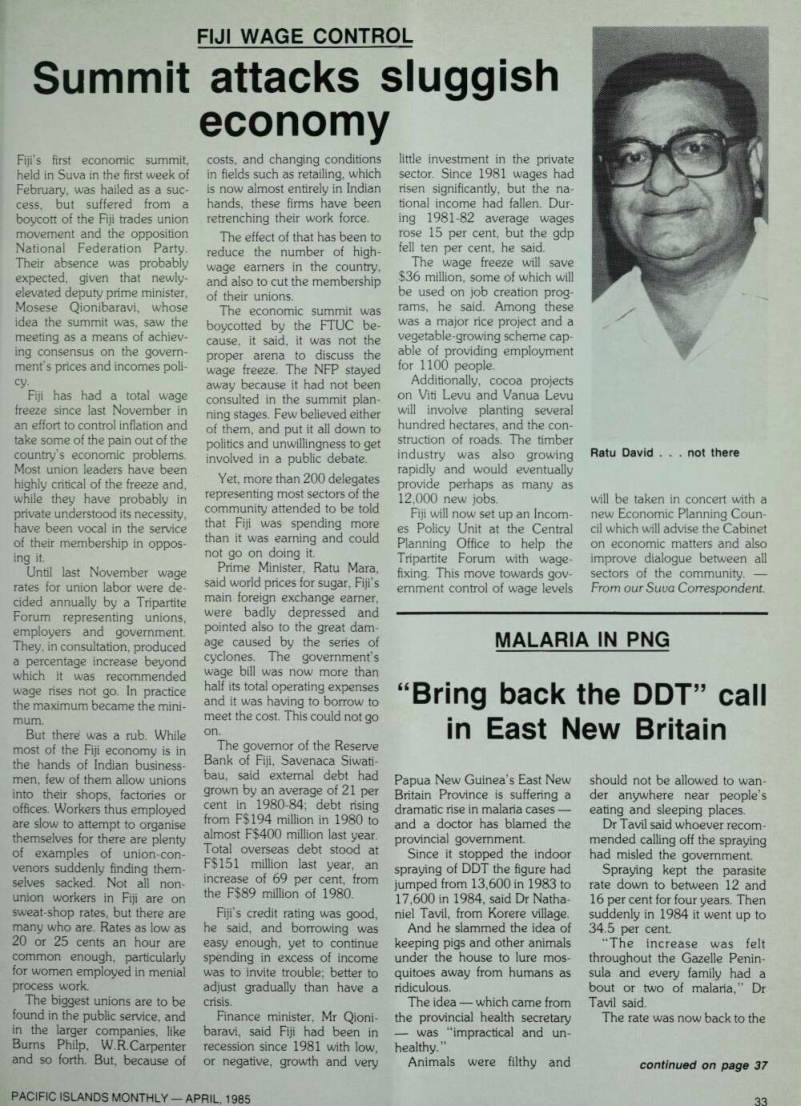
Ratu David ... not there