letters
pp. 10-11 · Read in the full issue
NZ radiation lab chief replies to Moruroa report critics
The article of the Danielssons in the October 1984 issue of Paci fic Islands Monthly continues their efforts to undermine the conclusions of the scientific mis sion to Moruroa. A number of sweeping allegations are made in which they claim that the mission failed (a) to establish the effect of the French testing program on the health of French Polynesians, (b) to assess the extent and significance of possible venting and leaking of radioactive material, and (c) to assess the nature of the hazards presented by radioac tive wastes originally deposited on the north coast of the atoll.
In fact, all of these points are considered in some detail in the mission report. With regard to (a) the Danielssons appear to have overlooked or missed the whole significance of the con clusions of the report. A fun damental consideration is that if there is no significant radiation exposure there can be no radia tion-induced cancers. As the report records, the levels of radiation exposure in Tahiti during and immediately follow ing the period of French atmos pheric testing have been low in relation to natural levels of exposure.
Over the 11-year period 1964-1975 the mean radiation exposure (effective dose equivalent) of persons in Tahiti (where the greater proportion of the French Polynesian popu lation resides) was about 8 millisieverts (mSv) from natural radiation (from cosmic radia tion, terrestrial gamma emitters, and potassium-40 and other internal emitters), and only about 0.4 mSv from fallout radionuclides. For New Zealand the corresponding values are about 18 mSv from natural radiation and about 0.25 mSv
from fallout.
If the case of miners exposed to radon gas in relatively high concentrations underground is excluded, it has not been de monstrated that natural radia tion levels have any effect on cancer rates, even for areas of the world where background rates are very much higher (20-50 times) than in New Zealand. Clearly the contribu tion of fallout radionuclides to radiation exposure both in Tahiti and in New Zealand has been less than normal varia tions in natural radiation expo sure rates from place to place.
This is the basis for the conclusion in the report that radiation exposure levels in French Polynesia do not lead to the expectation of any detect able radiation-induced cancers.
Having established the levels of radiation exposure, examina tion of cancer statistics could be considered of lesser signi ficance. However, the statistics were examined and have been reported. Within the limitations of the data, most particularly the relatively small population base, there is no evidence of any increase in malignancy rates which might be attribu table to exposure to radioactive fallout.
The Danielssons imply that nothing was learned about radioactive leakage because no submarine inspection around the atoll was made and no detonation occurred during the time of the mission visit. They indicate leakage has “demon strably occurred” but offer no evidence. They appear to har bor the misconception that leakage would occur at the time of tests. In fact leakage of radioactivity would occur as a slow process over an extended period of time. The greater proportion of fission products
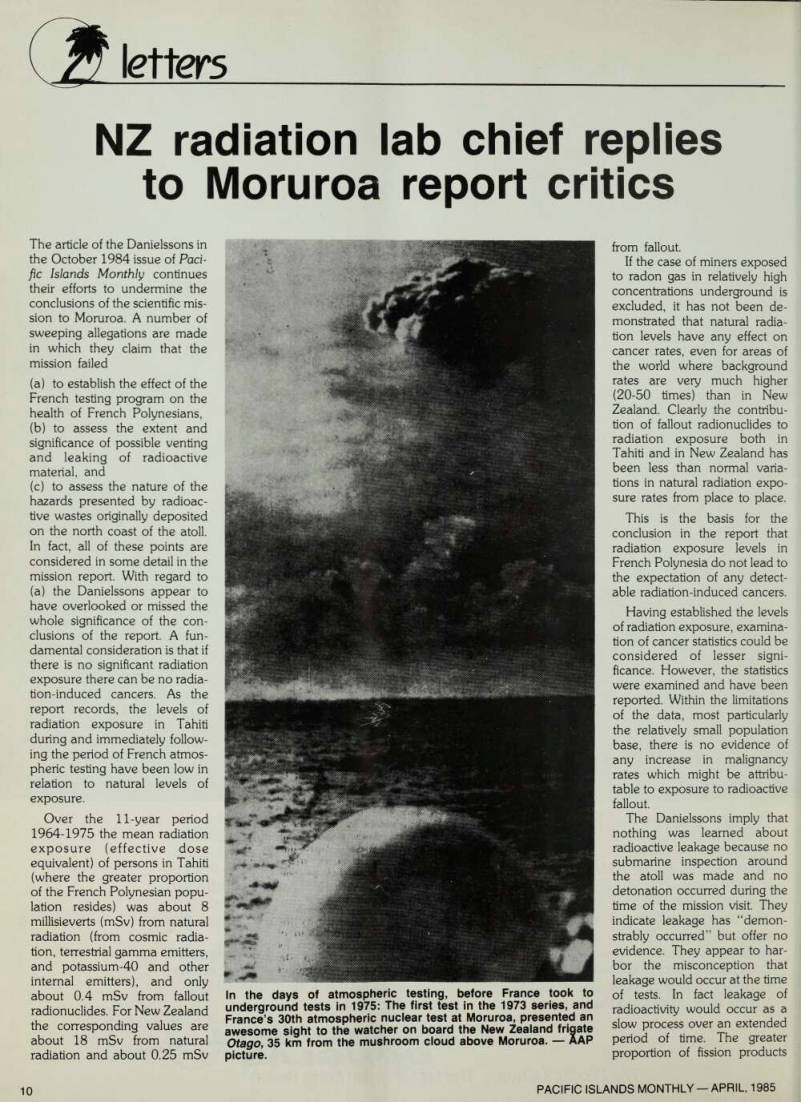
In the days of atmospheric testing, before France took to underground tests in 1975: The first test in the 1973 series, and France’s 30th atmospheric nuclear test at Moruroa, presented an awesome sight to the watcher on board the New Zealand frigate Otago, 35 km from the mushroom cloud above Moruroa. -AAP picture.
arising from the underground detonations is fused in rock and only available for water trans port at the leaching rate of the rock. Radioactive material in solution cannot be transported to the lagoon at a rate faster than that of the rate of move ment of water through the volcanic rock strata in which the detonations occur. It is to be noted also that if leakage were to be detected this is not neces sarily to be equated with the development of a local health risk. Apart from the fact that sea water contains considerable natural radioactivity, radioac tive materials commonly can be detected in concentrations many orders of magnitude be low those which might be consi dered to give rise to a possible long-term risk to health.
The Danielssons continue to raise the bogey of radioactive wastes dispersed in storms some years ago. The compara tively few persons at Moruroa who have been involved in waste-management practices have all been rigorously moni
tored, and the report notes that every reasonable effort is being made to clean up previously contaminated land areas. There is no evidence of unusual or excessive exposures of person nel. It is to be noted that the majority of the 3000 persons resident at Moruroa receive lower radiation exposures than persons living in almost all other parts of the world. This stems primarily from the fact that coral atolls have only very low con centrations of naturally-occur ring radionuclides. The average contribution of fallout radionuc lides in soil to human exposure at Moruroa is lower than in New Zealand, although for New Zea land, as in other countries, the soil concentrations of fallout radionuclides are much lower than those of naturally-occur ring radioactive materials.
A. C. Mcewan
Director, National Radiation Laboratory, Department of Health Christchurch New Zealand