yachts
pp. 59-60 · Read in the full issue
Lan G. Menzies
reports from Darwin,
Australia:
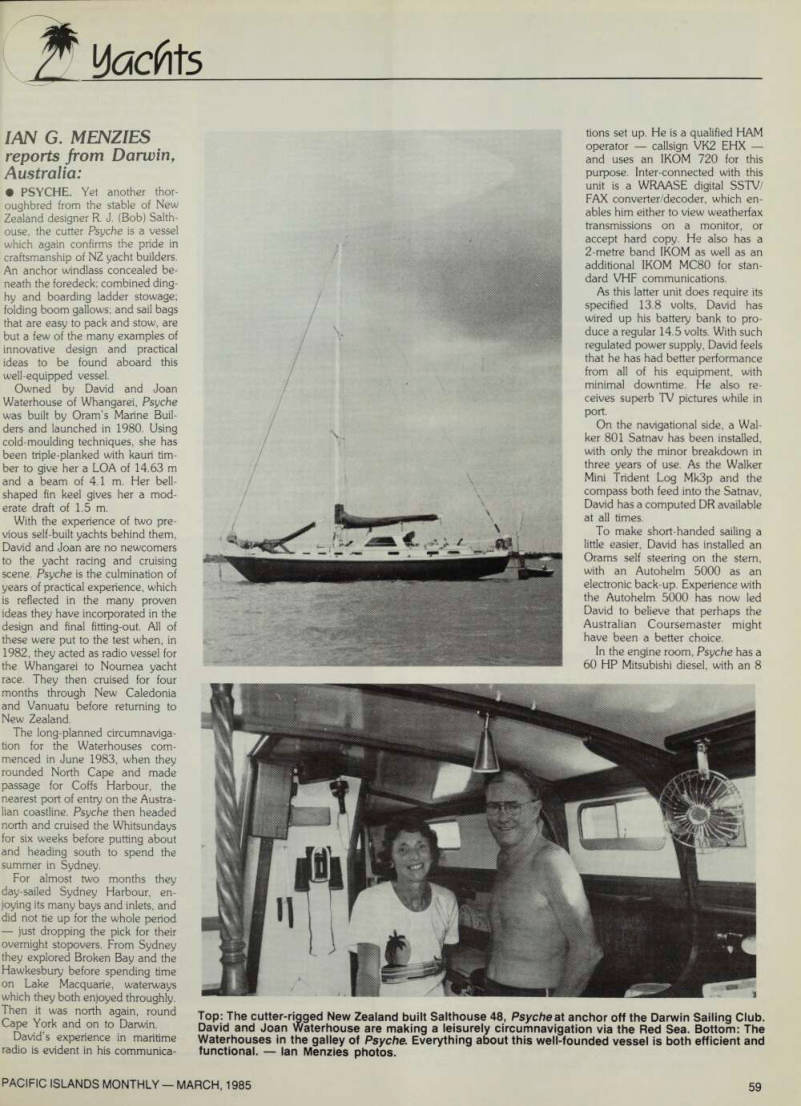
• PSYCHE. Yet another thor oughbred from the stable of New Zealand designer R. J. (Bob) Salth ouse, the cutter Psyche is a vessel which again confirms the pride in craftsmanship of NZ yacht builders.
An anchor windlass concealed be neath the foredeck; combined ding hy and boarding ladder stowage; folding boom gallows; and sail bags that are easy to pack and stow, are but a few of the many examples of innovative design and practical ideas to be found aboard this well-equipped vessel.
Owned by David and Joan Waterhouse of Whangarei, Psyche was built by Oram’s Marine Buil ders and launched in 1980. Using cold-moulding techniques, she has been triple-planked with kauri tim ber to give her a LOA of 14.63 m and a beam of 4.1 m. Her bell shaped fin keel gives her a mod erate draft of 1.5 m.
With the experience of two pre vious self-built yachts behind them, David and Joan are no newcomers to the yacht racing and cruising scene. Psyche is the culmination of years of practical experience, which is reflected in the many proven ideas they have incorporated in the design and final fitting-out. All of these were put to the test when, in 1982, they acted as radio vessel for the Whangarei to Noumea yacht race. They then cruised for four months through New Caledonia and Vanuatu before returning to New Zealand.
The long-planned circumnaviga tion for the Waterhouses com menced in June 1983, when they rounded North Cape and made passage for Coffs Harbour, the nearest port of entry on the Austra lian coastline. Psyche then headed north and cruised the Whitsundays for six weeks before putting about and heading south to spend the summer in Sydney.
For almost two months they day-sailed Sydney Harbour, en joying its many bays and inlets, and did not tie up for the whole period just dropping the pick for their overnight stopovers. From Sydney they explored Broken Bay and the Hawkesbury before spending time on Lake Macquarie, waterways which they both enjoyed throughly.
Then it was north again, round Cape York and on to Darwin.
David’s experience in maritime radio is evident in his communica-
tions set up. He is a qualified HAM operator callsign VK2 EHX and uses an IKOM 720 for this purpose. Inter-connected with this unit is a WRAASE digital SSTV/ FAX converter/decoder, which en ables him either to view weatherfax transmissions on a monitor, or accept hard copy. He also has a 2-metre band IKOM as well as an additional IKOM MCBO for stan dard VHF communications.
As this latter unit does require its specified 13.8 volts, David has wired up his battery bank to pro duce a regular 14.5 volts. With such regulated power supply, David feels that he has had better performance from all of his equipment, with minimal downtime. He also re ceives superb TV pictures while in port.
On the navigational side, a Wal ker 801 Satnav has been installed, with only the minor breakdown in three years of use. As the Walker Mini Trident Log Mk3p and the compass both feed into the Satnav, David has a computed DR available at all times.
To make short-handed sailing a little easier, David has installed an Orams self steering on the stem, with an Autohelm 5000 as an electronic back-up. Experience with the Autohelm 5000 has now led David to believe that perhaps the Australian Coursemaster might have been a better choice.
In the engine room, Psyche has a 60 HP Mitsubishi diesel, with an 8
Top: The cutter-riqged New Zealand built Salthouse 48, Psyche at anchor off the Darwin Sailing Club.
David and Joan Waterhouse are making a leisurely circumnavigation via the Red Sea. Bottom: The Waterhouses in the galley of Psyche. Everything about this well-founded vessel is both efficient and functional. lan Menzies photos.
HP Yanmar to direct-drive the compressor for the refrigerator and freezer. Approximately 75 minutes each day is all that is required for the Yanmar to maintain both units at normal operating temperatures.
The Yanmar can also be used as an additional charging unit for the batteries, as well as auxiliary prop ulsion in the event of main engine failure, via a chain take-off on to the propeller shaft.
The galley is also full of good ideas charcoal filters on all fresh-water taps to remove “tank taste” salt water over the very deep twin sinks, all surrounded by extremely high and solid, stainless steel fiddles. These fiddles have a dual role they prevent splash on to the sole, and they also serve as a rigid support on which to clamp the hand wringer, used to make wash days a whole lot easier.
Joan Waterhouse has chosen a kerosine stove, made by NZ Marine Stainless Fittings Ltd., to complete the fit-out of her spacious L-shaped galley. Fully gimballed, it has three top burners and an oven. Kerosine was chosen as an energy source for its ready availability in most ports of call.
On deck there are more innova tions to be seen. The galley boom folds down to lie snugly on the coach roof, while the workable foredeck opens up to reveal a powerful Nilsson 700 winch and adequate anchor stowage. The halyard winches on the mast are all ratchet lever action, self-tailing and are manufactured by Murray great for ease of operation, with no chance of losing a winch handle overboard.
One could go on forever Psyche is indeed a unique vessel.
From her spacious interior with the warmth of its mahogany trim, her superbly designed electronics and navigational systems, to her unclut tered and functional deck plan, Psyche is certainly a worthy ambas sador for New Zealand design and craftsmanship. As David and Joan Waterhouse make their leisurely passage across the Indian Ocean to the Seychelles, I am certain there will be many who will admire their yacht Psyche, and think likewise. • BRIAR. This boat is beautiful in the way only a vessel of her heritage can be. Over the last 50 years her blunt bow has pounded many an ocean, from the North Sea whence she came to the South Pacific.
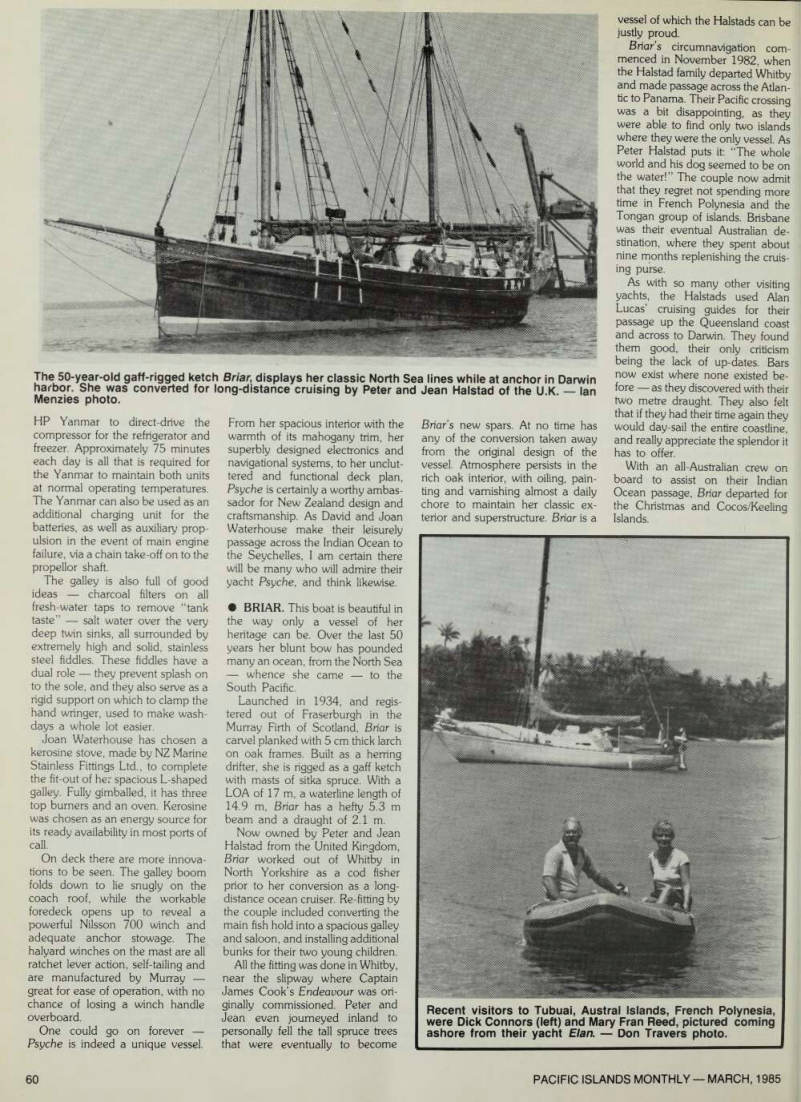
Launched in 1934, and regis tered out of Fraserburgh in the Murray Firth of Scotland, Briar is carvel planked with 5 cm thick larch on oak frames. Built as a herring drifter, she is rigged as a gaff ketch with masts of sitka spruce. With a LOA of 17 m, a waterline length of 14.9 m, Briar has a hefty 5.3 m beam and a draught of 2.1 m.
Now owned by Peter and Jean Halstad from the United Kingdom, Briar worked out of Whitby in North Yorkshire as a cod fisher prior to her conversion as a long distance ocean cruiser. Re-fitting by the couple included converting the main fish hold into a spacious galley and saloon, and installing additional bunks for their two young children.
All the fitting was done in Whitby, near the slipway where Captain James Cook’s Endeavour was ori ginally commissioned. Peter and Jean even journeyed inland to personally fell the tall spruce trees that were eventually to become
Briar’s new spars. At no time has any of the conversion taken away from the original design of the vessel. Atmosphere persists in the rich oak interior, with oiling, pain ting and varnishing almost a daily chore to maintain her classic ex terior and superstructure. Briar is a
vessel of which the Halstads can be justly proud.
Briar’s circumnavigation com menced in November 1982, when the Halstad family departed Whitby and made passage across the Atlan tic to Panama. Their Pacific crossing was a bit disappointing, as they were able to find only two islands where they were the only vessel. As Peter Halstad puts it; “The whole world and his dog seemed to be on the water!” The couple now admit that they regret not spending more time in French Polynesia and the Tongan group of islands. Brisbane was their eventual Australian de stination, where they spent about nine months replenishing the cruis ing purse.
As with so many other visiting yachts, the Halstads used Alan Lucas’ cruising guides for their passage up the Queensland coast and across to Darwin. They found them good, their only criticism being the lack of up-dates. Bars now exist where none existed be fore as they discovered with their two metre draught. They also felt that if they had their time again they would day-sail the entire coastline, and really appreciate the splendor it has to offer.
With an all-Australian crew on board to assist on their Indian Ocean passage, Briar departed for the Christmas and Cocos/Keeling Islands.
The 50-year-old gaff-rigged ketch Briar, displays her classic North Sea lines while at anchor in Darwin harbor. She was converted for long-distance cruising by Peter and Jean Halstad of the U.K. lan Menzies photo.
Recent visitors to Tubuai, Austral Islands, French Polynesia, were Dick Connors (left) and Mary Fran Reed, pictured coming ashore from their yacht Elan. Don Travers photo.